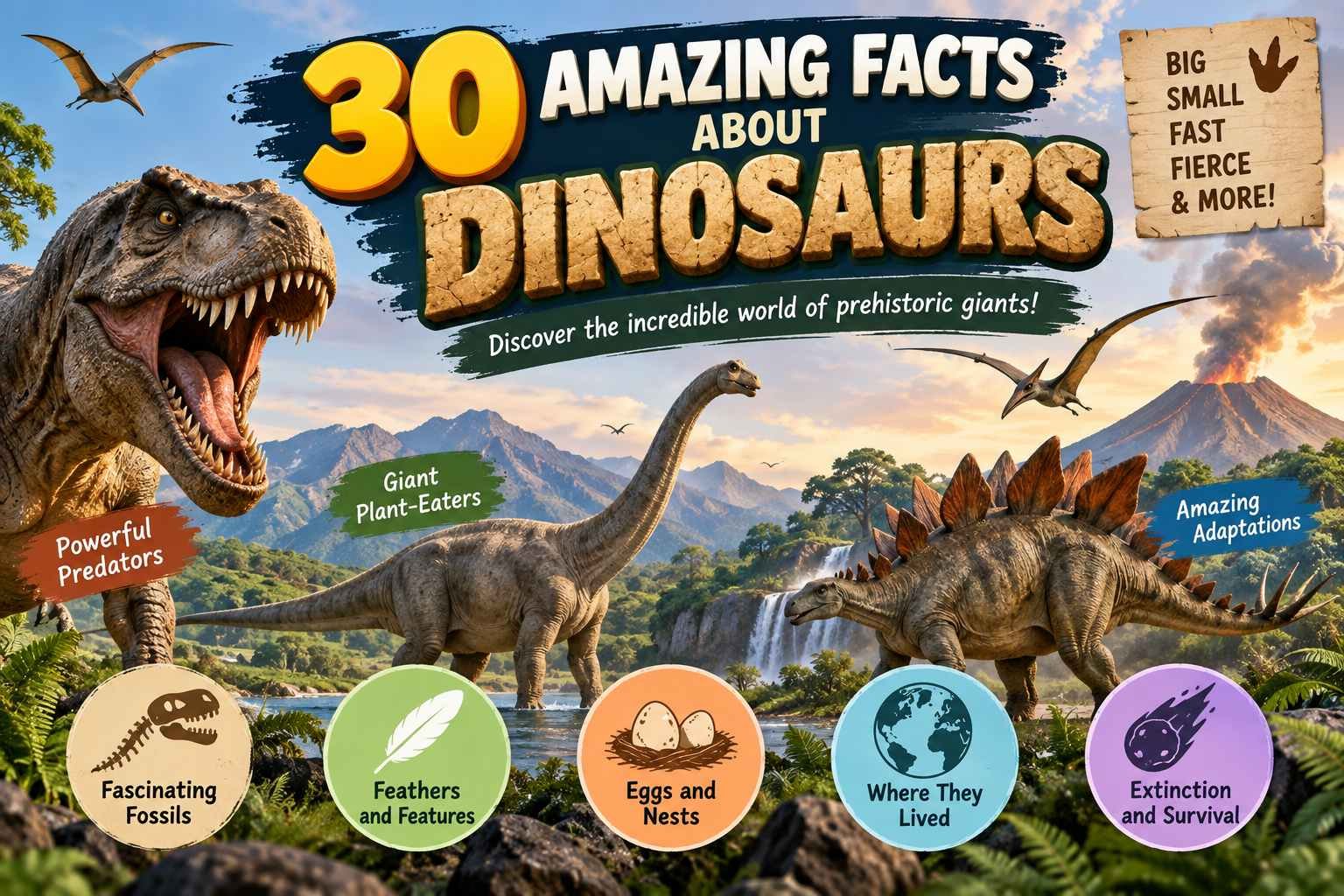
Dinosaurs are some of the most fascinating creatures to have ever walked the Earth. Millions of years after their disappearance, these prehistoric animals continue to capture our imagination with their enormous size, unusual features, and mysterious lives.
But dinosaurs were much more than giant creatures with sharp teeth. Some were covered in feathers, some were surprisingly small, and others had body features that scientists are still working to understand. And here’s something even more exciting: one branch of the dinosaur family is still alive today.
Whether you’re a dinosaur enthusiast or simply curious about the prehistoric world, these 30 amazing facts about dinosaurs will take you on a journey into the distant past.
1. Dinosaurs Lived Millions of Years Before Humans
Dinosaurs first appeared around 230 million years ago, during the Triassic Period. Humans, on the other hand, appeared much, much later.
Non-avian dinosaurs disappeared about 66 million years ago, long before modern humans evolved. If you could travel back to the age of dinosaurs, you would find a world completely different from the one we know today.
2. Birds Are Actually Living Dinosaurs

Here’s a fact that might surprise you: dinosaurs didn’t completely disappear. Modern birds evolved from a group of feathered theropod dinosaurs, making birds the living descendants of dinosaurs.
So, the next time you see a pigeon walking down the street or hear a bird singing outside your window, remember that you’re looking at a living member of the dinosaur family tree.
Also Read-25 Fascinating Facts About Sharks
3. Not All Dinosaurs Were Giant
When we think of dinosaurs, we often picture enormous creatures towering over trees. But many dinosaurs were actually quite small.
Some species were about the size of chickens or turkeys, while others were no bigger than a modern bird. The dinosaur family included an incredible range of body sizes, from tiny feathered animals to giants that stretched over 100 feet long.
4. The Largest Dinosaurs Were Longer Than a Basketball Court

Some of the largest sauropod dinosaurs reached extraordinary lengths. Long-necked giants such as Patagotitan may have stretched roughly 100 feet (30 meters) or more from head to tail.
Imagine standing beside a creature longer than a basketball court! These enormous plant-eaters are among the largest land animals known to science, although scientists are still studying exactly how big the biggest dinosaurs could grow.
smithsonianmag.com
5. The Name “Dinosaur” Means “Terrible Lizard”
The word dinosaur comes from Greek words meaning “terrible” or “fearfully great” and “lizard.”
The term was introduced by British scientist Richard Owen in 1842. Although dinosaurs are not actually lizards, the name stuck—and today, it is recognized around the world.
smithsonianmag.com
6. Some Dinosaurs Had Feathers

For a long time, dinosaurs were commonly imagined as scaly reptiles. However, fossil discoveries have revealed that many dinosaurs had feathers or feather-like coverings.
Some feathers may have helped with insulation, display, or other functions rather than flight. This means that certain dinosaurs may have looked more like unusual birds than the scaly monsters often shown in old illustrations.
7. Tyrannosaurus Rex Had Powerful Jaws
Tyrannosaurus rex, commonly known as T. rex, was one of the most famous meat-eating dinosaurs. It had a large skull, strong jaw muscles, and thick, blade-like teeth.
Its teeth were built for gripping and crushing prey, and some were several inches long. T. rex was a powerful predator, although scientists continue to investigate details of its hunting behavior and how it used its jaws.
8. T. Rex Had Tiny Arms—but They Were Strong

One of the strangest features of T. rex is its unusually small arms. Compared with its enormous body and powerful head, its forelimbs look almost comically tiny.
But small didn’t necessarily mean useless. T. rex’s arms were muscular, and scientists have proposed different ideas about how they may have been used. Their exact function remains a subject of scientific discussion.
9. Stegosaurus Had a Surprisingly Small Brain
Stegosaurus was a large, plant-eating dinosaur famous for the plates along its back and spikes on its tail.
Despite its impressive body size, its brain was relatively small. This doesn’t mean we can determine an animal’s intelligence from brain size alone, but Stegosaurus certainly had a very different brain-to-body ratio from humans.
10. Triceratops Had Three Facial Horns

Triceratops is easy to recognize thanks to its large bony frill and three prominent facial horns—two above its eyes and one on its nose.
These features may have played roles in defense, display, or interactions with other Triceratops. Its distinctive skull is one of the most recognizable dinosaur fossils ever discovered.
11. Some Dinosaurs Swallowed Stones
Certain plant-eating dinosaurs swallowed stones known as gastroliths. These stones may have helped grind food inside the digestive system.
Because dinosaurs couldn’t chew their food the way humans do, swallowing stones may have been one way some species processed tough plant material. However, not every stone found near a dinosaur fossil necessarily served this purpose.
12. Dinosaur Eggs Came in Different Shapes and Sizes

Dinosaur eggs weren’t all identical. Fossil discoveries show eggs with different shapes, sizes, shell textures, and patterns.
Some were rounded, while others were elongated. By studying eggshell structure and comparing eggs with embryos or other fossils, paleontologists can sometimes learn which dinosaur groups laid them.
13. Some Dinosaurs Built Nests and Cared for Eggs
Fossils provide evidence that certain dinosaurs laid eggs in nests and may have protected or incubated them.
For example, fossils of oviraptorosaurs have been found in positions suggesting that adults sat over their nests in a bird-like posture. Such discoveries offer fascinating clues about dinosaur parenting and reproductive behavior.
14. Velociraptors Were Smaller Than Movies Suggest

The Velociraptors shown in movies are often much larger than the real animals. Actual Velociraptor species were roughly turkey-sized in height, although they had long tails and could reach around 6 feet (2 meters) in total length.
They were feathered, too. The movie version is entertaining, but the real Velociraptor was a smaller, feathered predator with a distinctive curved claw on each hind foot.
15. Some Dinosaurs Had Armor on Their Bodies

Ankylosaurus and other armored dinosaurs had bony plates embedded in their skin, a feature known as osteoderms.
These structures formed protective armor across parts of the body. Ankylosaurus also had a large bony tail club, which may have been used for defense against predators. Its armor made it one of the most distinctive dinosaurs of the Cretaceous Period.
16. Some Dinosaurs Had Extremely Long Necks
Long-necked sauropods such as Diplodocus and Brachiosaurus evolved necks that helped them reach vegetation at different heights.
Their long necks were supported by specialized vertebrae, and some species had air spaces in their bones that helped reduce skeletal weight. These adaptations made their enormous bodies possible.
17. Spinosaurus Had a Huge Sail-Like Structure

Spinosaurus is famous for the tall, sail-like structure along its back, formed by elongated spines extending from its vertebrae.
Scientists have proposed different explanations for this structure, including display or temperature-related functions. Spinosaurus also had a long, narrow snout and features associated with a diet that included fish. Its lifestyle and exact adaptations remain active areas of research.
18. Some Dinosaurs Had Remarkably Long Claws
Certain dinosaurs developed unusually long claws. Therizinosaurus, for example, had enormous curved claws on its forelimbs.
Although these claws may look frightening, scientists think Therizinosaurus was primarily a plant-eater. Its claws may have helped with feeding, defense, or other behaviors, though their precise use is still debated.
19. Dinosaur Fossils Have Been Found on Every Continent

Dinosaur fossils have been discovered on all seven continents, including Antarctica.
When many dinosaurs lived, Earth’s continents were arranged differently from today. Over millions of years, tectonic movement changed their positions, but dinosaur fossils preserved evidence of how widely these animals once spread.
20. The Earth’s Continents Looked Very Different in the Age of Dinosaurs
During the early part of the dinosaur era, Earth’s landmasses were joined in a supercontinent called Pangaea.
Over time, Pangaea broke apart, and the continents gradually moved toward their modern positions. This shifting geography influenced how animals spread and evolved across the planet.
21. Not Every Prehistoric Reptile Was a Dinosaur

Pterosaurs, such as Pteranodon, are often mistakenly called flying dinosaurs. However, they were a separate group of flying reptiles that lived during the same broad era.
Marine reptiles such as plesiosaurs and mosasaurs weren’t dinosaurs either. They shared prehistoric oceans and landscapes with dinosaurs, but belonged to different evolutionary groups.
22. Some Dinosaurs May Have Had Colorful Feathers
Fossil evidence has allowed scientists to investigate the colors of some feathered dinosaurs.
In certain exceptionally preserved fossils, researchers have studied tiny structures called melanosomes, which are associated with pigment. These findings suggest that some dinosaurs may have had patterns or colors rather than being uniformly gray or brown.
23. Dinosaur Footprints Tell Stories Without Bones

Dinosaur footprints, known as trackways, are valuable fossils in their own right. They can reveal how dinosaurs moved, whether several animals traveled together, and sometimes clues about their speed.
Unlike bones, footprints preserve moments of activity. A trackway can offer a rare glimpse into what a dinosaur was doing millions of years ago.
24. Some Dinosaurs May Have Lived in Groups
Fossil trackways and mass bone beds suggest that certain dinosaur species may have moved or lived in groups.
Scientists have found evidence consistent with group movement in some herbivorous dinosaurs. However, social behavior likely differed among species, and a collection of fossils alone doesn’t always prove that dinosaurs lived together permanently.
25. The Largest Dinosaurs Were Mostly Plant-Eaters
Many of the biggest dinosaurs ever discovered were sauropods—long-necked, plant-eating dinosaurs.
Their enormous size required them to consume large quantities of vegetation. Their long necks may have helped them access different food sources, although the feeding habits varied among species.
26. Dinosaurs Replaced Their Teeth Throughout Life
Many toothed dinosaurs could replace lost or worn teeth throughout their lives.
This was particularly useful for species whose teeth experienced heavy wear while feeding. Fossils can preserve replacement teeth developing beneath functional ones, giving scientists a closer look at how dinosaur jaws worked.
27. The Asteroid Impact Was a Major Cause of Dinosaur Extinction

About 66 million years ago, a large asteroid struck near what is now Mexico’s Yucatán Peninsula. The impact is strongly linked to the mass extinction that wiped out all non-avian dinosaurs.
The collision triggered enormous environmental changes, including dust and aerosols that disrupted sunlight and food chains. Birds—the surviving dinosaur lineage—made it through, while many other groups disappeared.
28. Not All Dinosaurs Went Extinct
When people say “dinosaurs went extinct,” they’re usually referring to non-avian dinosaurs.
Birds survived the end-Cretaceous mass extinction and continued evolving into the many species we see today. In scientific terms, birds are dinosaurs—so dinosaurs are still part of our world.
29. Paleontologists Can Learn From Tiny Fossil Details

Dinosaur discoveries aren’t limited to huge skeletons. Tiny details in fossils—including microscopic bone structure, eggshell textures, and traces of feathers—can reveal important information.
Modern imaging and chemical analysis help scientists investigate fossils in ways that weren’t possible in the past. Sometimes, a small fossil fragment can answer a surprisingly big question about prehistoric life.
30. Scientists Are Still Discovering New Dinosaurs
Even after centuries of dinosaur research, new species and important fossil evidence continue to be discovered.
Some findings come from fresh excavations, while others emerge when researchers re-examine fossils already stored in museums. Each discovery can reshape our understanding of dinosaur diversity, behavior, and evolution.
Conclusion
Dinosaurs were far more diverse and fascinating than many of us imagine. From feathered predators and armored plant-eaters to enormous long-necked giants, these prehistoric animals developed remarkable ways to survive in a changing world.
Their fossils tell stories about ancient ecosystems, evolution, and even the catastrophic events that reshaped life on Earth. And perhaps the most amazing part is that dinosaur research is still evolving—new discoveries continue to challenge old ideas and reveal details we never knew before.
The next time you see a bird, remember that you’re looking at a living connection to the age of dinosaurs. The prehistoric world may be gone, but its legacy is still flying above us.
1 thought on “30 Amazing Facts About Dinosaurs”