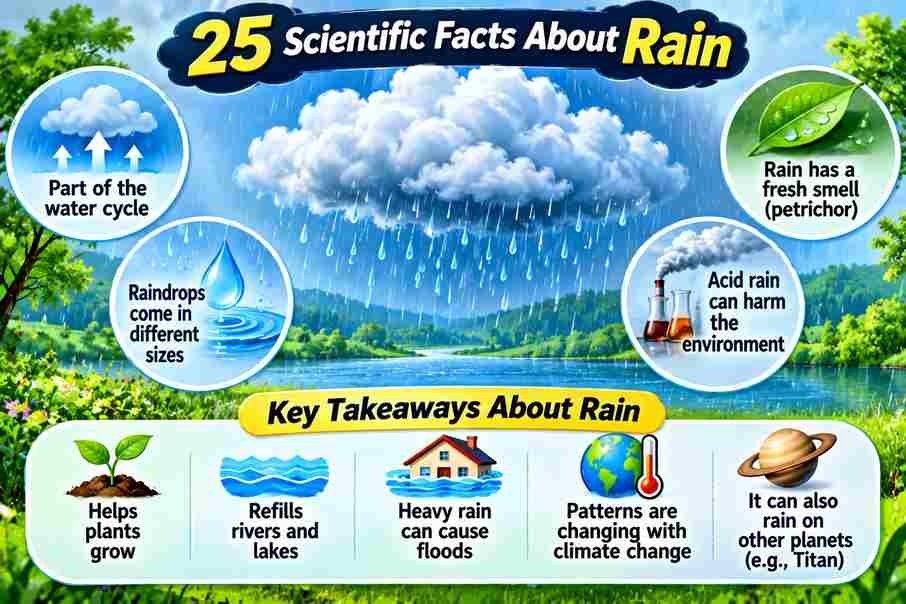
Rain is one of the most familiar parts of nature, but have you ever wondered how it actually forms? Why do raindrops fall from clouds? Why does rain sometimes have a fresh smell, and why do some places receive much more rainfall than others?
Rain plays an important role in keeping our planet alive. It provides fresh water for plants, animals, and humans, supports agriculture, fills rivers and lakes, and helps maintain Earth’s natural water cycle. Although we experience rain regularly, many fascinating scientific processes happen before a single raindrop reaches the ground.
From the formation of clouds to unusual rainfall on other planets, there is much more to rain than meets the eye.
Here are 25 scientific facts about rain that will help you understand this amazing natural phenomenon.
1. Rain Is Part of the Natural Water Cycle
Rain is an important stage of the water cycle, also known as the hydrological cycle. Water from oceans, rivers, lakes, and other surfaces evaporates because of the Sun’s heat. The water vapour rises into the atmosphere, cools down, and forms tiny droplets that create clouds.
When these droplets become large and heavy enough, they may fall to the ground as precipitation. This process continuously moves water between the Earth’s surface and atmosphere.
2. Rain Forms When Water Vapour Condenses
Rain begins with water vapour in the atmosphere. As moist air rises, it generally cools. When it reaches its dew point, water vapour can condense into tiny liquid droplets.
These droplets gather around microscopic particles in the air, such as dust, salt, or other aerosols. As more droplets develop and grow, clouds form. Under suitable conditions, these droplets eventually become large enough to fall as rain.
3. Clouds Do Not Always Produce Rain
Have you ever looked at dark clouds and expected rain, only to see nothing happen? That is because not every cloud produces precipitation that reaches the ground.
Clouds contain tiny water droplets or ice crystals. Sometimes these particles are too small to fall as rain. Even when precipitation begins, it may evaporate before reaching the Earth’s surface, especially when the air below the cloud is dry.
4. Raindrops Are Not Shaped Like Teardrops
Many pictures show raindrops with a pointed top and rounded bottom. However, real raindrops usually do not have this shape.
Small raindrops are nearly spherical because surface tension pulls the water into a rounded shape. Larger drops become flattened at the bottom as air resistance pushes against them while they fall. Very large drops can become unstable and break into smaller droplets.
5. Raindrops Come in Different Sizes
Not all raindrops are the same size. Their size depends on how they form, grow, and interact inside clouds.
Some clouds produce tiny droplets that create light drizzle, while others produce larger drops during heavy rainfall. Raindrops can also collide and combine with one another as they move through clouds.
This variation in size is one reason why rainfall can feel gentle in one situation and much heavier in another.
6. Raindrops Fall at Different Speeds
The speed of a falling raindrop depends mainly on its size and the resistance of the surrounding air.
Small droplets fall relatively slowly, while larger raindrops generally fall faster until air resistance balances the force of gravity. This balanced speed is known as terminal velocity.
The shape of the drop and wind conditions can also affect how it moves through the atmosphere.
7. Rain Has a Fresh Smell Known as Petrichor
Have you ever noticed a pleasant earthy smell after the first rain following a long dry period? This smell is called petrichor.
It comes partly from oils released by plants and a compound called geosmin, which is produced by certain soil-dwelling microorganisms. When raindrops hit dry ground, tiny airborne particles can carry these compounds into the air.
That is why the smell of rain can be especially noticeable after a long dry spell.
8. Rain Can Form Through Two Main Cloud Processes
Rain can develop through different processes inside clouds. In relatively warm clouds, tiny water droplets collide and combine into larger droplets. This is called the collision-coalescence process.
In colder clouds, ice crystals can grow by collecting water vapour while nearby supercooled droplets evaporate. The ice crystals may eventually become heavy enough to fall and melt into raindrops as they pass through warmer air.
9. There Are Different Types of Rainfall
Rainfall does not happen in just one way. Scientists commonly describe three major types based on how air rises and cools.
- Convectional rainfall: Warm, moist air rises, cools, and forms clouds. It often produces heavy showers and thunderstorms.
- Orographic rainfall: Moist air is forced upward when it encounters mountains or high land. It cools and may produce rain on the windward side.
- Cyclonic or frontal rainfall: Air masses with different temperatures meet, causing warmer air to rise and produce clouds and precipitation.
Each type of rainfall is associated with different weather conditions.
10. Mountains Can Change Rainfall Patterns
Mountains have a major influence on where rain falls. When moist air meets a mountain range, it is forced to rise. As it rises, it cools and may produce clouds and rainfall.
The side facing the incoming moist air is called the windward side and often receives more rain. The opposite side may receive much less rainfall because the air descends and becomes warmer and drier. This dry region is known as a rain shadow.
11. Some Places Receive Much More Rain Than Others
Rainfall is not distributed evenly around the world. Tropical regions often receive heavy rainfall because warm temperatures encourage evaporation and rising moist air.
Mountain ranges, ocean currents, prevailing winds, and geographical location also influence rainfall. Some deserts receive very little rain throughout the year, while certain tropical regions experience frequent and intense rainfall.
12. Scientists Measure Rainfall Using Rain Gauges
A rain gauge is an instrument used to measure how much rain falls in a particular area. It collects rainfall over a specific period and records the amount of water received.
Rainfall is usually measured in millimetres. For example, 10 millimetres of rain means that water would cover a flat surface to a depth of 10 millimetres if none of it ran off, evaporated, or soaked into the ground.
Weather stations use rainfall measurements to study weather patterns and monitor changing conditions.
13. Rainfall Can Be Measured Using Weather Radar
Rain gauges measure rainfall at a particular location, but weather radar helps scientists observe precipitation across much larger areas.
Weather radar sends out radio waves and measures signals reflected by raindrops, snowflakes, and other particles. This information helps meteorologists estimate where precipitation is occurring and how it is moving.
Radar images are particularly useful for tracking storms and monitoring severe weather.
14. Acid Rain Can Harm the Environment
Acid rain is precipitation that has become more acidic than normal because of certain pollutants in the atmosphere. Sulfur dioxide and nitrogen oxides released from sources such as power plants, industries, and vehicles can react with water and other substances in the air.
Acidic precipitation can affect lakes, rivers, forests, and soil. It can also speed up the damage of buildings and monuments made from certain materials.
15. Rain Sometimes Evaporates Before Reaching the Ground
Have you ever seen rain falling from a cloud but noticed that the ground below remains dry? This phenomenon is called virga.
It occurs when raindrops or ice particles fall into a layer of dry air and evaporate before reaching the surface. Virga is often visible as streaks hanging beneath clouds.
It is a fascinating reminder that precipitation does not always reach the ground.
16. Rain Can Fall in Different Forms
Rain is only one type of precipitation. Depending on atmospheric temperature and cloud conditions, water can reach the ground in several forms.
- Rain consists of liquid water droplets.
- Drizzle consists of very small liquid droplets.
- Snow falls as ice crystals or snowflakes.
- Sleet consists of small ice pellets.
- Hail forms inside strong thunderstorms when ice particles grow through repeated movements within the cloud.
The type of precipitation depends on the temperature and structure of the atmosphere.
17. Some Rain Can Contain Dust From Faraway Places
Rain can sometimes carry dust and tiny particles from distant regions. Strong winds can lift mineral dust into the atmosphere and transport it over long distances.
When rain falls through dusty air, it can collect some of these particles and bring them to the ground. In some places, this can leave reddish or brownish marks on cars, windows, and outdoor surfaces.
This shows how weather systems can connect distant parts of the world.
18. Rain Helps Plants Grow
Rain provides water that plants need for essential biological processes. Plant roots absorb water from the soil, which helps transport nutrients and supports photosynthesis.
Without enough water, many plants cannot grow properly and may eventually dry out. Rain also helps maintain soil moisture, supports forests, and provides water for agricultural crops.
However, too much rain can also damage plants by flooding roots and washing away nutrients.
19. Rain Supports Rivers, Lakes, and Groundwater
Rainfall helps refill rivers, lakes, ponds, and reservoirs. Some rainwater flows over the land into streams and rivers, while some enters the soil and moves underground.
This underground water is known as groundwater. It is an important source of fresh water for households, agriculture, and industries in many parts of the world.
Rainfall therefore plays a major role in maintaining freshwater supplies.
20. Heavy Rain Can Cause Flash Floods
Although rain is essential for life, excessive rainfall over a short period can become dangerous. When the ground cannot absorb water quickly enough, excess water flows across the surface.
This can cause flash floods, especially in urban areas, steep valleys, and places with poor drainage. Flash floods can develop rapidly and damage roads, buildings, crops, and other infrastructure.
This is why weather warnings and proper drainage systems are important during periods of heavy rainfall.
21. Rainfall Patterns Are Changing With Climate Change
Climate change can influence the water cycle by increasing temperatures and changing evaporation and atmospheric moisture. A warmer atmosphere can hold more water vapour, which can contribute to heavier rainfall when suitable weather conditions occur.
However, rainfall changes are not the same everywhere. Some regions may experience more intense rainfall, while others may face longer dry periods or changes in seasonal rainfall patterns.
Scientists study these changes to understand future water availability and flood risks.
22. Rain Can Fall on Other Planets
Earth is not the only planet where scientists have found evidence of precipitation-like processes. However, rain on other worlds can be very different from the water rain we experience.
For example, scientists believe that Venus may have sulfuric acid droplets in its clouds, although they evaporate before reaching the surface. On Saturn’s moon Titan, methane and ethane can form clouds and fall as liquid precipitation.
These unusual weather systems show how different planetary environments can be.
23. The Amazon Rainforest Depends on Regular Rainfall
The Amazon rainforest is one of the wettest and most biologically diverse regions on Earth. Regular rainfall helps maintain its rich vegetation and supports countless animal and plant species.
Trees also release water vapour into the atmosphere through a process called transpiration. This moisture contributes to cloud formation and can influence rainfall patterns across the region.
The relationship between forests and rainfall is an important part of the rainforest’s natural water cycle.
24. Rainwater Is Not Always Safe to Drink
Rainwater may look clean, but it can collect dust, pollutants, microorganisms, and other contaminants as it falls through the atmosphere or flows over rooftops and storage surfaces.
In some areas, rainwater harvesting is used to collect water for household and agricultural purposes. However, rainwater intended for drinking should be properly filtered and treated according to local safety standards.
Its quality depends on the environment, collection system, and storage conditions.
25. Scientists Use Rainfall Forecasts to Prepare for Disasters
Weather forecasting plays an important role in protecting people from floods, storms, and other rain-related hazards.
Meteorologists use satellites, weather radar, rain gauges, computer models, and atmospheric observations to predict rainfall. These forecasts help authorities prepare emergency services, manage reservoirs, and issue warnings to communities.
Although forecasts are not always exact, improvements in weather technology are making rainfall predictions increasingly useful.
Conclusion
Rain may seem like an ordinary part of everyday life, but it is connected to some of the most important natural processes on Earth. It helps maintain the water cycle, supports plant growth, fills rivers and lakes, and provides fresh water for humans and animals.
From the science behind raindrop formation to the unusual rainfall found on other planets, these facts show how fascinating this natural phenomenon really is.
Understanding rain is also important for preparing for floods, managing water resources, and studying climate change. The next time you hear raindrops hitting your window, remember that every drop is part of a remarkable journey through the atmosphere and back to Earth.
Frequently Asked Questions About Rain
1. How is rain formed?
Rain forms when water vapour in the atmosphere cools and condenses into tiny droplets inside clouds. These droplets grow through collisions or other cloud processes until they become heavy enough to fall to the ground.
2. Why does rain smell so good?
The fresh smell after rain is called petrichor. It is associated with plant oils and geosmin, a compound produced by certain microorganisms in soil. Raindrops can help release these substances into the air.
3. What are the three main types of rainfall?
The three commonly described types are convectional rainfall, orographic rainfall, and cyclonic or frontal rainfall. They occur through different atmospheric processes that cause moist air to rise and cool.
4. Can it rain without clouds?
Ordinary rainfall comes from clouds. However, precipitation may evaporate before reaching the ground, creating a phenomenon called virga. It can look like rain is falling from the sky even when the ground remains dry.
5. Why is rain important for life on Earth?
Rain provides fresh water for plants, animals, and humans. It supports agriculture, replenishes rivers and lakes, helps maintain groundwater supplies, and plays an essential role in Earth’s water cycle.