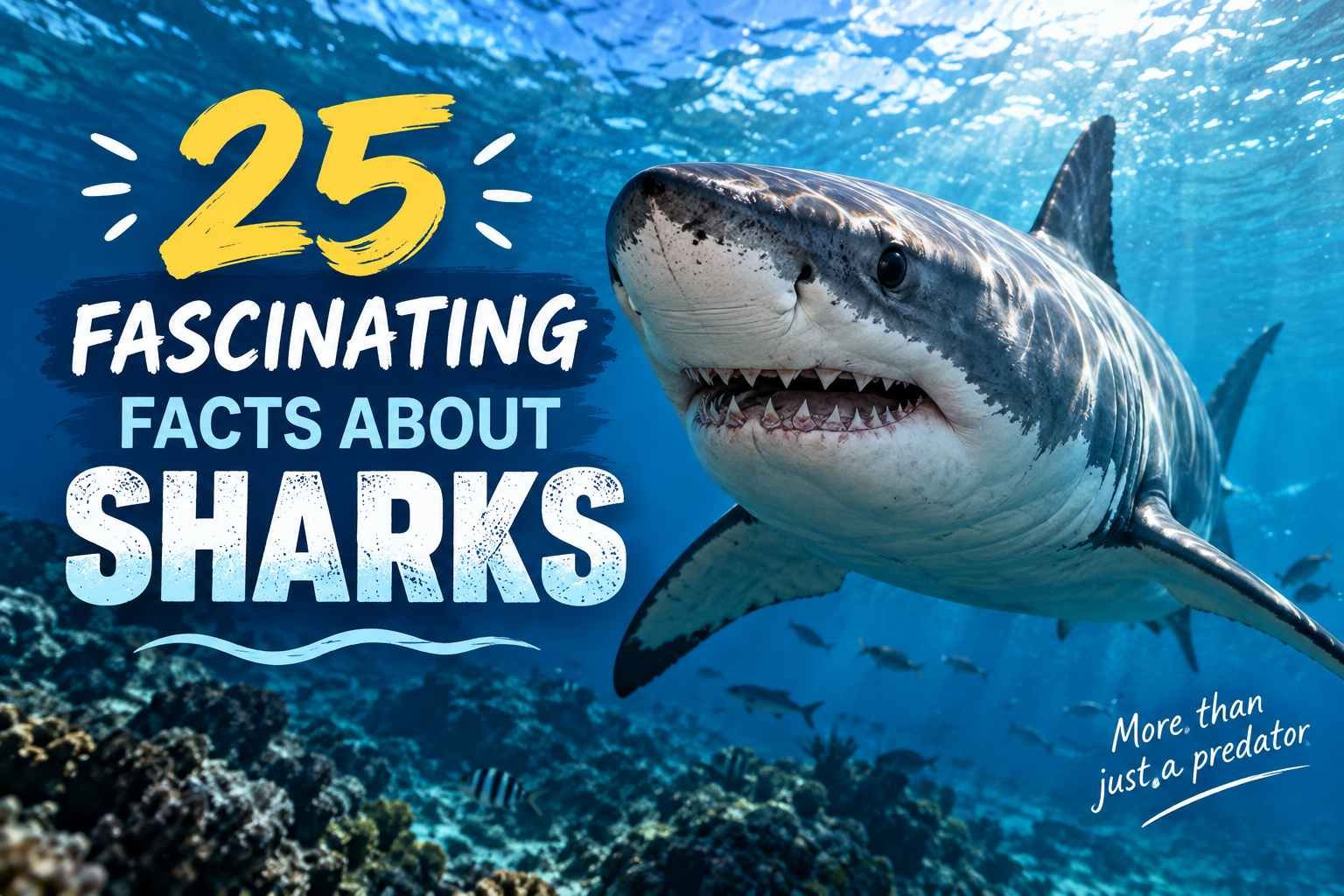
Sharks are some of the most fascinating creatures in the ocean. For millions of years, these incredible fish have swum through Earth’s waters, developing extraordinary senses, unusual body features, and hunting abilities that continue to amaze scientists.
But sharks are often misunderstood. Movies and dramatic headlines have given them a frightening reputation, even though most shark species pose little danger to humans. From tiny sharks that can fit in your hand to giants longer than a bus, the shark family is far more diverse than many people realize.
Ready to explore the underwater world of these amazing animals? Here are 25 fascinating facts about sharks that might change the way you see them.
1. Sharks Have Been Around Longer Than Dinosaurs
Sharks are truly ancient animals. Their evolutionary history stretches back more than 400 million years, meaning their ancestors were swimming in Earth’s oceans long before dinosaurs appeared.
Scientists study fossilized shark teeth, scales, and other remains to understand how these animals evolved. Their long history is a remarkable example of how life can adapt and survive through enormous changes on Earth.
2. There Are More Than 500 Species of Sharks
When people hear the word “shark,” they often picture a great white shark. However, the shark family includes more than 500 known species, each with its own appearance, behavior, and adaptations.
Some live in deep, dark waters, while others inhabit coral reefs or coastal areas. With so many different species, sharks are much more varied than their movie reputation suggests.
3. Sharks Don’t Have Bones
Here’s a surprising fact: sharks don’t have skeletons made of bone like humans do. Instead, their skeletons are made mostly of cartilage—the flexible tissue found in your nose and ears.
Cartilage is lighter than bone, helping sharks move efficiently through the water. Their skeletons may be flexible, but they are still strong enough to support these impressive ocean animals.
4. The Whale Shark Is the Largest Fish in the World

The whale shark holds the title of the largest living fish on Earth. These enormous animals can reach around 40 feet (12 meters) or more in length, with some estimates placing the largest individuals even bigger.
Despite their massive size, whale sharks are gentle filter feeders. Instead of chasing large prey, they consume tiny organisms such as plankton and small fish.
5. The Dwarf Lanternshark Is Tiny Enough to Fit in Your Hand
Not every shark is a giant. The dwarf lanternshark is one of the smallest known shark species, reaching only about 6–8 inches (15–20 centimeters) long.
This tiny shark lives in deep waters off the northern coast of South America. It’s a striking reminder that sharks come in a wide range of sizes—not just the enormous ones we see in documentaries.
6. Shark Skin Feels Like Sandpaper
A shark may look smooth and slippery, but its skin can feel surprisingly rough. It’s covered in tiny tooth-like structures called dermal denticles, which point toward the tail.
These microscopic structures help reduce drag as water flows over the shark’s body. So shark skin isn’t just protective—it’s also a clever adaptation that helps many sharks swim more efficiently.
7. Sharks Have an Extraordinary Sixth Sense
Sharks possess special sensory organs called ampullae of Lorenzini, which allow them to detect weak electrical fields produced by other animals.
These sensors are especially useful when prey is hidden beneath sand or difficult to see. A shark can detect tiny electrical signals generated by muscle activity, giving it another way to locate potential food in the ocean.
8. Sharks Can Detect Vibrations in the Water
Sharks don’t rely on eyesight alone when hunting. They have a sensory system called the lateral line, which detects movements and vibrations in the surrounding water.
Imagine a fish swimming nearby in murky water. Even if a shark can’t see it clearly, the movement can create vibrations that the shark may detect. This ability is particularly helpful in dark or low-visibility environments.
9. Some Sharks Can Live for Centuries

The Greenland shark is one of the longest-living vertebrates known to science. Researchers estimate that some individuals may live for several hundred years.
One study estimated the age of a large Greenland shark at roughly 392 years, although the uncertainty range was wide. These sharks grow extremely slowly and live in cold Arctic and North Atlantic waters, making them particularly remarkable animals.
oceanservice.noaa.gov
10. Sharks Are Found in Oceans Around the World
Sharks inhabit oceans across the globe, from warm tropical waters to cold polar seas. Different species have adapted to a wide range of marine environments, including coral reefs, open oceans, and the deep sea.
Some sharks prefer shallow coastal waters, while others spend much of their lives far from land. Their wide distribution shows just how successfully sharks have adapted to different ocean habitats.
11. Sharks Can Replace Lost Teeth

Unlike humans, who generally have two sets of teeth, sharks can continuously replace lost teeth throughout their lives.
Many species have several rows of teeth waiting behind the front row. When a tooth falls out, another can move forward to take its place. Over a lifetime, some sharks may go through thousands of teeth.
12. Not All Sharks Need to Keep Swimming to Breathe
You’ve probably heard that sharks must swim constantly or they’ll suffocate. That’s true for some species, but not all of them.
Certain sharks, including nurse sharks, can pump water over their gills while resting. This allows them to remain still on the seafloor and continue breathing. Other species rely more heavily on swimming to keep water moving over their gills.
13. Some Sharks Give Birth to Live Young
Shark reproduction is more diverse than many people expect. Some species lay eggs, while others give birth to live young.
The details vary by species. In certain sharks, embryos develop inside the mother’s body and receive nourishment through a placenta-like connection. In others, the young develop inside eggs that remain within the mother until they hatch.
14. Baby Sharks Are Called Pups
A newborn shark is called a pup. Depending on the species, pups may be born alive or hatch from eggs.
Unlike many mammals, most shark species don’t provide extended parental care after birth. The young generally have to find food and avoid predators on their own—a challenging start to life in the ocean.
15. Some Shark Embryos Eat Their Siblings Before Birth
This might sound like something from a science-fiction movie, but it happens in sand tiger sharks.
Inside the mother’s uterus, the strongest embryo in each of her two uterine compartments may consume its developing siblings. This unusual behavior is known as intrauterine cannibalism and means that only a small number of pups typically survive to birth.
16. The Shortfin Mako Is the Fastest Known Shark

The shortfin mako is famous for its speed and powerful swimming ability. It can reach around 46 miles per hour (74 kilometers per hour) in short bursts, making it one of the fastest sharks.
Its streamlined body and strong tail help it move rapidly through the water. This speed is useful when chasing fast-moving prey such as fish.
17. Hammerhead Sharks Have a Unique Field of Vision
Hammerhead sharks are instantly recognizable because of their unusual, hammer-shaped heads.
The wide placement of their eyes gives them a broad field of vision. Their distinctive head shape also provides more space for sensory organs that help detect electrical signals from prey. It’s a fascinating example of how an animal’s body shape can support its survival.
18. Whale Sharks Have Unique Spot Patterns
Every whale shark has a distinctive pattern of light-colored spots and stripes across its body. These markings are so individual that researchers can use them to identify and track particular sharks.
It’s a little like a natural fingerprint. By photographing these patterns, scientists can learn more about whale shark movements, migration, and behavior without needing to capture the animals.
19. Some Sharks Glow in the Dark

Some deep-sea sharks can produce light through a process called bioluminescence. Species such as the kitefin shark have light-producing organs that create a faint glow.
In the dark ocean, this light may help with camouflage, communication, or other behaviors. It’s a surprising reminder that the deep sea is full of adaptations we rarely get to see.
20. The Cookiecutter Shark Leaves Round Bites
The cookiecutter shark may be small, but it has a rather unusual feeding strategy. It bites circular plugs of flesh from larger animals, including fish and marine mammals.
Its bite leaves a distinctive round wound, almost as if a cookie cutter had been used. These sharks have even been known to leave bite marks on much larger ocean animals.
21. Bull Sharks Can Enter Freshwater
Most people associate sharks with saltwater, but bull sharks are capable of moving into freshwater environments.
They can regulate the salt levels inside their bodies, allowing them to travel between saltwater, brackish water, and freshwater. This unusual ability means bull sharks may be found in rivers and estuaries, not just the open ocean.
22. Some Sharks Can Reproduce Without a Male
In rare documented cases, female sharks have produced offspring without fertilization by a male. This process is called parthenogenesis.
Scientists have observed this phenomenon in some captive sharks, including females kept without access to males. It appears to be uncommon, and researchers are still studying how and when it occurs.
23. Sharks Don’t All Have the Same Kind of Teeth
A shark’s teeth often reveal a lot about what it eats. Great white sharks have broad, serrated teeth suited to cutting prey, while mako sharks have narrower, pointed teeth that help them grip slippery fish.
Other sharks, especially those that feed on small animals, have teeth adapted for crushing or holding food. There isn’t one universal shark bite—different species have evolved different tools for different diets.
24. Sharks Play an Important Role in Ocean Ecosystems
Sharks are not just fascinating animals; many are also important to the health of marine ecosystems.
As predators, some sharks help influence the populations and behavior of other marine animals. This can have wider effects throughout the food web. However, not every shark is an apex predator—many smaller species are themselves prey for larger animals.
25. Sharks Need Protection, Too

Despite their fearsome reputation, many shark species face serious threats from human activities. Overfishing, accidental capture in fishing gear, and demand for shark products have contributed to population declines in different parts of the world.
Sharks also tend to grow slowly and produce relatively few young compared with many other fish, making recovery difficult for some species. Protecting sharks and their habitats helps preserve the balance and biodiversity of ocean ecosystems.
Conclusion
Sharks are much more than the frightening predators often portrayed in movies. They are ancient, diverse, and remarkably adapted animals, with sensory abilities, body structures, and life cycles that continue to surprise scientists.
From the tiny dwarf lanternshark to the enormous whale shark, every species has its own story. And while some sharks are powerful predators, many are simply moving through the ocean, feeding, migrating, and playing their part in a complex marine ecosystem.
The more we learn about sharks, the clearer it becomes that these animals deserve both our curiosity and our respect. The ocean is a more fascinating place with sharks in it—and understanding them is one way we can help protect it.
2 thoughts on “25 Fascinating Facts About Sharks”