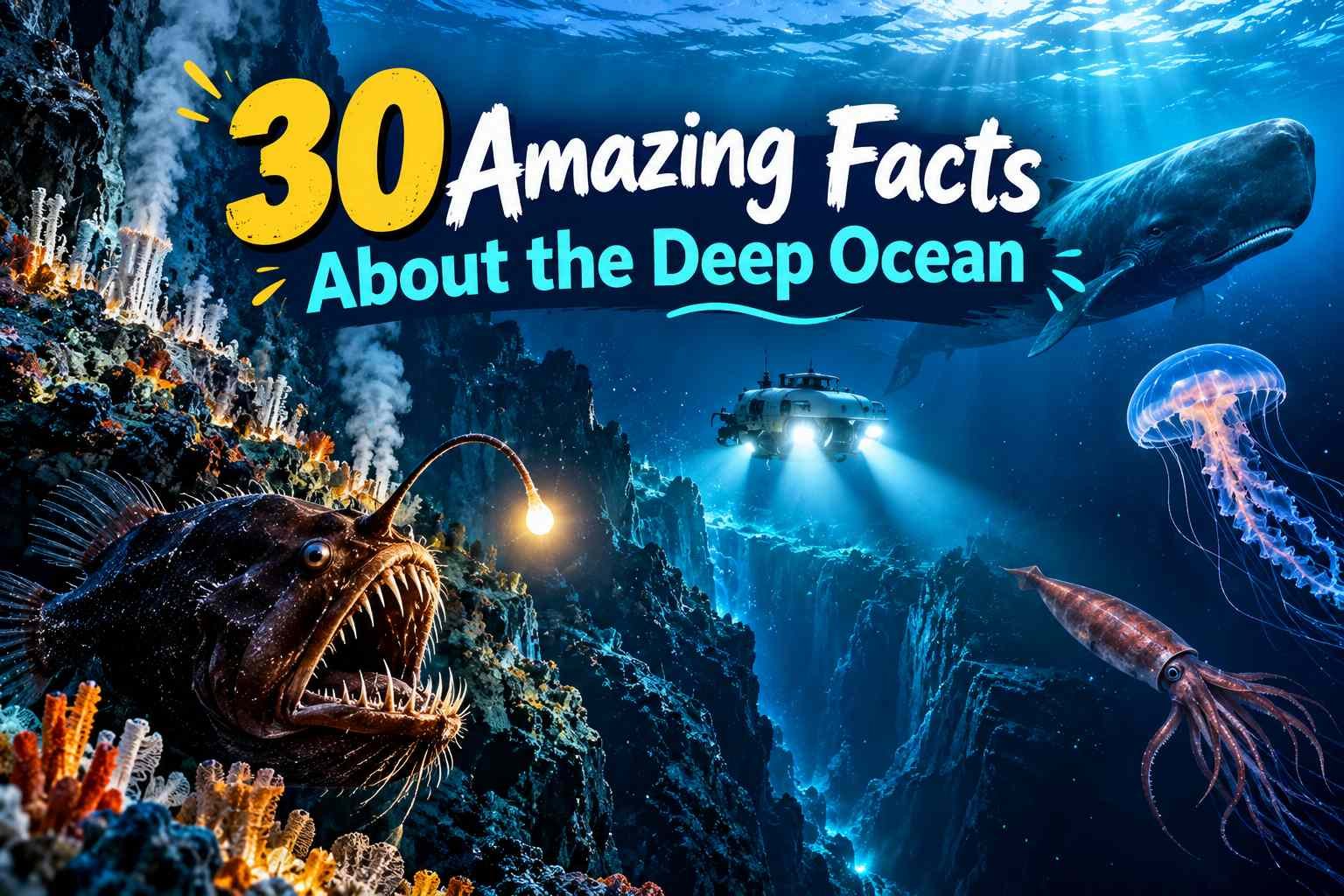
The deep ocean is one of the most mysterious places on Earth. Far below the waves, sunlight disappears, pressure becomes enormous, temperatures can drop dramatically, and creatures live in conditions that would be almost impossible for humans to survive.
What makes the deep ocean even more fascinating is how little we actually know about it. Scientists continue to discover new species, unusual ecosystems, and geological features hidden beneath the surface. In fact, one of the supplied sources notes that only a small portion of the seafloor has been accurately mapped.
From the deepest point on Earth to fish that can practically disappear in the darkness, here are 30 amazing facts about the deep ocean that reveal just how extraordinary the world beneath the waves really is.
1. The Ocean Is Much Deeper Than Most People Imagine
The average depth of the world’s ocean is about 3,688 metres (12,100 feet). But that’s only an average—the deepest areas plunge much farther down.
To put that into perspective, the height of Mount Everest could fit inside the deepest part of the ocean with plenty of water still above its summit.
2. Challenger Deep Is the Deepest Known Point
The deepest known point in Earth’s oceans is Challenger Deep, located in the Mariana Trench.
The supplied source gives its depth as approximately 10,994 metres and describes the pressure there as an astonishing eight tonnes per square inch.
That’s a world far removed from the ocean beaches we know.
Also Read-25 Fascinating Facts About Sharks
3. Almost All of the Deep Ocean Is Completely Dark
Sunlight doesn’t penetrate very far into the ocean. Once you travel down beyond the sunlit upper layers, natural light becomes extremely limited.
The supplied source estimates that up to 99% of the ocean is in complete darkness all the time.
For animals living there, darkness isn’t unusual—it’s simply their normal environment.
4. Humans Have Explored Only a Small Part of the Ocean
The deep ocean remains largely unexplored. One supplied source states that only about 5% of the seafloor has been accurately mapped.
Another source gives a broader estimate of less than 10% of the world’s oceans being mapped, emphasizing just how much remains unknown.
There may be entire underwater landscapes and species that humans have never seen.
5. The Deep Ocean Contains an Enormous Amount of Habitable Space
Although oceans cover around 71% of Earth’s surface, their depth makes them even more significant.
The supplied Marine Madness source notes that the oceans contain around 99.9% of Earth’s habitable space for life.
That’s a remarkable reminder that our planet’s livable world extends far below the surface.
6. The Deep Ocean Is Under Crushing Pressure
As you descend deeper into the ocean, the weight of the water above you increases enormously.
At Challenger Deep, the pressure is described in the supplied source as around eight tonnes per square inch.
Deep-sea animals have evolved special bodies and biological adaptations that allow them to survive under these extreme conditions.
7. The Deep Ocean Has Its Own Giant Mountain Range
Mountains aren’t just found on land. One of Earth’s greatest mountain systems is hidden beneath the sea.
The Mid-Ocean Ridge stretches for more than 65,000 kilometres across the seafloor of the major oceans. The supplied source describes it as roughly four times longer than the Andes, Rockies, and Himalayas combined.
Much of this enormous mountain system is invisible from the surface.
8. There Is a Giant Waterfall Under the Ocean
It sounds impossible, but the ocean contains enormous underwater waterfalls.
The Denmark Strait Cataract, between Iceland and Greenland, is a massive underwater waterfall. The supplied source describes approximately 5 million cubic metres of water falling continuously over an underwater ridge by about 3,505 metres.
It is far taller than many of the world’s famous waterfalls.
9. Point Nemo Is Extremely Far From Land
Deep in the Pacific Ocean lies Point Nemo, the location considered the oceanic point farthest from land.
The supplied source says it is more than 1,000 miles from any landmass. Interestingly, astronauts aboard the International Space Station can sometimes be closer to Point Nemo than people on land are.
That makes it one of the most isolated places on our planet.
10. The Pacific Ocean Is Enormous
The Pacific is the largest ocean on Earth. At its widest point, it stretches approximately 12,300 miles, according to the supplied source.
It is so enormous that its width at one point is greater than the diameter of the Moon.
11. The Pacific Contains More Than 25,000 Islands
The Pacific Ocean isn’t just huge—it contains an incredible number of islands.
The supplied source estimates that the Pacific contains more than 25,000 islands.
Many of these islands are thousands of kilometres away from major continental landmasses.
12. The Ocean Moves in a Giant Global Conveyor Belt
Deep ocean water doesn’t simply sit still.
The global ocean conveyor belt moves enormous quantities of water around the planet. According to the supplied source, a parcel of water can take up to 1,000 years to complete a full cycle.
These large-scale movements are important to the Earth’s climate system.
13. The Ocean Stores Huge Amounts of Carbon
The ocean acts as a massive natural carbon store.
The supplied source estimates that the oceans store around 38,000 gigatons of carbon, which is about 16 times more than the entire terrestrial biosphere.
This is one reason the ocean is so important to Earth’s climate.
14. Deep-Sea Animals Travel Up and Down Every Day
One of the largest animal migrations on Earth happens in the ocean every single day.
Millions of deep-sea creatures travel upward toward the surface at night to feed on plankton before returning to deeper waters in the morning. This phenomenon is called Diel Vertical Migration.
It is a gigantic daily movement that most people never see.
15. Some Deep-Sea Fish Are Almost Completely Black
Darkness creates a serious challenge for deep-sea animals—but some species have evolved an incredible solution.
The supplied source describes 16 species of ultra-black fish whose skin absorbs more than 99.5% of the light that hits it.
This makes them extremely difficult to see in the darkness of the deep ocean.
16. The Deepest Recorded Fish Was Found in the Mariana Trench
Scientists have found fish living at extraordinary depths.
The supplied source identifies a ghost fish as the deepest recorded living fish, filmed at a depth of 8,143 metres during a dive into the Mariana Trench.
Think about that the next time you picture an ordinary fish swimming near the surface.
17. Some Deep-Sea Fish Produce Their Own Light
In an environment where sunlight doesn’t reach, producing light can be incredibly useful.
Many deep-sea animals use bioluminescence to communicate, attract prey, confuse predators, or find potential mates. The deep ocean is therefore not always completely black—it can sparkle with flashes of biological light.
This remarkable ability is one of the defining features of deep-sea life.
18. Anglerfish Have One of the Strangest Reproductive Strategies
Some deep-sea anglerfish have an extraordinary reproductive adaptation known as sexual parasitism.
The supplied source explains that in some species, tiny males bite into much larger females and eventually fuse with their bodies, remaining attached for the rest of their lives.
It is certainly one of the strangest relationships found in the animal kingdom.
19. Greenland Sharks Can Live for Centuries
The Greenland shark is famous for its exceptionally long lifespan.
The supplied source states that Greenland sharks can live for more than 400 years, meaning some living individuals may have been born centuries ago. Researchers estimated their ages by examining radioactivity patterns in their eye lenses.
That makes these sharks among the longest-lived vertebrates known.
20. Sperm Whales Have Enormous Sound-Producing Structures
Sperm whales are specially adapted for life in the deep ocean.
The supplied source explains that they use their enormous snouts to produce powerful booming sounds, with sound waves reverberating through structures in their heads.
Sound is especially important in the deep sea, where vision is severely limited.
21. Dolphins Can Use Echolocation to “See” Through Soft Tissue
Dolphins use high-frequency sounds for echolocation.
According to the supplied source, their sounds can reflect from harder structures such as bone and cartilage while passing through softer tissue. This can give dolphins information about objects or animals beyond what their eyes can directly see.
It’s an impressive example of how sound can become a tool for exploring an underwater world.
22. Octopuses Have Three Hearts
Octopuses are among the most unusual animals in the ocean.
They have three hearts—one systemic heart that pumps blood around the body and two branchial hearts that pump blood through the gills. Their blood is also blue because it uses copper-containing hemocyanin rather than iron-based haemoglobin.
Deep-ocean octopus species take these unusual adaptations into some of the planet’s harshest environments.
23. Some Pygmy Seahorses Barely Move
Not every deep or reef-associated marine animal is constantly travelling through the ocean.
The supplied source notes that some pygmy seahorses remain on the same sea fan for their entire lives and may move within an area no larger than a dinner plate.
For these tiny animals, staying close to home can be the best survival strategy.
24. Sea Sponges Are Older Than Dinosaurs
Sea sponges have an extraordinarily ancient history.
The supplied source states that sea sponges existed more than 640 million years ago, potentially making them among the earliest multicellular animals.
Dinosaurs appeared much later, meaning sponges were already living in Earth’s oceans long before dinosaurs walked on land.
25. Some Sea Sponges May Live for Thousands of Years
Certain deep-sea sponges have incredibly long lifespans.
The supplied source reports that some sea sponges can live for more than 11,000 years.
If accurate for the species and individuals discussed, that would place them among the longest-lived animals known.
26. Great White Sharks Can Replace Thousands of Teeth
Sharks are well equipped for a life of constant tooth loss and replacement.
The supplied source says great white sharks can lose well over 20,000 teeth during their lifetime and can have around 300 teeth at a time, including replacement teeth waiting behind the visible rows.
For a predator, having a renewable supply of teeth is a pretty useful adaptation.
27. Frilled Sharks Can Have Extremely Long Pregnancies
The deep-sea frilled shark has an unusual reproductive record.
The supplied source describes pregnancies lasting as long as three and a half years, or about 42 months, and says a litter can contain up to 15 offspring.
That’s an astonishingly long period compared with the pregnancies of most familiar animals.
28. Deep-Sea Animals Can Survive Without Sunlight
Not every deep-ocean ecosystem depends directly on sunlight.
In some deep-sea environments, organisms can obtain energy from chemical processes rather than photosynthesis. This allows entire communities to exist far below the sunlit zone.
These ecosystems demonstrate that life doesn’t always need sunlight in the way plants and surface ecosystems do.
29. Coral Reefs Occupy Less Than 1% of the Seafloor
Coral reefs may cover a surprisingly small portion of the seafloor, but their ecological importance is enormous.
The supplied source says coral reefs cover less than 1% of the seafloor while supporting up to one-quarter of known marine species.
Their importance extends beyond marine life because reefs also provide food, income, coastal protection, and sources for medicines.
30. Much of the Deep Ocean Is Still a Mystery
Perhaps the most amazing fact of all is how much we still don’t know.
The supplied sources emphasize that much of the deep sea remains unexplored and that scientists believe there could be millions of undiscovered species.
That means the next major discovery could be waiting somewhere thousands of metres beneath the surface.
Conclusion
The deep ocean is almost like another world hidden on our own planet. It has towering underwater mountains, enormous pressure, permanent darkness, strange creatures, powerful currents, and ecosystems that can survive in places humans could never visit without advanced technology.
From 400-year-old Greenland sharks and ultra-black fish to three-hearted octopuses and fish living more than 8,000 metres below the surface, the deep sea is full of biological surprises.
And perhaps the most exciting part is that we are still only scratching the surface. As underwater technology improves, scientists may uncover thousands of new species and geological wonders that completely change what we know about life on Earth.