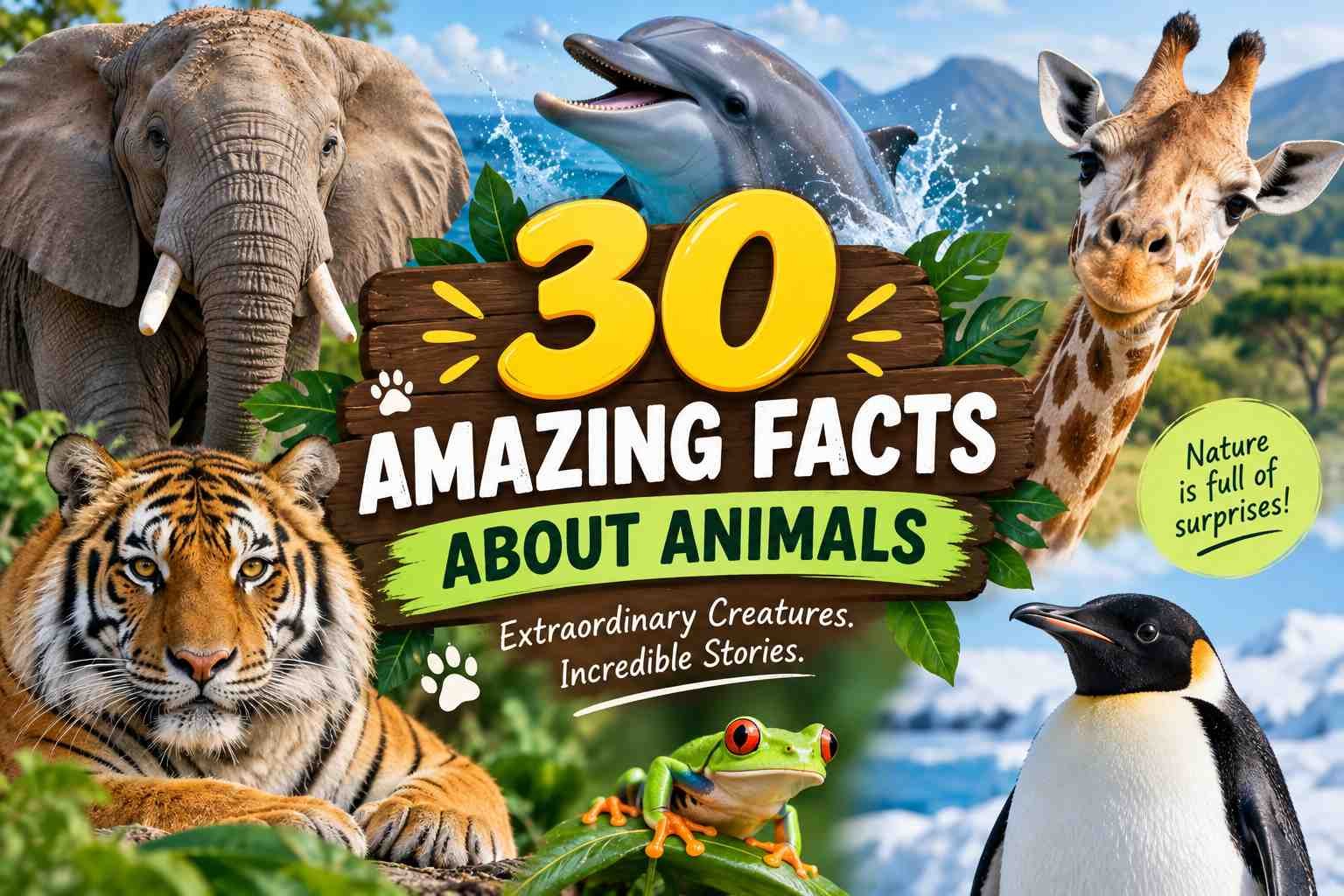
The animal kingdom is full of incredible surprises. From enormous whales swimming through the oceans to tiny insects performing extraordinary feats, animals have developed some truly remarkable abilities to survive, communicate, and thrive in their environments.
Some animals can recognize themselves in mirrors, others can navigate using the Earth’s magnetic field, and a few have physical abilities that seem almost impossible. The more we learn about wildlife, the more fascinating the natural world becomes.
Whether you’re an animal lover, a curious reader, or someone who simply enjoys learning something new, these 30 amazing facts about animals will introduce you to some of nature’s most surprising secrets.
1. Blue Whales Are the Largest Animals Ever Known to Have Lived

The blue whale holds the record as the largest animal known to have ever lived on Earth—even larger than the biggest dinosaurs. These magnificent marine mammals can grow to around 100 feet (30 meters) long and weigh more than 100 tons.
What’s even more surprising is their diet. Despite their enormous size, blue whales primarily feed on tiny, shrimp-like creatures called krill.
2. Elephants Can Recognize Themselves in Mirrors
Elephants are known for their intelligence, emotional behavior, and strong social bonds. In studies, some elephants have shown signs of recognizing their own reflections in mirrors.
Mirror self-recognition is considered one possible indicator of self-awareness. This ability is not common across the animal kingdom, making elephants particularly fascinating creatures to study.
Also Read-25 Fascinating Facts About Sharks
3. Dolphins Have Their Own Signature Whistles
Dolphins communicate using clicks, whistles, and other sounds. One especially interesting behavior is that many dolphins develop a distinctive signature whistle that helps identify them to others.
Researchers believe dolphins can use these whistles much like individual acoustic labels. It’s an intriguing reminder that animal communication can be far more complex than we might expect.
4. Bats Are the Only Mammals Capable of Sustained Flight

Many mammals can glide through the air, but bats are the only mammals capable of true, sustained powered flight.
Their wings are made from a thin membrane of skin stretched across elongated finger bones. This unusual structure gives bats remarkable control while flying, helping them maneuver through forests, caves, and even crowded urban areas.
5. Giraffes Have the Same Number of Neck Bones as Humans
You might assume that an animal with such a long neck would have many more neck bones than a human. Surprisingly, giraffes typically have just seven cervical vertebrae—the same number as humans.
The difference is that each giraffe vertebra is extremely elongated. This allows giraffes to reach high branches without needing dozens of extra bones in their necks.
6. Polar Bears Have Black Skin Beneath Their Fur

Polar bears may look completely white, but their skin is actually black. Their fur is not truly white either; the individual hairs are largely transparent and scatter visible light, giving the bears their familiar pale appearance.
Their dark skin helps absorb sunlight, while their dense fur and thick layer of fat provide insulation in the freezing Arctic environment.
7. Sloths Can Hold Their Breath for a Surprisingly Long Time
Sloths are famous for moving slowly, but they have another unusual ability: they can slow their heart rate and remain underwater for extended periods.
Some sloths can hold their breath for up to around 40 minutes under certain conditions. This helps them cross rivers and other waterways, even though they spend most of their lives in trees.
8. Cheetahs Are the Fastest Land Animals

Cheetahs are built for speed. They can reach roughly 60–70 miles per hour (97–113 km/h) in short bursts, making them the fastest land animals.
Their flexible spine, long legs, and powerful muscles help them accelerate rapidly. However, these impressive speeds cannot be maintained for long, so cheetahs rely on quick chases rather than lengthy pursuits.
9. Koalas Have Fingerprints That Resemble Human Fingerprints
Koalas have distinctive fingerprints with ridge patterns that can look remarkably similar to those of humans.
Even under close examination, their prints can be difficult to distinguish from human fingerprints. This unusual similarity is especially interesting because koalas and humans are separated by a huge evolutionary distance.
10. Cows Can Form Strong Social Bonds
Cows are social animals that can develop preferred companions within their herds. Research suggests that familiar company can influence their stress levels and behavior.
When separated from preferred companions, some cows may show signs of distress. This gives us a glimpse into the complex social lives of animals that people often underestimate.
11. Hummingbirds Can Fly Backward

Hummingbirds are the only birds capable of sustained backward flight. Their unique shoulder joints allow their wings to rotate in a way that helps them move forward, backward, and hover in place.
This incredible control is especially useful when they feed on nectar from flowers. They can hover in front of a flower, move back to adjust their position, and quickly fly away.
12. Flamingos Aren’t Born Pink
Baby flamingos are usually born with grayish or whitish feathers rather than the bright pink coloring adults are known for.
Their pink color develops over time because of pigments called carotenoids found in their diet, including algae and small crustaceans. The amount and type of pigment they consume influence how vivid their feathers become.
13. Ostriches Have the Largest Eyes of Any Land Animal

Ostriches have enormous eyes relative to their body size. Their eyes are roughly two inches (about 5 centimeters) across, helping them spot potential threats from a distance.
As flightless birds living in open environments, ostriches rely heavily on their excellent eyesight to detect danger across the savanna.
14. Some Parrots Can Live for More Than 60 Years
Certain large parrot species, including macaws and cockatoos, can live for several decades. Some individuals may even reach or exceed 60 years, depending on the species and their living conditions.
Their long lifespan is one reason parrots require a serious, long-term commitment as pets. These intelligent birds need social interaction, mental stimulation, and proper care throughout their lives.
15. Penguins Sometimes Use Pebbles During Courtship

Some penguin species, including gentoo penguins, use pebbles to build nests. During courtship, a penguin may offer a pebble to a potential mate.
While this behavior is often described as a penguin “proposal,” the pebble also serves a practical purpose. It can become part of the nest, helping keep eggs above wet or cold ground.
16. Octopuses Have Three Hearts

Octopuses have three hearts, and each has a specific job. Two hearts pump blood through the gills, while the third circulates blood to the rest of the body.
Their blood is also blue because it contains a copper-based protein called hemocyanin, which carries oxygen. These unusual features help octopuses survive in their underwater environments.
17. Seahorses Have a Unique Role Reversal in Pregnancy
Seahorses are famous for their unusual reproductive process. The female transfers her eggs into a specialized pouch on the male’s body, where the eggs are fertilized and develop.
The male then carries the developing young and eventually gives birth to tiny seahorses. It’s one of the most distinctive reproductive strategies found in the animal kingdom.
18. Sharks Are Older Than Dinosaurs

Sharks have an evolutionary history stretching back more than 400 million years. That means shark ancestors existed long before the first dinosaurs appeared.
Their long history doesn’t mean modern sharks have remained unchanged. Different shark species have evolved over time, developing a wide range of body shapes, senses, and feeding strategies.
19. Jellyfish Don’t Have Brains
Jellyfish don’t have a centralized brain like humans or many other animals. Instead, they have a simple nerve net that helps them sense their surroundings and coordinate basic movements.
Despite lacking a brain, jellyfish can swim, respond to light, and detect certain environmental signals. Their simple nervous system is a fascinating example of how life can function in very different ways.
20. Some Fish Can Change Their Sex During Their Lifetime
Certain fish species can change sex during their lives, a process known as sequential hermaphroditism.
For example, clownfish typically live in groups with a dominant breeding female. If she dies, the breeding male can change sex and become the female. Other species, such as some wrasses, can change from female to male.
21. Frogs Can Absorb Water Through Their Skin

Frogs have specialized skin that allows them to absorb water directly from their surroundings. Many species take in much of the water they need through a region on their underside called the pelvic patch.
Their skin also plays a role in breathing, allowing oxygen and carbon dioxide to pass through under suitable conditions. This is one reason frogs are particularly sensitive to changes in their environment.
22. Chameleons Change Color for More Than Camouflage
Chameleons are famous for changing color, but camouflage is only part of the story.
They can also change their coloration in response to temperature, mood, and social interactions. In some species, color changes help communicate aggression, readiness to mate, or other signals to nearby chameleons.
23. Some Turtles Can Live for More Than 100 Years
Certain turtle species are remarkably long-lived. Giant tortoises, for example, can survive for well over a century under suitable conditions.
Their slow growth, gradual development, and relatively low adult mortality contribute to their long lifespans. These animals are living examples of how differently life spans can vary across species.
24. Crocodiles Cannot Stick Out Their Tongues
Crocodiles have tongues, but they cannot freely stick them out like humans can. A membrane holds the tongue to the floor of the mouth, limiting its movement.
This structure helps crocodiles keep water from entering their throats while submerged. It’s a small but fascinating adaptation for a reptile that spends much of its time in aquatic environments.
25. Butterflies Taste With Their Feet

Butterflies have taste receptors on their feet. When they land on a plant, these receptors help them detect chemical compounds on its surface.
This ability is especially useful for female butterflies searching for suitable plants on which to lay their eggs. By tasting the plant, they can help determine whether it will provide food for their future caterpillars.
26. Bees Communicate Through a Waggle Dance
Honeybees have a remarkable way of sharing information about food sources. A worker bee can perform a waggle dance to communicate the direction and approximate distance of a food source to other bees.
The angle and duration of the dance provide clues about where the food can be found. It’s an extraordinary example of communication in a small insect.
27. Ants Can Carry Many Times Their Own Body Weight

Many ants are capable of carrying objects that weigh several times more than their own bodies. Their small size gives them a strength advantage relative to their weight.
Depending on the species and the task, an ant may carry many times its body weight. This impressive ability helps ants transport food and materials back to their colonies.
28. Dragonflies Have Nearly 360-Degree Vision
Dragonflies have enormous compound eyes that cover much of their heads. These eyes contain thousands of tiny visual units, allowing them to detect movement across a wide field of view.
Their vision is especially useful for spotting prey and avoiding predators while flying. Combined with their remarkable aerial control, it makes dragonflies highly effective hunters.
29. Axolotls Can Regenerate Lost Limbs

Axolotls are extraordinary amphibians known for their ability to regenerate lost body parts. They can regrow limbs and repair certain damaged tissues, including parts of the spinal cord and heart.
Scientists study axolotls to better understand tissue repair and regeneration. Their remarkable biology may eventually help researchers learn more about healing in other animals, including humans.
30. Ravens Can Solve Complex Puzzles
Ravens are highly intelligent birds with impressive problem-solving abilities. In scientific studies, they have demonstrated the ability to use tools, remember experiences, and solve multi-step challenges.
Their intelligence helps them adapt to changing environments and find food in creative ways. Ravens are a great example of why animal intelligence should never be judged by appearance alone.
Conclusion
The animal kingdom is filled with extraordinary abilities, surprising behaviors, and fascinating adaptations. From blue whales that dwarf almost every other living creature to tiny ants capable of carrying heavy loads, every animal has something unique to teach us.
These facts also remind us that animals are far more than the creatures we see in zoos, documentaries, or our backyards. They are intelligent, adaptable, and deeply connected to the ecosystems they inhabit.
The more we learn about animals, the more reasons we find to appreciate and protect them. Every new discovery opens another window into the remarkable diversity of life on Earth.