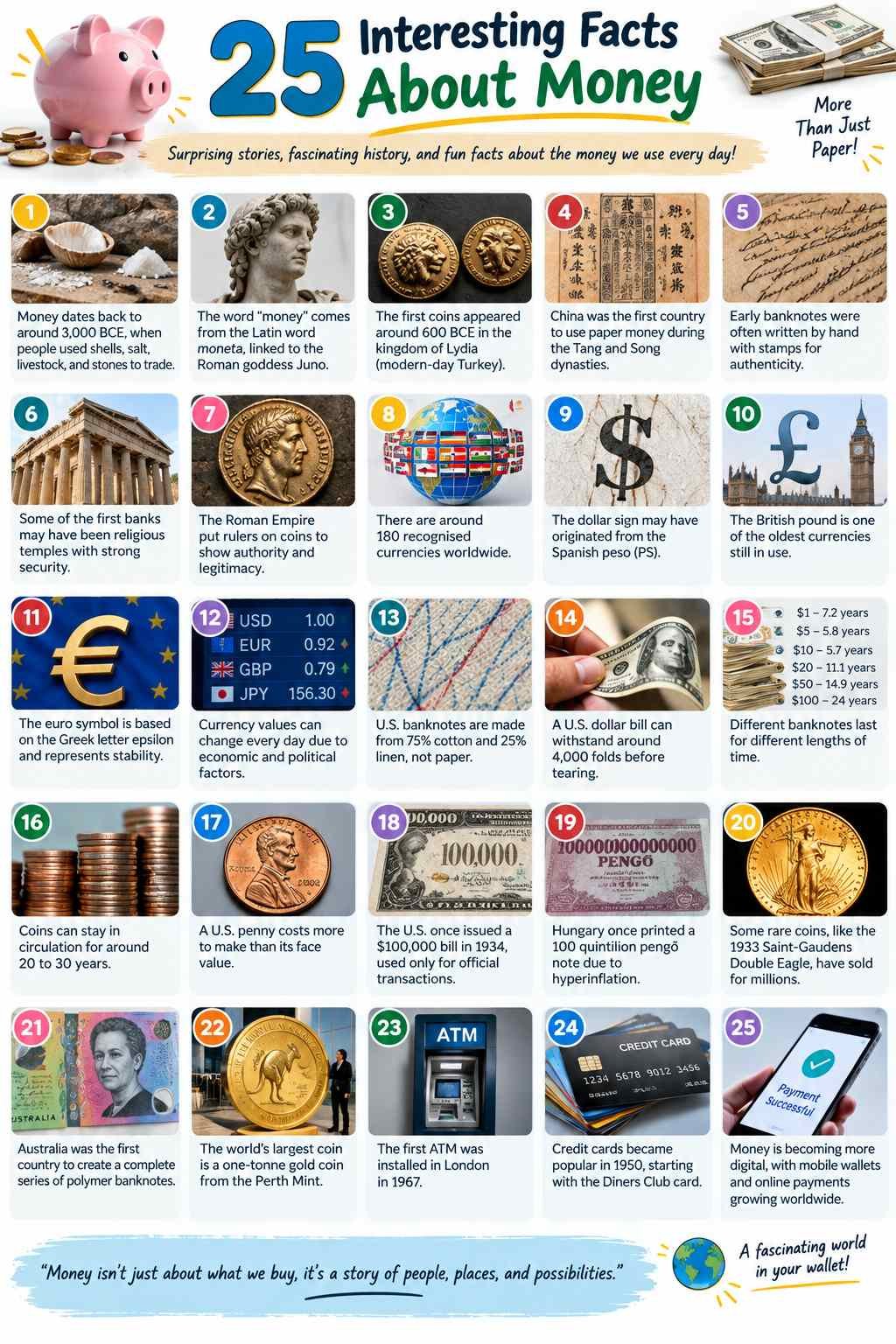
Money is something we use almost every day, whether we’re buying groceries, paying bills, saving for the future, or shopping online. But have you ever wondered where money came from, why banknotes have different designs, or how a simple coin can sometimes be worth millions?
From ancient shells and the first paper money to giant gold coins and unusual banknotes, the story of money is full of fascinating surprises. It has evolved over thousands of years, and some of its most interesting facts might change the way you look at the cash in your wallet.
So, let’s take a journey through history, currency, and the world of finance with these 25 interesting facts about money!
1. Money Dates Back Thousands of Years
Money has a long history, dating back to around 3,000 BCE. Before modern coins and banknotes existed, people used valuable items to trade for the things they needed.
Shells, salt, livestock, and even large stones were used as money in different societies. These items worked because people agreed that they had value and could be exchanged for goods or services.
2. The Word “Money” Has Ancient Roman Roots
Have you ever wondered where the word money comes from? It can be traced through Old French and Latin to the word moneta.
Moneta was a title associated with Juno, a Roman goddess. A temple dedicated to Juno was connected with coin production, helping link her name to money and minting.
Also Read-25 Amazing Facts About the Human Body
3. The First Coins Appeared Around 600 BCE
Coins as we know them today have a history stretching back more than 2,500 years. Some of the earliest known coins were minted in the ancient kingdom of Lydia, located in modern-day Turkey.
These coins were made from electrum, a natural mixture of gold and silver. They provided a standardised way to make payments and helped make trade easier.
4. China Was a Pioneer of Paper Money
Carrying large quantities of metal coins could be inconvenient, especially for merchants travelling long distances. China helped change that by developing early forms of paper money.
During the Tang and Song dynasties, merchants used written payment notes, and paper currency developed further. It was a major step in the evolution of money, making some transactions easier to manage.
5. Early Banknotes Were Written by Hand
Before modern printing technology, early banknotes could be handwritten on sheets of paper. Marks or stamps were sometimes used to help establish that a note was genuine.
It’s quite different from the highly detailed banknotes produced today, which use specialised printing methods and security features to make counterfeiting more difficult.
6. The First Banks May Have Been Temples
Some of the earliest banking activities may have taken place in religious temples. These buildings often had strong security and could store valuable goods, making them suitable places for safekeeping.
Ancient records from Babylon describe financial activities such as loans, deposits, and exchanges. These early practices helped lay the foundations for the banking systems we use today.
7. The Roman Empire Put Rulers on Coins
Coins have not always been just about buying things. In the Roman Empire, rulers were depicted on coins to communicate authority and legitimacy.
Over time, featuring important people on money became a way to honour historical figures, celebrate national identity, and represent a country’s heritage.
8. There Are Around 180 Recognised Currencies Worldwide
Money looks different depending on where you travel. The US dollar, British pound, Japanese yen, Indian rupee, and euro are just a few examples of currencies used around the world.
One of the money articles in our source material cites around 180 recognised currencies. Each has its own value, and exchange rates determine how much one currency is worth compared with another.
9. The US Dollar Sign May Have Come From the Spanish Peso
The familiar dollar sign ($) has an interesting possible origin. One widely cited explanation connects it to the Spanish peso, which was sometimes abbreviated as “PS.”
Over time, the letters may have been written over one another and gradually developed into the symbol we recognise today. The exact origin is debated, but the Spanish peso explanation is one of the best-known theories.
10. The British Pound Is One of the Oldest Currencies Still in Use
The British pound has a history stretching back to Anglo-Saxon England. Around 775 CE, silver pennies were used as currency, and the pound sterling developed over time.
Although the currency has changed considerably, the pound remains in use today, making it one of the oldest currencies still used in the world.
11. The Euro Symbol Has a Meaning Behind Its Design
The euro symbol (€) is more than just a stylish letter. Its design is based on the Greek letter epsilon, which is associated with the beginning of the word “Europe.”
The two horizontal lines in the symbol are intended to represent stability. It’s a small design with a meaning connected to the shared currency used by many European countries.
12. Currency Values Can Change Every Day
The value of money is not fixed when you compare it with other currencies. Exchange rates move in response to factors such as inflation, trade relationships, economic conditions, and political developments.
That’s why the amount of foreign currency you receive for a certain sum can be different from one day to the next. It’s also why travellers often check exchange rates before visiting another country.
13. Some US Banknotes Were Made From Cotton and Linen
Despite being commonly called “paper money,” US dollar bills are not made from ordinary paper. According to the SoFi article in our source material, US banknotes are made from a blend of 75% cotton and 25% linen.
This fabric-like material helps make banknotes durable enough to handle repeated use. Tiny coloured fibres are also incorporated into the material.
14. A US Dollar Bill Can Withstand Thousands of Folds
Banknotes go through a lot during their lifetime. They’re folded, carried in pockets, placed in wallets, and passed from person to person.
The US Bureau of Engraving and Printing is cited as saying that a dollar bill can withstand around 4,000 double folds before tearing. That’s a surprising amount of wear for something so frequently handled!
15. Not All Banknotes Last the Same Amount of Time
Have you noticed that some banknotes seem to disappear from circulation faster than others? The lifespan of a note can depend on its denomination and how frequently it is used.
For example, the SoFi article gives estimated US banknote lifespans ranging from about 5.7 years for a $10 bill to around 24 years for a $100 bill. Notes that are handled more often tend to wear out sooner.
16. Coins Can Stay in Circulation for Decades
Coins are generally more durable than banknotes. They can pass through many hands and remain in circulation for years before becoming too worn to use.
The SoFi article notes that coins can stay in circulation for around 20 to 30 years. When they become too worn, they may be removed from circulation and recycled.
17. A Penny Can Cost More to Make Than Its Face Value
Here’s a curious money fact: sometimes, producing a coin costs more than the amount printed on it.
The SoFi article reported that the cost of producing a US penny had risen above one cent, partly due to material and production expenses. When a coin costs more to manufacture than it is worth, it can raise questions about whether continuing production makes economic sense.
18. The US Government Once Issued a $100,000 Bill
Imagine holding a banknote worth $100,000! The US government printed such a bill in 1934, featuring President Woodrow Wilson.
However, it wasn’t intended for everyday shopping or public circulation. It was used for official transactions between Federal Reserve Banks, making it very different from the cash people carry in their wallets.
19. Hungary Once Printed an Almost Unbelievably Large Denomination
In 1946, Hungary experienced extreme hyperinflation, meaning prices rose dramatically as the currency lost value.
During this period, Hungary issued a banknote with a denomination of 100 quintillion pengő—a 1 followed by 20 zeros. The note is a striking example of how severe inflation can make ordinary currency denominations seem almost meaningless.
20. Some Rare Coins Sell for Millions of Dollars
Most coins are worth the amount printed on them, but rare and historically important coins can be worth much more to collectors.
One famous example is the 1933 Saint-Gaudens Double Eagle coin. The Safescan article reports that one sold at auction in 2021 for approximately $18.9 million. Its rarity and history helped make it an extraordinary collector’s item.
21. Australia Created a Complete Polymer Banknote Series
Australia made history by becoming the first country to introduce a complete series of polymer banknotes.
Unlike traditional paper-based notes, polymer banknotes are made from a type of plastic. They are designed to be durable and include security features that help make counterfeiting more difficult.
22. The World’s Largest Coins Can Be Truly Massive
When we think of coins, we usually picture something small enough to fit in our pocket. But some coins are enormous!
The Perth Mint in Australia created a one-tonne gold coin measuring about 80 centimetres in diameter. Made almost entirely of gold, it is a remarkable example of how coins can also be produced as impressive display pieces.
23. The First ATM Was Installed in London
Automated Teller Machines, or ATMs, changed the way people access cash. The first widely recognised ATM was installed at a Barclays Bank branch in Enfield, London, in 1967.
The machine was credited to inventor John Shepherd-Barron. It was an important step towards making cash withdrawals possible without having to visit a bank teller during normal banking hours.
24. Credit Cards Helped Transform Everyday Payments
Credit cards have made it possible to pay for purchases without carrying cash. Early cards were often limited to particular companies or businesses.
In 1950, Diners Club introduced a card that could be used at a variety of establishments. This helped pave the way for the modern credit card system, which has since become a familiar part of everyday shopping.
25. Money Is Becoming More Digital Every Year
Money is no longer limited to coins and banknotes. Today, people can make payments using mobile wallets, online banking, cards, and digital payment services.
The SoFi article highlights the growing use of digital wallets around the world. As technology continues to evolve, the way people store, send, and spend money is changing too. Cash still matters, but digital payments have become an important part of modern life.
Conclusion
Money has come a long way from shells, salt, and ancient coins to banknotes, credit cards, and digital wallets. Its history is full of unusual inventions, surprising records, and fascinating stories that show just how much money has shaped human society.
The next time you take a coin from your pocket or tap your phone to pay for something, remember that you’re using part of a system that has been evolving for thousands of years.
Which of these interesting facts about money surprised you the most? Whether it’s the enormous Hungarian banknote, the history of the dollar sign, or the first ATM, there’s always something new to discover about the money we use every day.