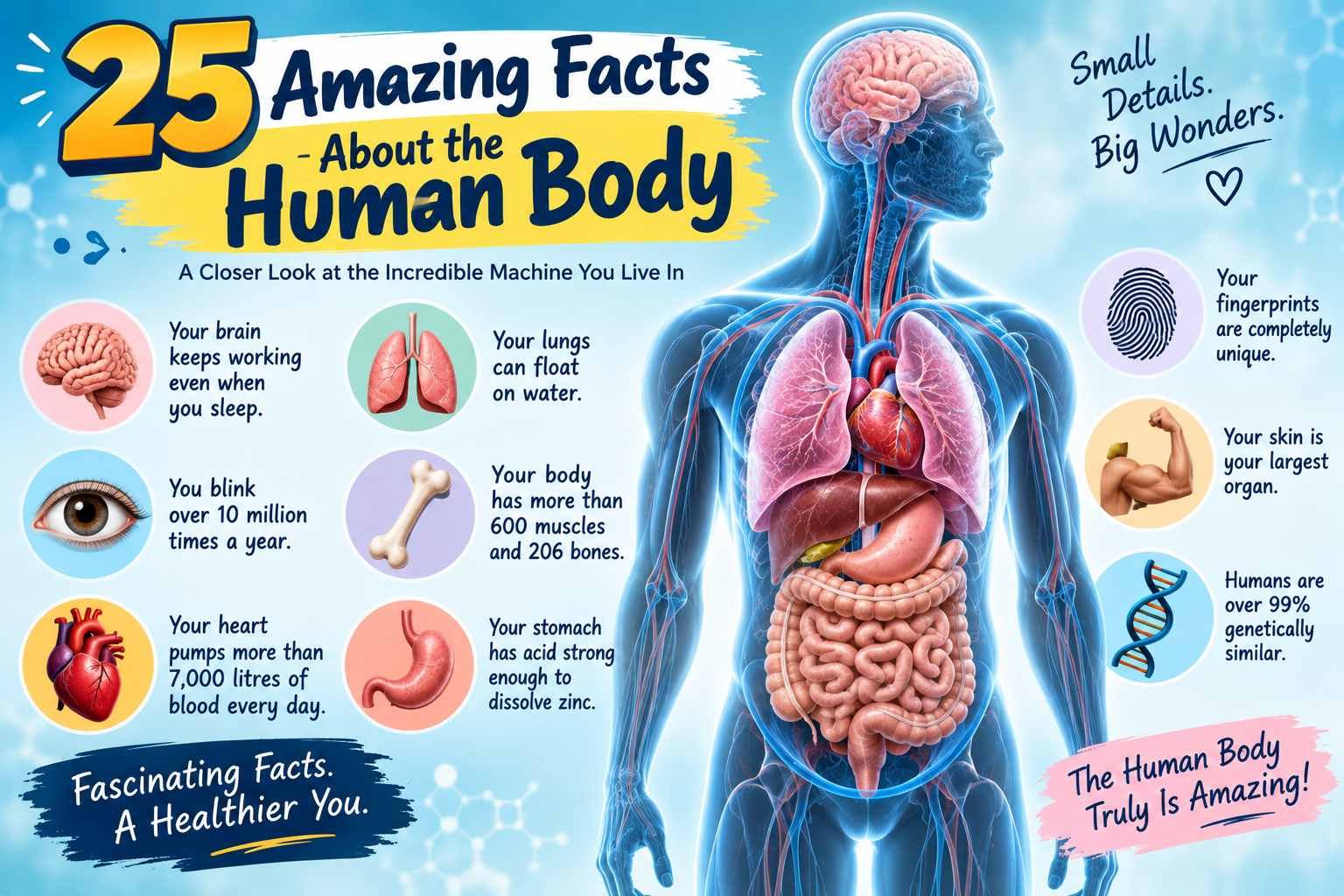
The human body is an incredible piece of living machinery. Every second, countless processes are happening inside you without you even noticing—from your heart moving blood around your body to your lungs exchanging gases and your brain processing an endless stream of information.
The more you learn about the body, the more surprising it becomes. Some facts are fascinating, some are downright strange, and a few might even make you look at your own body differently. Here are 25 amazing facts about the human body that are worth knowing.
1. Your lungs can float on water
Your lungs are filled with millions of tiny air sacs called alveoli. Because of the air-filled spaces inside them, the lungs are buoyant and can float on water. They are unusual among human organs in this respect.
2. Your nose works like a natural air conditioner
Your nose does much more than help you smell. Structures called turbinates help warm incoming air, while specialized cells help add moisture. Your nasal passages also filter particles before the air reaches your lungs.
Also Read-25 Strange Facts That Sound Completely Impossible
3. Sneezing and coughing are your body’s defense mechanisms
A sneeze or cough can be annoying, but your body has a good reason for doing it. These reflexes help remove foreign substances and irritants from your airways. In other words, your body has its own built-in cleaning system.
4. Your lungs aren’t completely germ-free
Even healthy lungs aren’t sterile environments. Microorganisms can be present in the respiratory system, despite the body’s many defenses against harmful microbes.
5. Your food doesn’t simply “fall” into your stomach
When you swallow, your esophagus uses rhythmic muscular contractions to push food toward your stomach. This process is called peristalsis, and importantly, it happens involuntarily.
6. Your digestive system and brain communicate with each other
Your digestive system and brain are connected through what scientists call the gut-brain axis. Because of this connection, stress and changes in brain function can influence digestion and other gastrointestinal processes.
7. Your brain keeps working while you sleep
Going to sleep doesn’t mean your brain simply switches off. Your brain remains active during sleep, carrying out important processes while you rest.
8. Your brain uses a surprisingly large amount of energy
Although the brain represents only a small portion of your body’s total mass, it requires a substantial amount of energy to keep functioning. The sample source notes that the brain accounts for roughly 20 percent of the body’s energy use.
9. The sciatic nerve is the longest nerve in your body
The sciatic nerve runs from the lower part of the spinal cord down through the leg. Because it travels such a long distance, it is considered the body’s longest nerve.
10. Your bones aren’t solid all the way through
Bones may look like hard, solid structures, but they contain a softer, spongy interior called bone marrow. This tissue has important roles in the body, including the production of blood cells.
11. The tiniest bones in your body are inside your ears
Three tiny bones called the malleus, incus, and stapes are located in the middle ear. Together, they’re known as the ossicles, a word derived from Latin meaning “tiny bones.”
12. Your femur is an incredibly strong bone
The femur, or thighbone, is the longest and strongest bone in the human body. It has to withstand considerable forces as you walk, run, jump, and simply stand.
13. Broken bones can repair themselves
Your bones have an amazing ability to heal. After a fracture, the body begins producing new cells and rebuilding the damaged area. That’s one reason doctors may use a cast or other support while the bone heals.
14. Your knee is the body’s largest joint
The knee is a remarkably complex joint. It connects the thighbone, shinbone, and kneecap and helps support your body while allowing your leg to bend and straighten. The sample source identifies it as the body’s largest joint.
15. Your reproductive system contains the largest and smallest human cells
One of the strangest facts about human biology is that the reproductive system contains the largest human cell—the egg—and the smallest—the sperm. Their dramatic difference in size reflects their very different biological roles.
16. Some people are born with two uteruses
A rare congenital condition called uterus didelphys occurs when a person develops two uteruses. It results from an unusual development of the reproductive system before birth.
17. Your body contains more than 600 muscles
From the muscles that help you walk to the tiny muscles involved in hearing, your body contains more than 600 muscles. Together, they allow you to move, maintain posture, breathe, and perform countless everyday actions.
18. Your gluteus maximus is the largest muscle
The gluteus maximus is the largest muscle in the human body. It plays an important role in extending the hip, helping with movements such as climbing stairs, standing up, and running.
19. One of your smallest muscles is hidden inside your ear
Deep inside your ear is a tiny muscle called the stapedius. The source describes it as the body’s smallest muscle, connecting structures involved in the ear’s sound-processing system.
20. Your heart works incredibly hard
Your heart is working continuously, day and night. The sample source estimates that it typically pumps more than 7,000 litres of blood every day. Think about that the next time you feel your heartbeat—it is doing its job without taking a vacation.
21. Your skin is your largest organ
Your skin isn’t simply an outer covering. It is the body’s largest organ and plays an important role in protecting the tissues underneath. One source estimates that skin can account for around 15 percent of a person’s total body weight.
22. Your body constantly sheds skin cells
Your skin is continually renewing itself. One of the sample sources notes that humans shed more than 30,000 dead skin cells every minute, which are replaced by newer cells.
23. Your fingerprints are remarkably unique
Your fingerprints are formed by patterns of ridges on your fingertips, and each person’s pattern is highly distinctive. Scientists have proposed several possible functions for these ridges, including helping with grip and touch.
24. Your body is more than 99 percent genetically similar to other humans
Despite the enormous differences we see in people’s appearance, human beings are genetically extremely similar. The sample source describes humans as more than 99 percent identical at the genetic level. The small differences that do exist contribute to our individual characteristics.
25. You are slightly taller in the morning
Have you ever noticed that you seem a little taller after waking up? During the day, gravity compresses the soft tissues between the vertebrae. After several hours lying down, some of that compression is relieved, so people can be around 1 centimetre taller in the morning than later in the day.
Conclusion
The human body may seem familiar because we live in it every day, but it is anything but ordinary. From microscopic cells and tiny ear bones to the brain, lungs, muscles, and constantly beating heart, almost every part has a fascinating story behind it.
And perhaps the most amazing thing is that scientists are still learning about the human body. Anatomy and physiology have been studied for thousands of years, yet new discoveries continue to reveal just how complicated and remarkable we really are.
The next time you take a breath, blink your eyes, walk across a room, or simply feel your heartbeat, remember—you are carrying around one of nature’s most extraordinary creations.
1 thought on “25 Amazing Facts About the Human Body”