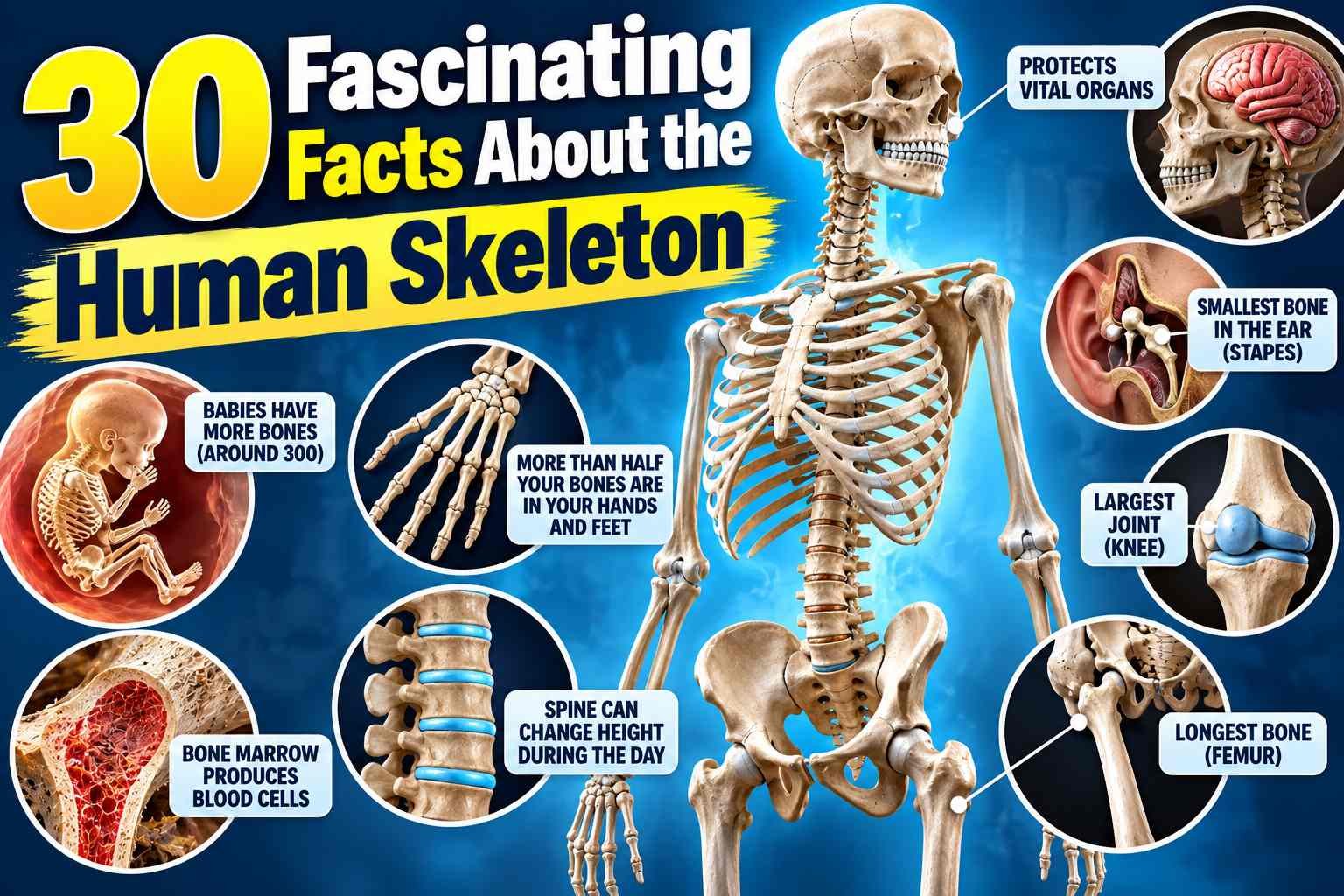
When you think about the human skeleton, you probably picture the familiar 206 bones that give your body its shape. But there is much more going on beneath your skin. Your skeleton is a living, constantly changing system that supports movement, protects delicate organs, stores minerals, produces blood cells, and even plays a role in how your body responds to stress.
From the tiny bones hidden inside your ears to the surprisingly flexible structure of your spine, the human skeleton is full of fascinating details. Some facts are so unexpected that you may never look at your bones the same way again.
So, let’s take a closer look at 30 fascinating facts about the human skeleton.
1. The Adult Human Skeleton Usually Has 206 Bones
The adult human skeleton is commonly described as having 206 bones. These bones work together to provide structure, protect internal organs, and allow the body to move.
However, 206 is an anatomical standard rather than an absolute number for every person. Natural variations can occur, including extra bones or differences caused by bones joining together.
2. Babies Have More Bones Than Adults
Here is one of the most surprising skeleton facts: babies are born with around 300 bones, considerably more than most adults.
As a child grows, some of these separate bones gradually fuse together. By adulthood, the skeleton usually settles at around 206 bones. In other words, bones do not simply disappear—they become joined to form larger structures.
Read Also-25 Amazing Facts About the Human Body
3. Your Skeleton Is More Than Just Bones
The skeletal system is not made up of bones alone. It also includes cartilage and ligaments.
Ligaments are strong bands of connective tissue that help stabilize joints, while cartilage provides flexible support and cushions areas where bones meet. Cartilage can also be found in places such as the nose, larynx, and between vertebrae.
4. Bones Are Living Tissue
Bones may look like hard, lifeless structures, but they are actually living tissue.
Your bones constantly undergo a process called remodeling, in which old bone is removed and new bone is formed. This helps the skeleton adapt to everyday activity and maintain itself over time.
5. More Than Half of Your Bones Are in Your Hands and Feet
Your hands and feet contain a surprisingly large portion of your skeleton.
Each hand has 27 bones, giving you 54 bones in both hands. Each foot has 26 bones, adding another 52. Together, your hands and feet contain 106 bones—more than half of the standard adult total.
6. The Smallest Bone in Your Body Is in Your Ear
The stapes, also known as the stirrup, is the smallest bone in the human body.
It is located in the middle ear and works with two other tiny bones—the malleus and incus—to transmit sound vibrations toward the inner ear. Despite its tiny size, it plays an important role in hearing.
7. Your Femur Is the Longest Bone
The femur, or thigh bone, extends from the hip to the knee and is the longest bone in the human body.
It is also remarkably strong because it must support and transfer forces during activities such as standing, walking, running, and jumping.
8. One Bone in Your Body Doesn’t Connect to Another Bone
Most bones in your skeleton connect directly or indirectly with other bones. The hyoid bone is a fascinating exception.
This U-shaped bone sits near the base of the tongue and is supported by muscles and ligaments rather than being joined to another bone. It helps with important functions such as swallowing and speech.
9. Your Skeleton Protects Vital Organs
Your bones act like a natural protective shield.
The skull surrounds and protects the brain, while the rib cage helps protect the heart and lungs. Meanwhile, the vertebral column provides protection and support for the spinal cord.
10. Your Skeleton Helps You Move
Bones cannot move by themselves. Movement happens through teamwork between your bones, muscles, and nervous system.
When nerves send signals to skeletal muscles, the muscles contract. Those contractions pull on bones and create movement at joints.
11. The Skeleton Has Two Major Divisions
Anatomists divide the human skeleton into two major sections: the axial skeleton and the appendicular skeleton.
The axial skeleton includes structures such as the skull, vertebral column, and thoracic cage. The appendicular skeleton includes the limbs and the girdles that connect them to the body.
12. Bones Come in Five Main Shapes
Bones are classified according to their shape and function. The five commonly recognized types are long, short, flat, irregular, and sesamoid bones.
For example, the femur is a long bone, the frontal bone of the skull is a flat bone, and the patella is a sesamoid bone. The small bones of the hands and feet include short bones.
13. Long Bones Have an Interesting Internal Structure
A long bone is not simply a solid piece of hard material.
Its outer portion contains compact bone, while spongy bone is found inside. Long bones also contain a medullary cavity, which contains bone marrow. This arrangement gives bones strength while keeping their structure relatively efficient.
14. Bone Marrow Helps Make Blood Cells
Some bones contain red bone marrow, a soft tissue where blood cells are produced.
In adults, active red marrow is found in areas including the vertebrae, ribs, sternum, pelvis, skull, and parts of certain long bones.
15. Bone Marrow Is Not Just Empty Space
Bone marrow contains more than blood-producing cells. Marrow can contain fat cells, blood cells, and immune cells.
Research discussed in one of the supplied sources also highlights that fat within bone marrow has metabolic and endocrine functions, showing that the inside of a bone can be biologically active in ways that were not always appreciated.
16. Most People Have 12 Pairs of Ribs
The typical human rib cage has 12 pairs of ribs.
However, anatomical variations do occur. A small percentage of people are born with an additional cervical rib, which develops near the neck region.
17. Your Spine Changes Your Height During the Day
Have you ever noticed that you seem slightly taller in the morning than at night?
One reason is the cartilage and other tissues around the joints of the spine. During the day, gravity compresses these structures. After lying down and resting, they can regain some of their previous height.
18. Astronauts Can Become Taller in Space
The effect of gravity on the spine becomes especially interesting in space.
Without Earth’s normal gravitational pull, astronauts can become temporarily up to about 3% taller because the structures between the vertebrae are less compressed.
It is a fascinating example of how strongly gravity influences the human body.
19. Your Bones Are Constantly Being Remodeled
Even after your bones stop growing in length, they are not permanently finished.
Bone tissue is continually broken down and rebuilt through remodeling. Everyday activity, mechanical forces, and the body’s changing needs all contribute to this ongoing process.
20. Broken Bones Can Repair Themselves
Your skeleton has an impressive natural repair system.
After a fracture, the body begins producing new tissue and working to repair the damaged area. Medical treatments such as casts or braces can help keep the broken bone properly aligned while healing takes place.
21. Bones Store a Large Amount of Calcium
Bones are not only structural supports—they also serve as an important mineral storehouse.
A large proportion of the body’s calcium is stored in bones. When calcium is needed for important processes such as muscle contraction and nerve signaling, the body can draw on these mineral reserves.
22. Your Teeth Are Part of the Skeletal System—but They Aren’t Bones
Teeth are commonly discussed alongside bones because they are part of the body’s skeletal structures, but technically, teeth are not bones.
Their outer enamel is exceptionally hard and protects the sensitive tissues inside each tooth. In fact, enamel is harder than ordinary bone.
23. The “Funny Bone” Isn’t Actually a Bone
The funny bone is one of those everyday names that can be misleading.
When you hit the inside of your elbow and experience that strange tingling sensation, you are actually irritating the ulnar nerve, not hitting a special bone called the funny bone.
That explains why the sensation can travel down your arm and into your hand.
24. Your Knee Is a Major Joint Where Several Bones Meet
The knee is a complex joint involving the femur, tibia, and patella.
These large bones work together to support the body and allow the leg to bend and straighten. The knee also has to handle considerable forces during ordinary activities such as walking and climbing stairs.
25. Not Every Joint Moves Freely
Joints differ greatly in how much movement they allow.
The sutures of the skull are essentially immovable, while some joints permit only slight movement. Others, such as the shoulder, hip, wrist, and ankle, allow a broad range of motion.
26. Your Skeleton Can Be Divided into Compact and Spongy Bone
Bone is not uniform from the outside to the inside.
Compact bone is dense and provides much of the skeleton’s strength. Trabecular, or spongy, bone has a lighter, more porous structure and is found inside many bones as well as in areas such as the pelvis, ribs, and skull.
27. Your Bones Have to Handle Millions of Steps
Think about how many times your feet hit the ground every day. Over a year, the number of steps can reach into the millions.
This repeated loading is one reason the skeleton must be strong and resilient. Bones are designed to withstand the forces generated by everyday movement and physical activity.
28. Bones May Play a Role in the Stress Response
The skeleton does more than provide physical support.
Research described in the supplied sources has linked osteocalcin, a hormone produced by bone-forming cells, with the body’s response to acute stress. Studies have found changes in osteocalcin during stressful situations, suggesting that bones can communicate with other body systems.
29. Your Skeleton Changes as You Grow
Bone development begins before birth and continues after you are born.
Some bones that are separate early in life gradually fuse together. The sacrum, for example, begins as several vertebrae and eventually becomes a single fused structure in adulthood.
30. Your Skeleton Is Built for a Lifetime of Movement
Perhaps the most fascinating fact of all is how many jobs your skeleton performs at the same time.
It gives your body shape, protects important organs, works with muscles to produce movement, stores minerals, houses marrow, and continually adapts to the demands placed upon it. Your bones may seem still and simple from the outside, but inside, they are part of a remarkably active living system.
Conclusion
The human skeleton is far more than a collection of hard bones holding us upright. From the 206 bones in the adult skeleton to the tiny stapes inside the ear, every part has a purpose. Bones protect our organs, support movement, store minerals, produce blood cells, and continuously remodel throughout life.
What makes the skeleton especially fascinating is that it is never truly static. It changes as we grow, adapts to physical demands, repairs itself after injury, and even communicates with other parts of the body.
So, the next time you think about your bones, remember that beneath the surface is a living system working quietly every second to keep you moving.
Frequently Asked Questions
How many bones does an adult human have?
An adult human skeleton typically has 206 bones.
Do babies have more bones than adults?
Yes. Babies are born with around 300 bones, and many of these gradually fuse as they grow.
What is the smallest bone in the human body?
The stapes, located in the middle ear, is the smallest bone.
What is the longest bone in the human body?
The femur, or thigh bone, is the longest bone.
Which bone is not connected to another bone?
The hyoid bone is the notable exception. It is supported by muscles and ligaments rather than being directly connected to another bone.