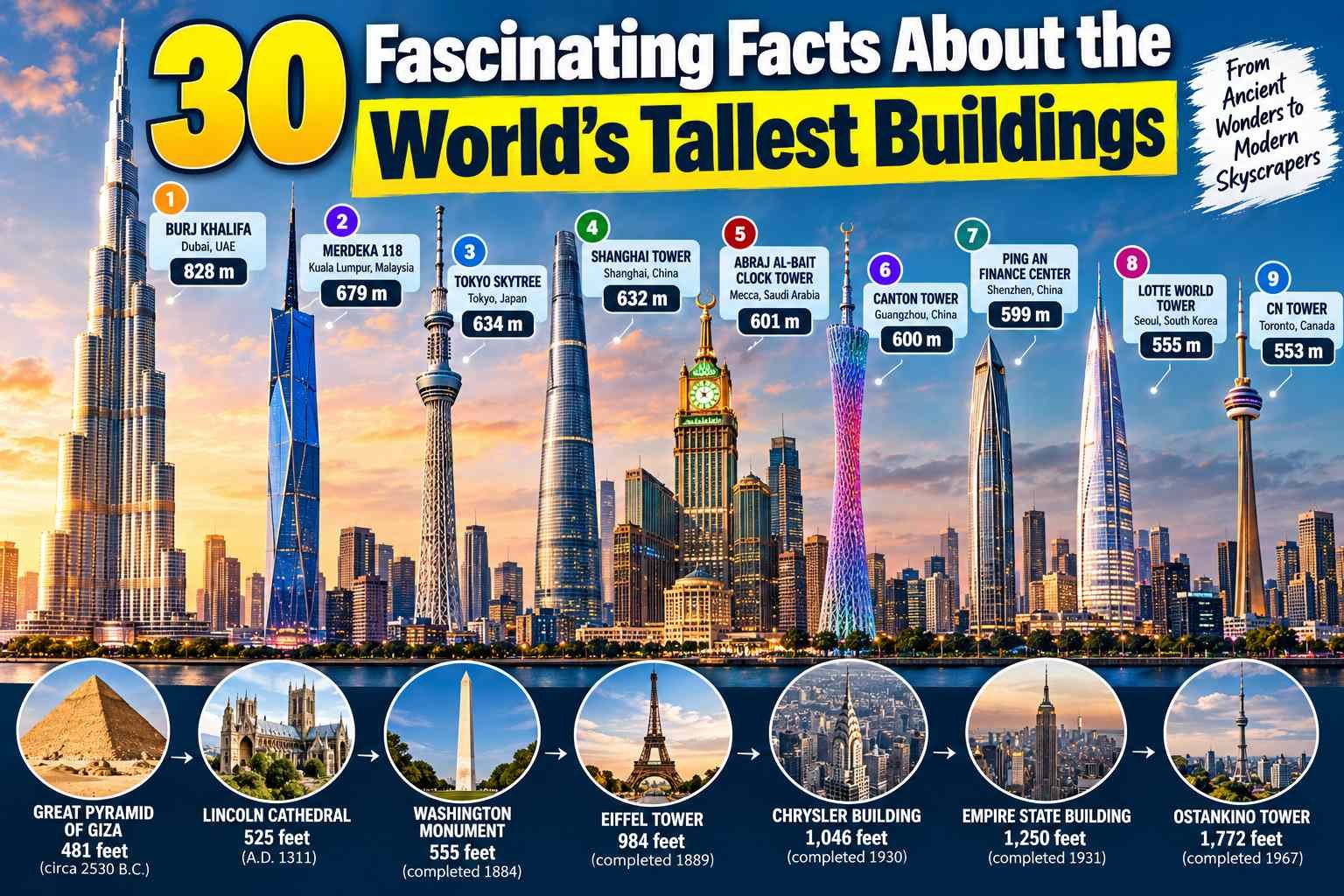
There is something almost irresistible about looking up at a skyscraper and wondering, “How did people build something this tall?” For centuries, humans have been trying to reach higher—first with pyramids and religious monuments, and later with steel-framed skyscrapers that seem to disappear into the clouds.
Today, the world’s tallest buildings are much more than impressive landmarks. They are engineering experiments, commercial centers, tourist attractions, and symbols of what modern technology can achieve. Their height comes with enormous challenges, from controlling wind movement to transporting people hundreds of meters above the ground.
The race for height is also nothing new. The Great Pyramid of Giza held the title of tallest man-made structure for thousands of years before cathedrals, monuments, towers, and eventually skyscrapers began taking the record.
So, let’s look at 30 fascinating facts about the world’s tallest buildings and discover some of the incredible stories hidden behind these giants.
1. The Burj Khalifa Is 828 Meters Tall
The Burj Khalifa in Dubai currently stands at 828 meters (2,717 feet) and remains the world’s tallest skyscraper according to the supplied 2025 architectural source.
The building has 163 usable floors and contains offices, luxury apartments, a hotel, restaurants, fitness and wellness facilities, and other spaces. Its enormous height required engineers to develop innovative construction and structural techniques.
2. The Burj Khalifa Was Built in About Six Years
Creating a skyscraper nearly a kilometer high is obviously not a quick project. The supplied source states that construction of the Burj Khalifa took around six years.
Approximately 330,000 cubic meters of concrete were used, along with huge quantities of steel, glass, and other materials. The scale of the construction is difficult to imagine until you consider the amount of material involved.
3. The Burj Khalifa Has a Y-Shaped Core
One of the interesting engineering features of the Burj Khalifa is its Y-shaped buttressed core.
Its structural arrangement, together with the tower’s spiraling wings, helps counter the effects of strong winds at great heights. Building extremely tall is not simply about adding more floors—the structure has to remain stable as wind forces become increasingly important.
4. High-Strength Concrete Had to Be Pumped to Extraordinary Heights
The Burj Khalifa required more than ordinary construction techniques.
Engineers developed a pressurized pumping system capable of delivering high-strength concrete to around 2,000 feet. At such heights, getting construction materials to exactly where they are needed becomes a major engineering challenge in itself.
5. Shanghai Tower Reaches 632 Meters
China’s Shanghai Tower rises approximately 632 meters above Shanghai.
Located in the Pudong financial district, the tower has 128 floors above ground and five underground floors. Its distinctive twisted form is not simply for appearance—the shape helps reduce wind loads on the building.
6. Shanghai Tower Has 106 Elevators
Imagine having to climb more than a hundred floors every day!
Shanghai Tower contains 106 elevators, including some of the fastest elevators in the world. They connect offices, conference areas, retail and service spaces, and observation areas throughout the building.
7. Merdeka 118 Is About 679 Meters Tall
Malaysia’s Merdeka 118 reaches approximately 679 meters, making it one of the world’s tallest skyscrapers.
The building has 118 usable floors and includes offices, a hotel, a public viewing platform, and cultural institutions. Its name, “Merdeka,” means independence, giving the building a symbolic connection to Malaysia’s history.
8. Tokyo Skytree Is 634 Meters High
Not every extremely tall structure is a traditional skyscraper.
Tokyo Skytree reaches 634 meters and functions primarily as a television and radio broadcasting tower. It also attracts visitors with its two glass observation decks, offering spectacular views across Tokyo.
9. The Canton Tower Has a Distinctive Twisted Shape
The Canton Tower in Guangzhou rises approximately 600 meters and is famous for its elegant, twisting appearance.
Its structure is based on two ellipses that twist against each other, creating its distinctive silhouette. Inside, visitors can find observation and leisure facilities, restaurants, gardens, exhibition areas, and other attractions.
10. Ping An Finance Center Is Almost 600 Meters Tall
The Ping An Finance Center in Shenzhen reaches approximately 599 meters.
Its slender form and mirrored glass facade make it one of the city’s most recognizable landmarks. The building contains offices, conference facilities, retail areas, and a viewing platform near the top.
11. Abraj Al-Bait Has One of the World’s Largest Clocks
Standing around 601 meters tall in Mecca, the Abraj Al-Bait Clock Tower is part of a huge complex located next to the Holy Mosque.
One of its most striking features is its enormous clock. The tower has four 43-meter clock faces, illuminated by around two million LEDs.
12. The Clock Tower’s Mosaic Uses Millions of Pieces
The scale of Abraj Al-Bait’s decoration is almost as impressive as its height.
The supplied source describes a glass mosaic containing more than 90 million individual pieces, incorporating the coat of arms of Saudi Arabia. It is an extraordinary example of how decorative details can become enormous at skyscraper scale.
13. Lotte World Tower Is 555 Meters Tall
Seoul’s Lotte World Tower reaches approximately 555 meters.
The slender, conical skyscraper was opened in 2016 after about six years of construction. It combines luxury apartments, offices, shopping, a hotel, and a public observation area.
14. The CN Tower Once Held the Tallest-Tower Record
Toronto’s famous CN Tower stands approximately 553 meters high.
Completed in 1976, it became an important telecommunications facility and tourist attraction. It was once the world’s tallest freestanding tower and remains one of Canada’s most recognizable landmarks.
15. The Great Pyramid Was Once the Tallest Structure on Earth
The history of tall buildings goes back much further than skyscrapers.
The Great Pyramid of Giza reached approximately 481 feet when completed around 2530 B.C. It remained the tallest man-made structure for more than 3,800 years.
Think about that for a moment: one building held the height record for thousands of years before another structure finally surpassed it.
16. The Great Pyramid Was Built by Stacking Millions of Stones
The Great Pyramid did not rely on modern steel frames or concrete pumps.
Its enormous height was achieved through the painstaking process of stacking millions of stones. Some of the stones weighed around two tons, making the construction achievement even more remarkable given the technology available at the time.
17. Lincoln Cathedral Once Surpassed the Great Pyramid
For thousands of years, the Great Pyramid dominated the record books. Then came Lincoln Cathedral in England.
Its central spire, completed in 1311, brought the structure to approximately 525 feet, surpassing the Great Pyramid’s original height.
18. The Eiffel Tower Was Originally Meant to Be Temporary
The Eiffel Tower was completed in 1889 for the Exposition Universelle in Paris.
Its original design was a 300-meter open-lattice wrought-iron tower. Interestingly, it was intended to be dismantled after about 20 years. Instead, its usefulness for scientific observation and telecommunications helped secure its future.
19. The Eiffel Tower Uses Around 18,000 Metal Parts
The Eiffel Tower’s famous appearance comes from its intricate iron framework.
The supplied historical source states that it consists of approximately 18,000 metallic parts and is supported by four curved piers designed to help with wind resistance.
For a structure built in the 19th century, its combination of appearance and engineering remains remarkable.
20. The Chrysler Building Won a Skyscraper Race
The construction of New York’s Chrysler Building was partly connected to a competition for the title of world’s tallest building.
Architect William Van Alen secretly added a 185-foot stainless-steel spire, pushing the building’s total height to approximately 1,046 feet and allowing it to claim the record in 1930.
21. The Empire State Building Quickly Took the Record
The Chrysler Building did not hold the title for long.
Construction of the Empire State Building began on March 17, 1930, and the building opened on May 1, 1931. It reached 1,250 feet and 103 stories at opening, quickly taking the height record from its New York rival.
22. The Empire State Building Used Millions of Bricks
The Empire State Building’s construction was an enormous logistical operation.
Workers raised approximately 200,000 cubic feet of Indiana limestone and granite, along with 10 million bricks and hundreds of tons of aluminum and stainless steel.
The organization of labor and materials was itself a major achievement.
23. The Ostankino Tower Reached 1,772 Feet
Moscow’s Ostankino TV Tower reached approximately 1,772 feet and became the world’s tallest freestanding structure when completed in 1967.
The tower was designed for broadcasting and continues to provide television and radio services. It also includes observation decks and a restaurant.
24. The Ostankino Tower Uses 149 Steel Cables
The Ostankino Tower has an unusual structural system.
According to the supplied historical source, 149 steel cables run through its concrete trunk and provide additional stability. Its shape has also been compared to an upside-down flower.
25. Tall Buildings Are Not Just About Height
A skyscraper may look like a simple vertical object from a distance, but its shape can be carefully designed to deal with wind, gravity, usable floor space, and transportation.
For example, the tapering form proposed for the Jeddah Tower was designed to improve aerodynamics and help manage the building’s core and usable space.
26. The Jeddah Tower Was Planned to Pass 1,000 Meters
The Jeddah Tower, formerly known as Kingdom Tower, has been planned as a structure exceeding 1,000 meters in height.
That would put it beyond the one-kilometer mark and dramatically above the Burj Khalifa. The supplied architectural source describes the project as a future benchmark among the world’s tallest buildings, with completion plans extending into the late 2020s.
27. Jeddah Tower Was Designed by the Same Architect Behind Burj Khalifa
Jeddah Tower’s design is associated with architect Adrian Smith, who also designed the Burj Khalifa.
The supplied source notes that the tower’s design uses a distinctive three-sided, tapering form intended to deal with wind and gravity while creating a dramatic architectural profile.
28. Jeddah Tower’s Foundation Piles Are Enormous
A building designed to rise beyond one kilometer needs an extraordinary foundation.
The supplied Jeddah Tower material describes foundation piles approximately 10 feet in diameter and reaching as much as 360 feet in length. That’s comparable to the dimensions of a small room in width and the height of a very tall building in length.
29. Jeddah Tower Was Planned With 59 Elevators
At extreme heights, elevators become one of the biggest practical challenges.
The Jeddah Tower plans described in the supplied source included 59 elevators and 12 escalators, with five elevators designed as double-decker systems. Three sky lobbies were planned so that elevators would not have to travel continuously from ground level to the very top.
30. The Race to Build Taller Buildings Is Still Going
Perhaps the most fascinating fact is that the story of tall buildings is not finished.
The supplied architectural source points out that densely populated cities, limited land, technology, creativity, and the desire to create new architectural landmarks continue to push construction upward. From the Great Pyramid to the Burj Khalifa and proposed kilometer-high towers, each generation has found new ways to reach higher.
Conclusion
The world’s tallest buildings are much more than impressive numbers on a height chart. They represent centuries of human ambition, changing technology, and the desire to solve problems that once seemed impossible.
The journey from the Great Pyramid of Giza to the Eiffel Tower, Empire State Building, CN Tower, Burj Khalifa, and today’s megatall projects shows just how dramatically construction has evolved. Some buildings reached new heights through stone, others through steel and concrete, while today’s skyscrapers depend on sophisticated structural engineering, high-speed elevators, advanced materials, and computer-controlled design.