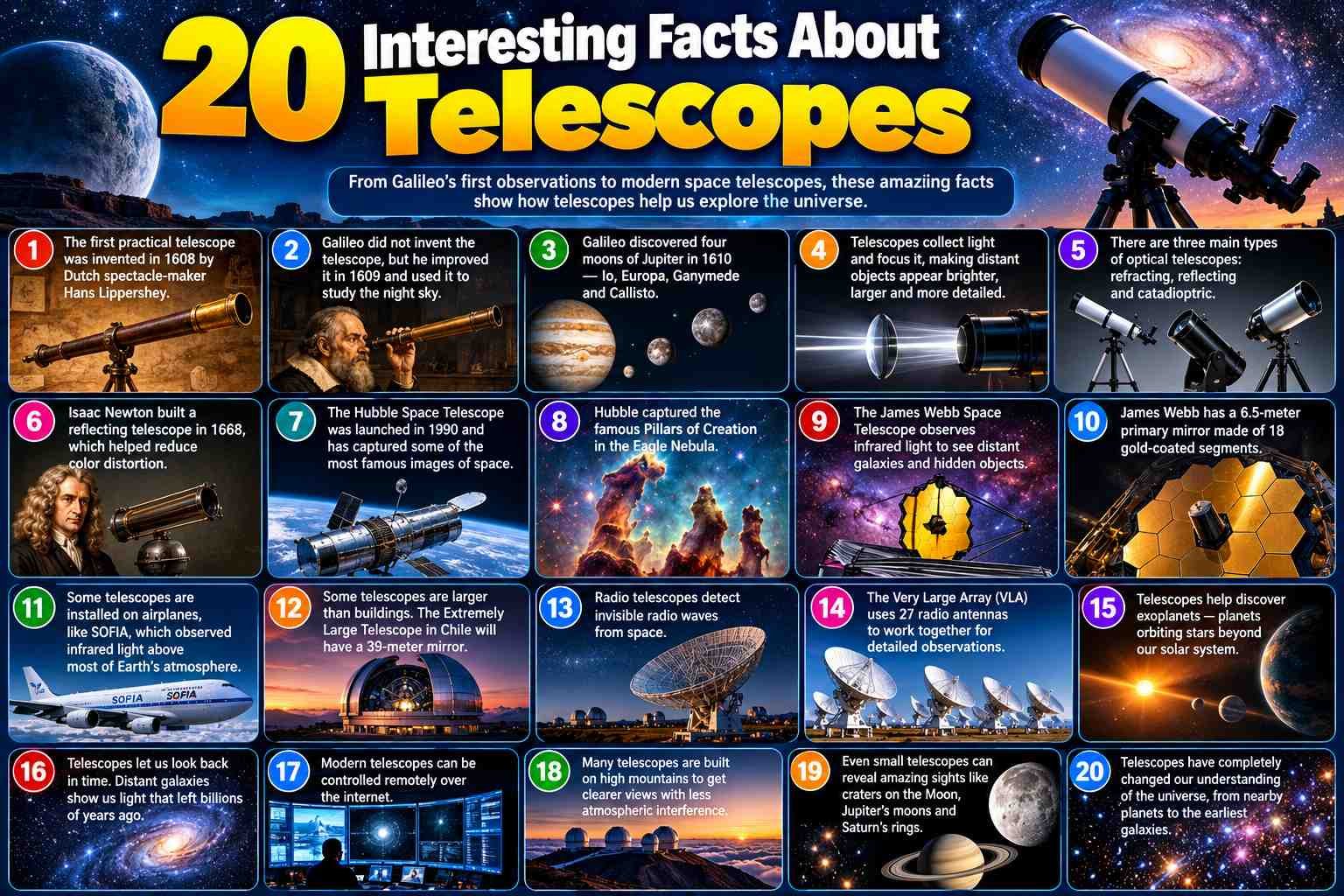
Have you ever looked up at the night sky and wondered what lies beyond those tiny, twinkling stars? For thousands of years, humans could only imagine what existed in the vast darkness above Earth. Then came an invention that changed astronomy forever—the telescope.
From Galileo’s early observations of Jupiter to the breathtaking images captured by the James Webb Space Telescope, telescopes have helped us explore distant planets, mysterious galaxies, colorful nebulae, and some of the oldest light in the universe.
But telescopes are much more than instruments that make distant objects appear closer. Some can detect invisible infrared light, others use enormous radio dishes, and a few travel through space to observe the universe without interference from Earth’s atmosphere.
Whether you’re a science enthusiast, a student, or someone who simply enjoys stargazing, these 20 interesting facts about telescopes will give you a new appreciation for one of humanity’s greatest scientific inventions.
1. The First Practical Telescope Was Invented in 1608
The story of the modern telescope began in the Netherlands in 1608. Dutch spectacle-maker Hans Lippershey is commonly credited with developing one of the first practical telescopes and applying for a patent.
Early telescopes used a combination of lenses to make distant objects appear larger. Although these instruments were simple compared with modern telescopes, they opened the door to an entirely new way of observing the world.
Interestingly, the telescope was not originally created specifically for astronomy. Its early uses included observing distant objects on Earth, particularly for navigation and military purposes.
2. Galileo Did Not Invent the Telescope
Many people believe Galileo Galilei invented the telescope, but that is a common misconception.
Galileo improved existing telescope designs in 1609 and began using them to study the night sky. His observations revealed mountains and craters on the Moon, moons orbiting Jupiter, and the phases of Venus.
These discoveries challenged long-standing ideas about the universe and helped establish the importance of observation in modern astronomy.
3. Galileo Discovered Four Moons of Jupiter
In January 1610, Galileo observed four bright objects near Jupiter through his telescope. After watching them change positions over several nights, he realized they were moons orbiting the planet.
Today, these are known as the Galilean moons: Io, Europa, Ganymede, and Callisto.
This discovery was revolutionary because it demonstrated that not everything in the heavens revolved around Earth. It provided powerful evidence against the traditional Earth-centered model of the universe.
4. Telescopes Collect Light Rather Than Simply Magnifying Objects
One of the most interesting facts about telescopes is that their most important job is collecting light.
A telescope gathers light from distant objects and focuses it to create an image. The larger its main lens or mirror, the more light it can collect.
This is why large telescopes can reveal faint galaxies, nebulae, and star clusters that are invisible to the naked eye.
Magnification is useful, but light-gathering ability and image resolution are often more important when observing the universe.
5. There Are Three Main Types of Optical Telescopes
Optical telescopes generally fall into three major categories: refracting, reflecting, and catadioptric telescopes.
Refracting telescopes use lenses to gather and focus light. Reflecting telescopes use mirrors, while catadioptric telescopes combine lenses and mirrors.
Each design offers different advantages. Refractors are often appreciated for their straightforward construction, reflectors can provide large apertures at comparatively affordable prices, and catadioptric telescopes offer compact designs.
The best choice depends on what an observer wants to study.
6. Isaac Newton Built a Reflecting Telescope
In 1668, Isaac Newton constructed an early practical reflecting telescope.
Unlike traditional refracting telescopes, which relied on lenses, Newton’s design used mirrors to gather and focus light.
This helped overcome a problem called chromatic aberration, which causes unwanted colored fringes around objects in some lens-based telescopes.
Newton’s invention influenced telescope development for centuries, and reflecting designs remain widely used in modern observatories.
7. The Hubble Space Telescope Was Launched in 1990
The Hubble Space Telescope is one of the most famous scientific instruments ever built.
Launched aboard the Space Shuttle Discovery on April 24, 1990, Hubble was placed into orbit around Earth, where it could observe the universe above much of the atmosphere’s interference.
Its images of distant galaxies, colorful nebulae, and star-forming regions have transformed our understanding of space.
Hubble has also helped astronomers measure cosmic distances, investigate galaxy evolution, and study the expansion of the universe.
8. The Hubble Telescope Captured the Famous Pillars of Creation
One of Hubble’s most recognizable images shows the Pillars of Creation, enormous columns of gas and dust inside the Eagle Nebula.
The pillars are located roughly 6,500 light-years from Earth and contain regions where new stars are forming.
Their dramatic appearance made them some of the most famous structures in astronomy.
What makes the image even more fascinating is that the light we see left the region thousands of years ago. We are observing the pillars as they existed in the distant past.
9. The James Webb Space Telescope Observes Infrared Light
The James Webb Space Telescope (JWST) is designed primarily to observe infrared light, which is invisible to human eyes.
Infrared observations allow astronomers to study objects hidden behind clouds of cosmic dust and detect light from extremely distant galaxies.
Launched on December 25, 2021, Webb has opened new opportunities to investigate early galaxies, star formation, exoplanet atmospheres, and the evolution of the universe.
Its observations complement those made by Hubble rather than simply replacing them.
10. James Webb Has a 6.5-Meter-Wide Primary Mirror
One of the most impressive features of the James Webb Space Telescope is its enormous primary mirror.
The mirror measures approximately 6.5 meters across and consists of 18 hexagonal segments coated with a thin layer of gold.
These segments work together to collect infrared light from distant objects.
Because the mirror was too large to fit inside its launch rocket fully extended, it had to be folded for launch and carefully unfolded in space.
11. Some Telescopes Are Built on Airplanes
Not every telescope operates from the ground or in space. Some have been installed inside aircraft.
One remarkable example was SOFIA, the Stratospheric Observatory for Infrared Astronomy.
This flying observatory used a modified Boeing 747SP aircraft carrying a large infrared telescope.
By flying high above much of Earth’s water vapor, SOFIA could observe infrared wavelengths that are difficult to study from ground level.
Although its science flights ended in 2022, SOFIA remains an extraordinary example of creative telescope engineering.
12. Some Telescopes Are Larger Than Buildings
Modern astronomical telescopes can be enormous.
Major observatories use mirrors several meters across to gather faint light from distant stars and galaxies.
The Extremely Large Telescope being developed in Chile is designed with a segmented primary mirror approximately 39 meters in diameter.
Building instruments of this scale requires advanced engineering, precise mirror alignment, and sophisticated systems to compensate for atmospheric distortion.
These giant telescopes are intended to help astronomers investigate distant planets, galaxies, and other cosmic mysteries.
13. Radio Telescopes Can Detect Invisible Signals From Space
When most people imagine a telescope, they picture a long tube with lenses. But radio telescopes look very different.
They often use enormous dish-shaped antennas to collect radio waves emitted by objects in space.
Radio telescopes allow scientists to study pulsars, distant galaxies, clouds of gas, and other astronomical phenomena that may not be easily observed using visible light.
Some radio telescopes resemble giant satellite dishes rather than traditional optical instruments.
14. The Very Large Array Uses 27 Radio Antennas
The Karl G. Jansky Very Large Array (VLA) in New Mexico is one of the world’s best-known radio observatories.
It consists of 27 radio antennas, each approximately 25 meters in diameter.
These antennas work together using a technique called interferometry, allowing astronomers to combine their signals and produce highly detailed observations.
The antennas can also be moved along railway tracks to change the array’s configuration.
15. Telescopes Can Help Discover Planets Outside Our Solar System
Telescopes have played a major role in discovering exoplanets, which are planets orbiting stars beyond our Sun.
One widely used detection method looks for tiny decreases in a star’s brightness when a planet passes in front of it.
This technique, known as the transit method, has helped astronomers discover thousands of distant worlds.
Some of these planets are rocky, others are enormous gas giants, and a few orbit within regions where temperatures might allow liquid water under suitable conditions.
16. Telescopes Let Us Look Back in Time
Here is one of the most mind-blowing facts about telescopes: when astronomers observe distant galaxies, they are actually looking into the past.
Light takes time to travel through space. For example, sunlight takes about eight minutes to reach Earth.
When a telescope observes a galaxy billions of light-years away, it detects light that began its journey billions of years ago.
This means telescopes are not just tools for studying distant places. They are also tools for exploring the history of the universe.
17. Telescopes Can Be Controlled Remotely
Modern observatories are often equipped with computerized systems that allow astronomers to operate telescopes from distant locations.
Instead of sitting beside a telescope all night, researchers may send observing instructions through computer networks and receive scientific data electronically.
Some observatories even perform automated observations based on weather conditions and programmed schedules.
Remote operation has made astronomy more accessible to researchers around the world.
18. Astronomers Build Telescopes on High Mountains
Many of the world’s major observatories are located on mountains, in deserts, or in other remote areas.
There is a scientific reason for this.
High-altitude locations often have thinner air, lower atmospheric water vapor, and fewer clouds. Remote areas can also provide darker skies with less artificial light pollution.
These conditions help telescopes collect clearer and more useful observations.
That is why locations such as Chile’s Atacama Desert and Hawaii’s Maunakea have become important centers for astronomy.
19. Even Small Telescopes Can Reveal Amazing Things
You do not need a giant observatory to enjoy astronomy.
A small beginner telescope can reveal craters on the Moon, Jupiter’s largest moons, Saturn’s rings, and the phases of Venus under suitable observing conditions.
Some bright star clusters and nebulae are also visible through modest equipment.
The first time someone sees Saturn’s rings with their own eyes can be an unforgettable experience.
For beginners, a stable mount, a reasonably sized aperture, and a dark observing location often matter more than extremely high magnification.
20. Telescopes Have Completely Changed Our Understanding of the Universe
Perhaps the most fascinating fact about telescopes is how dramatically they have changed human knowledge.
Before telescopes, people could observe only a limited number of stars and planets with their eyes.
Today, astronomers use optical, infrared, radio, X-ray, and other specialized telescopes to investigate distant galaxies, black holes, exoplanets, and the earliest stages of cosmic history.
From Galileo’s simple instrument to advanced space observatories, every generation of telescope technology has revealed new mysteries.
And with increasingly powerful instruments under development, the next major discovery could change how we understand the universe once again.
Conclusion
Telescopes are among the most important inventions in the history of science. What began as a simple arrangement of lenses has developed into an extraordinary collection of instruments capable of detecting light and other signals from across the universe.
These 20 interesting facts about telescopes show how far astronomy has come—from Galileo’s observations of Jupiter’s moons to the infrared discoveries of the James Webb Space Telescope.
Whether you’re watching the Moon through a small backyard telescope or admiring images captured by a giant observatory, every observation offers a reminder of just how vast and fascinating the universe really is.
The next time you look at the night sky, remember that countless galaxies, stars, and planets lie beyond what your eyes can see. Thanks to telescopes, we can explore at least some of those hidden wonders.
Frequently Asked Questions About Telescopes
1. Who invented the first telescope?
Hans Lippershey, a Dutch spectacle-maker, is commonly credited with developing one of the first practical telescopes in 1608.
2. What is the main purpose of a telescope?
The main purpose of a telescope is to collect and focus electromagnetic radiation, such as visible light, from distant objects so they can be studied in greater detail.
3. What are the three main types of optical telescopes?
The three main types are refracting telescopes, reflecting telescopes, and catadioptric telescopes.
4. Can you see planets with a small telescope?
Yes. A small telescope can reveal Jupiter’s largest moons, Saturn’s rings, the phases of Venus, and details on the Moon under suitable conditions.
5. What is the difference between Hubble and James Webb?
Hubble observes primarily ultraviolet, visible, and near-infrared light, while James Webb focuses on infrared wavelengths. Their capabilities complement each other.
6. Why are telescopes placed in space?
Space telescopes can observe without many of the atmospheric effects that interfere with ground-based observations. They can also detect certain wavelengths that Earth’s atmosphere blocks.
1 thought on “20 Interesting Facts About Telescopes – Amazing Astronomy Facts”