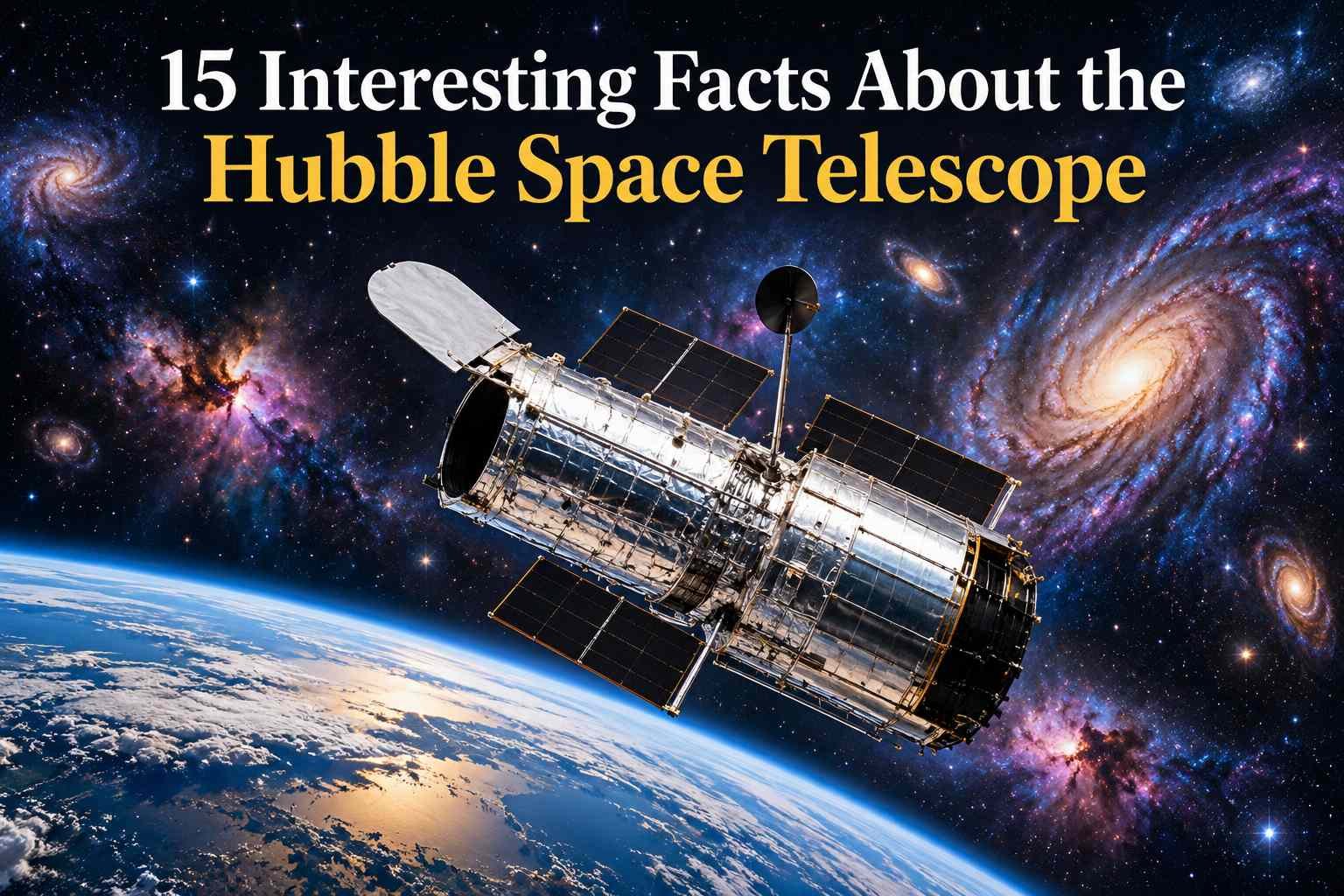
The Hubble Space Telescope has changed the way we see and understand the universe. Since its launch in 1990, it has captured breathtaking images of distant galaxies, studied stars and planets, and helped scientists investigate some of the biggest mysteries in space.
Named after astronomer Edwin Hubble, this remarkable observatory has spent decades exploring the cosmos from above Earth’s atmosphere. Its journey has included unexpected technical problems, incredible discoveries, and achievements that have transformed modern astronomy.
If you love space, galaxies, and astronomy, here are 15 interesting facts about the Hubble Space Telescope that reveal what makes this iconic observatory so extraordinary.
1. The Hubble Space Telescope Is Named After an Astronomer
The Hubble Space Telescope is named after Edwin Powell Hubble, an American astronomer who made important contributions to our understanding of the universe. In the 1920s, his observations helped establish that galaxies exist beyond the Milky Way and that the universe is expanding.
His groundbreaking work changed the way scientists viewed the cosmos. Naming the telescope after him was a fitting tribute to a scientist whose discoveries opened new doors in astronomy.
2. The Idea for Hubble Began Decades Before Its Launch
Did you know that the idea behind the Hubble Space Telescope dates back to the 1940s? In 1946, astrophysicist Lyman Spitzer Jr. explained the advantages of placing a telescope above Earth’s atmosphere.
The atmosphere can blur astronomical images and block certain wavelengths of light. A space-based telescope could overcome many of these limitations and provide a clearer view of distant objects. The project took years of planning, research, and funding before it finally became a reality.
Also Read-20 Interesting Facts About Telescopes – Amazing Astronomy Facts
3. Hubble Was Launched in 1990
The Hubble Space Telescope was launched on April 24, 1990, aboard NASA’s Space Shuttle Discovery. The mission, known as STS-31, took off from Kennedy Space Center in Florida.
Astronauts deployed the telescope into orbit the following day. Its launch marked an important milestone in space exploration, opening a new chapter in the study of distant stars, galaxies, and other celestial objects.
4. A Faulty Mirror Initially Blurred Its Images
One of the most surprising facts about the Hubble Space Telescope is that it experienced a serious optical problem shortly after launch.
Scientists discovered that its primary mirror had been polished to the wrong specifications. This defect, known as spherical aberration, caused many of its early images to appear blurry.
The problem was a major setback for NASA, but it did not end Hubble’s mission. In December 1993, astronauts carried out a servicing mission that installed corrective optics and upgraded its instruments. After the repair, Hubble began producing the sharp images scientists had hoped to see.
5. Hubble Captures Light That Earth’s Atmosphere Can Block
One major advantage of the Hubble Space Telescope is its location above Earth’s atmosphere. The atmosphere can distort incoming light and prevent some wavelengths from reaching ground-based observatories.
Hubble observes visible light, ultraviolet light, and near-infrared light. This ability allows astronomers to study objects in ways that would be difficult or impossible using many ground-based telescopes alone.
By collecting light from distant celestial objects, Hubble helps scientists investigate the properties of stars, galaxies, nebulae, and planetary atmospheres.
6. Hubble Travels Around Earth at Incredible Speed
Hubble does not remain in one place while observing space. It orbits Earth at approximately 27,300 kilometres per hour.
At this speed, the telescope completes one orbit in roughly 95 minutes. That means it circles our planet about 15 times in a single day.
Its rapid orbital movement allows Hubble to observe different parts of the sky as Earth turns beneath it. Despite moving so quickly, its pointing systems help it remain remarkably steady while collecting scientific data.
7. The Sun Powers the Hubble Space Telescope
Hubble relies on solar energy to operate its scientific instruments and onboard systems. Solar arrays collect sunlight and convert it into electricity.
But what happens when Earth blocks the Sun during part of Hubble’s orbit? The telescope uses stored electrical energy to keep its systems running while it passes through Earth’s shadow.
This combination of solar power and stored energy helps the observatory continue its work without needing fuel deliveries from Earth.
8. Hubble’s First Deep Field Revealed Thousands of Galaxies
In 1995, scientists pointed Hubble at a seemingly empty patch of sky and allowed it to collect light over an extended period. The result became known as the Hubble Deep Field.
The image revealed a remarkable collection of distant galaxies that were too faint to be easily seen in ordinary observations. What appeared to be an almost empty region of space turned out to contain an astonishing number of galaxies.
This experiment demonstrated how much astronomers could learn by observing a small area of the sky for a long time. Later deep-field observations revealed even more distant objects and helped scientists study the early universe.
9. Hubble Has Observed Extremely Distant Galaxies
Some of Hubble’s most famous observations show galaxies whose light has travelled for billions of years before reaching us.
Because light takes time to travel, observing distant galaxies also means looking back into the universe’s past. Their light offers clues about how galaxies formed and evolved when the universe was much younger.
Hubble’s deep-field images have helped astronomers identify ancient galaxies and investigate the conditions that shaped the early cosmos. These observations have made the telescope an essential tool for studying cosmic history.
10. Hubble Images Are Not Simply Ordinary Colour Photographs
The colourful pictures released by NASA often look like photographs taken with a conventional camera, but the process is more complex.
Hubble’s detectors record light through different filters. Scientists combine observations taken at different wavelengths to create colour images that reveal details about astronomical objects.
Some colours represent wavelengths that human eyes cannot see, such as ultraviolet or infrared light. These images help researchers distinguish features such as hot gas, dust, and different chemical elements.
The colours are scientifically informative, although they do not always represent exactly what an object would look like to the naked eye.
11. Astronauts Have Serviced Hubble in Space
Hubble was designed to be serviced and upgraded by astronauts. Following its launch, space shuttle crews carried out five servicing missions between 1993 and 2009.
During these missions, astronauts repaired equipment, replaced instruments, and improved the telescope’s capabilities. The first servicing mission was especially important because it corrected the primary mirror’s optical problem.
These upgrades helped Hubble remain scientifically productive for far longer than its original planned operating period. Its story demonstrates how maintenance and engineering improvements can extend the useful life of a major space observatory.
12. Hubble Has Helped Scientists Study Black Holes
Black holes are among the most mysterious objects in the universe because their gravity is so strong that even light cannot escape from within their event horizons.
Although Hubble cannot photograph the inside of a black hole, it can observe the stars, gas, and other material around these objects. By studying how matter behaves near suspected black holes, astronomers can learn about their properties and influence.
Hubble observations have contributed to research on supermassive black holes found in the centres of galaxies. This work helps scientists understand the relationship between black holes and the galaxies that surround them.
13. Hubble Has Contributed to Research on Dark Energy
One of the universe’s biggest mysteries is why its expansion is accelerating. Scientists use the term dark energy for the unknown cause associated with this acceleration.
Hubble observations of distant supernovae helped researchers investigate how the expansion rate of the universe has changed over time. This work contributed to the evidence for the accelerating expansion discovered in the late 1990s.
Dark energy remains an active area of scientific research. Hubble’s observations have helped astronomers measure cosmic distances and explore this puzzling feature of the universe.
14. Hubble Has Studied Planets Beyond Our Solar System
Planets that orbit stars outside our solar system are known as exoplanets. Many are extremely distant and cannot be photographed in detail using ordinary telescopes.
Hubble has helped scientists investigate some exoplanet atmospheres by studying starlight that passes through them. When a planet moves in front of its star, some of the starlight may pass through the planet’s atmosphere and reveal clues about its composition.
These observations help researchers understand how planets form and what their atmospheres contain. Although they do not prove that life exists elsewhere, they contribute to the broader search for potentially habitable worlds.
15. Hubble and the James Webb Space Telescope Work in Different Ways
The James Webb Space Telescope, launched in December 2021, is often described as Hubble’s successor, but the two observatories have different strengths.
Hubble observes visible, ultraviolet, and near-infrared light, while Webb is designed primarily to study infrared light. Webb’s larger mirror and infrared capabilities allow it to investigate very distant galaxies, star-forming regions, and objects hidden by cosmic dust.
Rather than making Hubble irrelevant, Webb complements its work. Together with other observatories, they give astronomers different ways to study the universe and understand how it has evolved.
Conclusion
The Hubble Space Telescope is much more than a camera in orbit. It is a remarkable scientific observatory that has helped humanity explore distant galaxies, investigate black holes, study planets, and understand the history of the universe.
Its journey has not always been easy. From the initial mirror problem to decades of repairs and scientific discoveries, Hubble shows what can be achieved through careful engineering and continued scientific effort.
As astronomers continue to study its observations alongside data from newer telescopes, Hubble’s discoveries remain an important part of our effort to understand the cosmos.
Frequently Asked Questions (FAQs)
1. What is the Hubble Space Telescope?
The Hubble Space Telescope is a space-based observatory launched by NASA in 1990 in partnership with the European Space Agency. It studies stars, galaxies, planets, and other celestial objects from orbit around Earth.
2. Why is the Hubble Space Telescope famous?
Hubble is famous for its detailed images of distant galaxies and nebulae and its contributions to research on the age and expansion of the universe, black holes, and exoplanets.
3. Who was the Hubble Space Telescope named after?
It was named after Edwin Powell Hubble, an astronomer whose observations helped establish that galaxies exist beyond the Milky Way and that the universe is expanding.
4. How fast does the Hubble Space Telescope travel?
Hubble travels around Earth at approximately 27,300 kilometres per hour and completes one orbit in about 95 minutes.
5. What is the difference between Hubble and the James Webb Space Telescope?
Hubble observes visible, ultraviolet, and near-infrared light, while the James Webb Space Telescope focuses primarily on infrared light. Their different capabilities allow scientists to study a wider range of astronomical objects and phenomena.
1 thought on “15 Interesting Facts About the Hubble Space Telescope”