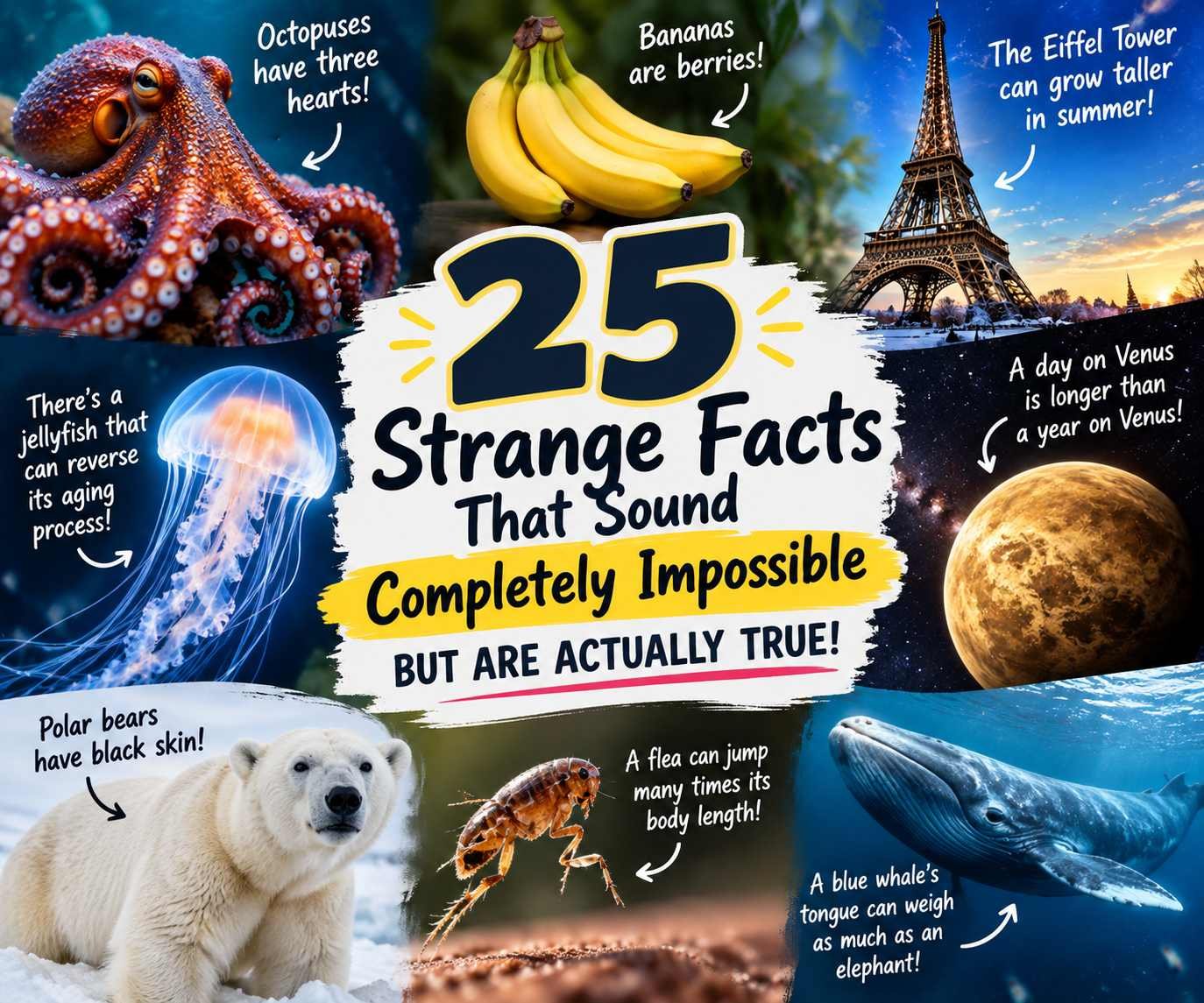
The world is full of facts that sound like someone made them up just to win an argument. Some involve animals with unbelievable abilities, others reveal strange things about the human body, nature, space, and even everyday objects.
The interesting part is that these aren’t science-fiction stories or internet myths. Many of them are real, although a few need a little explanation to make sense. So, if you enjoy facts that make you stop and say “Wait… what?”, you’re going to love this list.
Here are 25 strange facts that sound completely impossible but are surprisingly fascinating.
1 Octopuses Have Three Hearts
An octopus doesn’t have just one heart like humans do. It has three hearts.
Two hearts pump blood toward the gills, while the third pumps blood to the rest of the body. Even stranger, the main heart temporarily stops beating when an octopus swims, which is one reason these animals often prefer crawling along the ocean floor.
2 Bananas Are Botanically Berries
Here’s a fact that can make a trip to the grocery store surprisingly confusing.
Botanically speaking, bananas are berries, while strawberries aren’t considered true berries. The difference comes from how botanists classify fruits based on their structure and how they develop from flowers.
So technically, your breakfast banana belongs to a rather unusual botanical category.
Also Read- 30 Interesting Facts About the Moon
3 A Day on Venus Is Longer Than Its Year
Venus has one of the strangest rotations in our Solar System.
It takes about 243 Earth days for Venus to rotate once on its axis, while it takes only about 225 Earth days to complete one orbit around the Sun.
In other words, a Venusian day is longer than a Venusian year.
4 Some Turtles Can Breathe Through Their Rear End
It sounds like a joke, but certain freshwater turtles have a remarkable adaptation that allows them to absorb oxygen through specialized tissues near the rear of their bodies.
This ability can help them remain underwater for long periods, particularly during cold conditions when their metabolism slows down.
Nature clearly doesn’t always follow the rules we expect.
5 Wombat Poop Is Cube-Shaped
Yes, really.
Wombats produce cube-shaped droppings, making them one of the strangest examples of animal biology. Scientists have found that the unusual shape is produced inside the intestine because different sections of the intestinal wall have different levels of elasticity.
The cubes also have a practical purpose: they are less likely to roll away when wombats use them to mark territory.
6 Sloths Can Grow Algae on Their Fur
Sloths move so slowly that their fur can become a tiny ecosystem.
Certain algae can grow on the hair of sloths, sometimes giving their coats a greenish appearance. The coloring may also help them blend into the vegetation where they spend much of their lives.
It’s almost as if a sloth carries its own camouflage garden.
7 A Cloud Can Weigh Hundreds of Thousands of Kilograms
Clouds look light and fluffy because they’re made of tiny water droplets or ice crystals spread across a huge area.
But a typical large cumulus cloud can contain hundreds of thousands of kilograms of water. It doesn’t fall immediately because that water is distributed among countless tiny droplets and is supported by air currents.
So that innocent-looking cloud above your head may be much heavier than it appears.
8 Sharks Are Older Than Trees
Sharks have been swimming in Earth’s oceans for hundreds of millions of years.
The earliest shark-like animals appeared long before the first modern trees. Sharks therefore belong to an ancient lineage that has survived enormous changes in Earth’s environment.
Imagine an animal group existing before forests looked anything like they do today.
9 Some Animals Can Survive Being Frozen
Certain animals have extraordinary adaptations that allow them to survive freezing conditions.
For example, the wood frog can survive with much of its body frozen during winter. Its body produces substances that help protect its cells from severe damage.
When temperatures rise, the frog can thaw and become active again.
10 Your Stomach Gets a New Lining Regularly
Your stomach contains powerful digestive acids that help break down food. So why doesn’t the acid simply digest the stomach itself?
The stomach protects its tissues with a mucus barrier and other defenses. Its surface lining is also continuously renewed.
Without these protective mechanisms, the digestive acids inside your stomach could cause serious damage.
11 There Are More Possible Chess Games Than Atoms in the Observable Universe
Chess may look like a simple board game, but the number of possible games is enormous.
The number of possible chess game variations is often estimated to be around 10¹²⁰, known as the Shannon number. Estimates for the number of atoms in the observable universe are vastly smaller, around 10⁸⁰.
That means the number of possible chess games is unimaginably huge.
12 A Flea Can Jump Many Times Its Body Length
Fleas are tiny, but their jumping ability is extraordinary.
A flea can jump many times its own body length, allowing it to move rapidly between surfaces. Its powerful jumping mechanism comes from specialized structures and elastic energy stored in its body.
If humans had a similar ability, ordinary jumping would look more like superhero training.
13 Lightning Can Be Hotter Than the Surface of the Sun
A lightning bolt may last only a fraction of a second, but the air surrounding it can become incredibly hot.
The channel created by lightning can reach temperatures of roughly 30,000 kelvin, which is several times hotter than the Sun’s visible surface.
That sudden heating causes the surrounding air to expand rapidly, producing the sound we hear as thunder.
14 A Group of Flamingos Is Called a Flamboyance
Collective animal names can be surprisingly creative.
A group of flamingos is commonly called a flamboyance, a fitting name for a bird famous for its bright pink color and unusual appearance.
It’s difficult to imagine a more appropriate word for a large gathering of flamingos.
15 Some Snails Can Sleep for Years
When environmental conditions become extremely dry, certain snails can enter a dormant state called estivation.
Some species can remain inactive for remarkably long periods while conserving energy and moisture. In extreme cases, this dormancy can last for years.
For a creature that moves slowly anyway, this is an impressive level of patience.
16 The Eiffel Tower Can Become Taller in Hot Weather
The Eiffel Tower isn’t exactly the same height throughout the year.
Because it is made primarily of iron, the metal expands when heated. During warm weather, the tower can become several centimeters taller than it is under cooler conditions.
It isn’t growing, of course—it’s simply responding to temperature.
17 Some Fungi Can Control Insect Behavior
Certain fungi in the Ophiocordyceps group infect insects and can manipulate their behavior before eventually producing fungal structures that release spores.
The phenomenon sounds like something from a horror movie, but it is a real example of the complicated relationships that can evolve between parasites and their hosts.
18 A Blue Whale’s Tongue Can Weigh as Much as an Elephant
The blue whale is the largest known animal ever to have lived on Earth.
Its tongue alone can weigh roughly as much as an adult elephant, although exact comparisons vary with the size and age of the animals.
Considering that a blue whale can grow to extraordinary lengths, it’s perhaps not surprising that even one part of its body can be enormous.
19 Some Plants Can Communicate With Nearby Plants
Plants don’t have brains or nervous systems like animals, but that doesn’t mean they live in complete isolation.
Plants can send chemical signals and interact with organisms around them. Some can also release substances into the soil that influence nearby plants or communicate information about threats.
Plant life is much more active and responsive than it might appear.
20 The Sahara Desert Has Seen Snow
When people imagine the Sahara Desert, they usually picture endless sand and scorching heat.
But snow has occasionally fallen in parts of the Sahara. Certain areas can experience surprisingly cold winter conditions, particularly at higher elevations.
A desert covered in snow sounds impossible—until weather decides otherwise.
21 Some Jellyfish Can Reverse Their Life Cycle
One of the strangest creatures in the ocean is Turritopsis dohrnii, often nicknamed the “immortal jellyfish.”
When severely stressed or injured, this tiny jellyfish can transform its mature cells and return to an earlier stage of development. It can then begin its life cycle again.
This doesn’t make it literally impossible to kill—the animal can still die from disease, predators, or other causes—but its biological ability is extraordinary.
22 Polar Bears Have Black Skin
Polar bears look completely white, but underneath their thick fur, their skin is black.
Their fur is actually translucent rather than naturally white. It scatters and reflects visible light, creating the familiar white appearance.
The dark skin underneath can help absorb solar radiation in their cold Arctic environment.
23 Your Bones Are Surprisingly Strong
Bones may seem rigid and fragile, but they are remarkably strong structures.
Healthy bone combines minerals with a flexible protein framework, giving it a useful balance of strength and toughness. Bone is also living tissue that constantly undergoes remodeling.
Your skeleton isn’t simply a collection of solid pieces—it is an active part of your body.
24 Dolphins Sleep With Half Their Brain at a Time
Dolphins need to surface regularly to breathe, which creates a problem: they can’t simply fall into deep sleep like humans do.
One adaptation is unihemispheric sleep, in which one side of the brain rests while the other remains active enough to help the dolphin maintain essential functions.
This allows dolphins to rest while continuing to breathe and remain aware of their surroundings.
25 The Universe Is Stranger Than We Can Imagine
Perhaps the strangest fact of all is that reality contains phenomena that challenge our everyday understanding.
Black holes can bend spacetime, microscopic particles behave according to quantum rules that seem bizarre from a human perspective, and enormous structures exist across distances so vast that light can take billions of years to cross them.
The more we discover, the clearer it becomes that the universe doesn’t have to behave in ways that feel intuitive to us.
Conclusion
Some facts sound impossible simply because they’re so different from our everyday experience. A cube-shaped wombat dropping, a three-hearted octopus, a jellyfish that can reverse its development, or a cloud carrying an enormous amount of water can all seem like inventions at first.
But that’s what makes science, nature, and the world around us so fascinating. Reality is often much stranger than fiction.
And the best part? There are still countless discoveries waiting to surprise us.
2 thoughts on “25 Strange Facts That Sound Completely Impossible”