The Sun may look like a simple glowing ball in the sky, but it is actually a dynamic star that is constantly changing and releasing enormous amounts of energy into space. Without its light and heat, life as we know it on Earth would not exist.
The Sun is at the center of our solar system and controls the orbits of planets, asteroids, comets, and countless smaller objects through its immense gravity. It is also much more fascinating than it appears from Earth.
Here are 25 amazing facts about the Sun that will give you a new appreciation for the star that makes life on our planet possible.
1 The Sun Is a Star
The Sun is not a planet or a giant ball of fire. It is a star—a huge sphere of extremely hot plasma made primarily of hydrogen and helium.
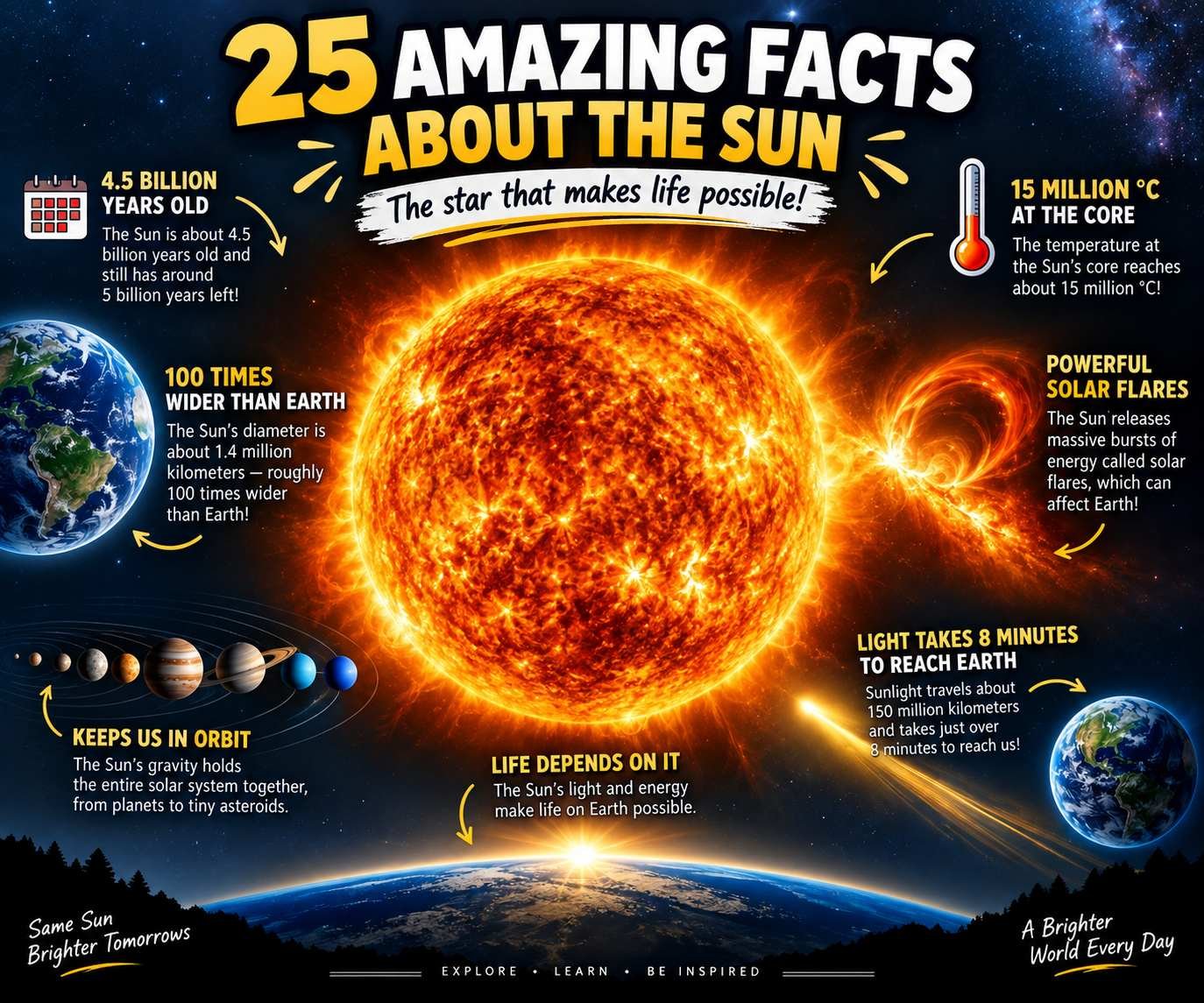
Our Sun is classified as a yellow dwarf star and is about 4.5 billion years old.
2 The Sun Is the Largest Object in Our Solar System
The Sun is by far the largest object in the solar system.+
Also Read-30 Interesting Facts About the Moon
Its diameter is approximately 1.4 million kilometers, making it about 100 times wider than Earth. Its enormous gravitational pull keeps the planets and other objects in orbit around it.
3 More Than a Million Earths Could Fit Inside the Sun
The Sun is so enormous that roughly 1.3 million Earths could fit inside it by volume.
And when it comes to mass, more than 330,000 Earths would be needed to equal the mass of the Sun.
That’s difficult to imagine when we see the Sun as a relatively small circle in the sky.
4 The Sun Is About 150 Million Kilometers From Earth
Earth orbits the Sun at an average distance of about 150 million kilometers, or approximately 93 million miles.
This distance is also called an astronomical unit (AU) and is commonly used to describe distances within our solar system.
5 Sunlight Takes About 8 Minutes to Reach Earth
Light travels incredibly fast, but the Sun is so far away that its light still needs several minutes to reach us.
Sunlight takes approximately 8 minutes and 20 seconds to travel from the Sun to Earth. So when you look at the Sun, you’re seeing it as it was a little more than eight minutes earlier.
6 The Sun Contains Almost All the Mass in the Solar System
The Sun isn’t just the biggest object in our solar system—it contains almost all of its mass.
Approximately 99.8% of the solar system’s mass is contained within the Sun. Most of the remaining material formed planets, moons, asteroids, comets, and other objects.
7 The Sun Is Made Mostly of Hydrogen and Helium
The Sun is primarily composed of hydrogen and helium.
Deep inside its core, hydrogen nuclei undergo nuclear fusion and are converted into helium. This process releases enormous amounts of energy that eventually makes its way outward and reaches space as light and other forms of radiation.
8 The Sun’s Core Is Incredibly Hot
The core is the hottest region of the Sun.
Temperatures there can reach approximately 15 million degrees Celsius. Under these extreme conditions, nuclear fusion can occur, producing the energy that powers the Sun.
9 The Sun’s Surface Is Cooler Than Its Core
The part of the Sun that we see as its visible surface is called the photosphere.
Its temperature is around 5,500°C, which is dramatically cooler than the Sun’s core.
Of course, 5,500°C is still far too hot for anything familiar on Earth to survive.
10 The Sun’s Atmosphere Is Hotter Than Its Surface
One of the biggest mysteries surrounding the Sun is that its outer atmosphere, called the corona, is much hotter than the photosphere beneath it.
The corona can reach temperatures of around 2 million°C, even though it is farther from the Sun’s core. Scientists continue to study the physical processes responsible for this unusual temperature difference.
11 The Sun Doesn’t Have a Solid Surface
When we talk about the “surface” of the Sun, we’re referring to the photosphere—the layer from which most of the visible light we see originates.
Unlike Earth, the Sun doesn’t have a solid ground that you could stand on. It is a gigantic ball of hot plasma.
12 The Sun Rotates
The Sun doesn’t simply sit still in space. It rotates around its own axis.
But because the Sun is not a solid object, different parts rotate at different speeds. The equatorial region takes roughly 25 Earth days to rotate once, while the polar regions take about 36 days.
This difference is known as differential rotation.
13 The Sun Orbits the Center of the Milky Way
The Sun is moving through space along with the entire solar system.
It orbits the center of the Milky Way galaxy while carrying the planets and other solar-system objects along with it. Our Sun is located in a region of the galaxy known as the Orion Spur.
14 One Trip Around the Galaxy Takes About 230 Million Years
The Sun is traveling through the Milky Way at an average speed of roughly 720,000 kilometers per hour.
Even at that enormous speed, it takes approximately 230 million years to complete one orbit around the center of our galaxy.
15 The Sun Is Not an Average-Sized Object Compared With Earth
The Sun is sometimes described as an average star, but compared with Earth, it is absolutely enormous.
Its radius is approximately 700,000 kilometers, and its mass is more than 330,000 times that of Earth.
There are also stars much larger than the Sun, so astronomers consider it relatively ordinary when compared with the enormous variety of stars in the universe.
16 The Sun Was Born From a Giant Cloud of Gas and Dust
The Sun formed about 4.6 billion years ago from a huge, rotating cloud of gas and dust known as the solar nebula.
Gravity caused the cloud to collapse toward its center. As material gathered there, the young Sun formed, while much of the remaining material eventually became the planets and other objects in our solar system.
17 The Sun Has Several Different Layers
The Sun isn’t uniform from the center to the outer atmosphere.
Its major regions include the core, radiative zone, convection zone, photosphere, chromosphere, transition region, and corona. Each region has different temperatures, densities, and physical properties.
18 The Sun Produces Energy Through Nuclear Fusion
The Sun’s energy comes from nuclear fusion.
Inside the core, hydrogen nuclei combine to form helium. A tiny amount of mass is converted into energy during this process, producing the enormous amount of energy that powers the Sun.
19 Energy Takes a Very Long Time to Move Through the Sun
Here’s a surprising detail: sunlight doesn’t simply travel directly from the Sun’s core to the surface.
Energy moves through the interior by interacting with matter again and again. Radiation can take roughly 170,000 years to travel from the core to the top of the convection zone.
Once energy reaches the surface, however, sunlight travels through space to Earth in just over eight minutes.
20 The Sun Produces Solar Wind
The Sun constantly releases a stream of charged particles called the solar wind.
This wind flows outward from the Sun and contributes to the enormous region of space influenced by the Sun’s magnetic field, known as the heliosphere.
21 Earth Is Inside the Sun’s Extended Atmosphere
It may sound strange, but Earth is technically located within the Sun’s extended atmosphere.
The solar wind creates the heliosphere, a huge magnetic bubble that extends far beyond the orbits of the planets. Earth exists inside this enormous region of solar influence.
22 The Sun Has No Moons
The Sun is a star, so it doesn’t have moons of its own.
Instead, planets and their moons—including Earth and our Moon—orbit the Sun.
23 The Sun Has a Powerful Influence on Space Weather
The Sun is constantly changing and releasing energy and particles into space. Events such as solar eruptions can affect the space environment around Earth.
This is why scientists closely monitor the Sun. The study of the Sun and its influence throughout the solar system is known as heliophysics.
24 The Sun Will Eventually Become a Red Giant
The Sun won’t remain in its current form forever.
In roughly 5 billion years, after it has exhausted much of the hydrogen fuel in its core, the Sun is expected to expand dramatically into a red giant. During this stage, it will become large enough to engulf Mercury and Venus, and Earth could also be affected. Eventually, the Sun will end its life as a white dwarf.
25 Life on Earth Depends on the Sun
Perhaps the most important fact about the Sun is its connection to life.
Plants use sunlight for photosynthesis, ecosystems ultimately depend on solar energy, and the Sun drives Earth’s climate and weather systems. At the same time, the Sun’s extreme radiation and temperatures mean that life as we know it could not exist on the Sun itself.
Conclusion
The Sun is much more than a bright object that rises every morning. It is a 4.5-billion-year-old star, the dominant source of energy in our solar system, and the gravitational center around which our planetary neighborhood is organized.
From its incredibly hot core and constantly moving atmosphere to its enormous journey around the Milky Way, the Sun is full of fascinating science. And although it appears familiar from Earth, scientists continue to discover new things about this remarkable star.
The next time you see sunlight streaming through your window, remember that you’re experiencing energy produced by a star that is about 150 million kilometers away—yet powerful enough to make life on Earth possible.
1 thought on “25 Amazing Facts About the Sun”