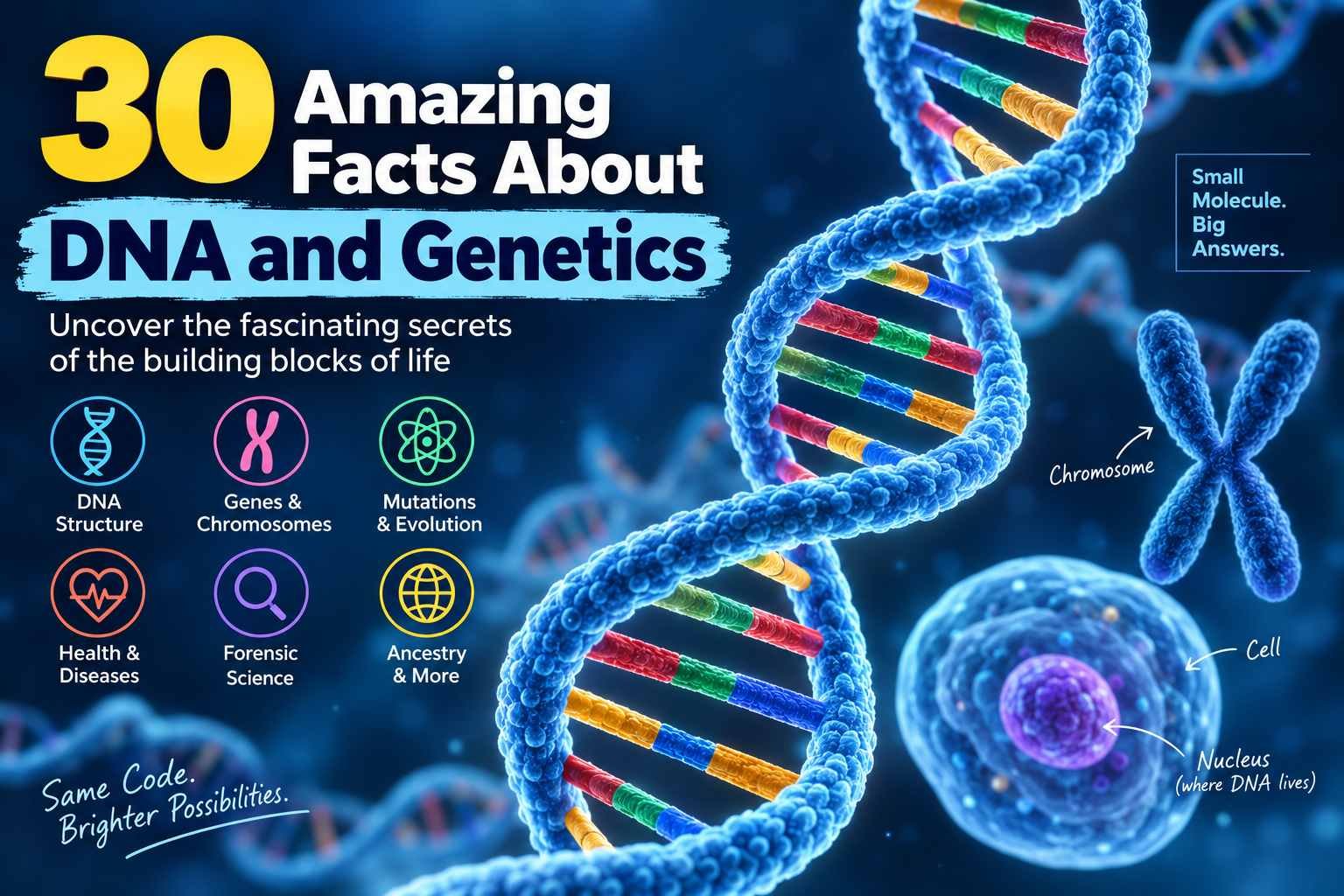
DNA is one of the most fascinating molecules in the natural world. It carries the genetic instructions that help shape who we are, from our physical features to the way our cells function. But DNA is much more than a biological blueprint—it holds clues about our ancestry, evolution, health, and the incredible diversity of life on Earth.
From its tiny molecular structure to its surprising role in forensic science, DNA has plenty of secrets to explore. Whether you are a science lover, a student, or simply curious about how life works, these 30 amazing facts about DNA and genetics will help you understand this remarkable molecule in a fun and easy way.
1. DNA Stands for Deoxyribonucleic Acid
DNA is short for deoxyribonucleic acid, a molecule that stores and passes on genetic information. It contains the instructions that help living organisms grow, develop, and maintain their cells.
Although the name sounds complicated, DNA plays a fundamental role in nearly every aspect of life. It is often described as the body’s instruction manual because it carries information used by cells to perform their functions.
2. DNA Has a Famous Double-Helix Shape
![Figure 1. (a) The double helical structure and (b) molecular structure of DNA [36] : Encoding Information in DNA: From Basic Structure to Nanoelectronics : Science and Education Publishing](https://images.openai.com/static-rsc-4/jSIIycoobSaOHalPlJUbTUtqQuBDv0_OMAi6NyaOfHwR0scgM0SC3hlOZsuIL-sfBOXc9ordDUaEqLI5d6mYbhSZML2FWW8RFGdw1W17BtNW_7s7wa3o8cjQSPV-GicwWkukqXaEe6SoLNfc9FL1V29RVPxCrUuSz45KzxftpJk?purpose=inline)
One of the most recognizable structures in science is the DNA double helix. It looks like a twisted ladder, with two strands winding around each other.
The structure was described in 1953 through work by James Watson and Francis Crick, with crucial contributions from Rosalind Franklin and Maurice Wilkins. Understanding this shape helped scientists explain how DNA stores information and makes copies of itself.
Also Read-30 Amazing Facts About Dinosaurs
3. DNA Uses Just Four Chemical Bases
DNA’s genetic code is built from four chemical bases: adenine (A), thymine (T), guanine (G), and cytosine (C).
These four bases form different sequences, much like letters form words. The order of the bases helps encode biological instructions. Despite using only four chemical letters, DNA carries an enormous amount of information.
4. DNA’s Bases Follow a Specific Pairing Rule
The four DNA bases do not pair randomly. Adenine (A) pairs with thymine (T), while guanine (G) pairs with cytosine (C).
This complementary pairing is essential for DNA replication. When the two strands separate, each strand can act as a template for building a matching strand, helping preserve genetic information as cells divide.
5. A Single Human Cell Contains a Surprising Amount of DNA
If the DNA in a typical human cell were stretched out, it would measure roughly two metres long.
That is an astonishing amount of genetic material to fit inside a microscopic cell. DNA achieves this through careful packing, folding, and coiling around proteins, allowing it to fit inside the cell’s nucleus.
6. Humans Have About 3 Billion DNA Base Pairs
The human genome contains approximately 3 billion base pairs in one set of chromosomes.
These base pairs make up the genetic instructions that scientists study to understand human biology, inherited traits, and certain diseases. The genome is incredibly large, yet it is compact enough to be stored inside our cells.
7. Humans Usually Have 46 Chromosomes
Most human body cells contain 46 chromosomes arranged in 23 pairs. We generally inherit one chromosome in each pair from our biological mother and the other from our biological father.
Chromosomes help organize DNA so that it can be copied and distributed when cells divide. The 23rd pair is commonly known as the sex chromosomes.
8. Genes Are Only a Small Part of Human DNA
Genes are segments of DNA that contain instructions for making functional products, including proteins. However, genes make up only a small portion of the human genome.
Less than 2% of human DNA directly codes for proteins. Much of the remaining DNA has other roles, including helping regulate when and how genes are used.
9. DNA Was First Isolated in 1869
Swiss researcher Friedrich Miescher first isolated a substance he called “nuclein” in 1869 while studying white blood cells.
At the time, scientists did not yet understand DNA’s role in heredity. It took decades of further research to establish DNA as the molecule responsible for carrying genetic information.
10. Your DNA Is Almost 99.9% the Same as Other Humans
Humans share approximately 99.9% of their DNA sequence with one another.
The small differences between individuals contribute to genetic variation, including differences in appearance and certain biological characteristics. Even with so much DNA in common, each person’s genetic makeup is remarkably individual—with the exception of cases such as identical twins, who begin with nearly the same DNA.
11. Humans Share DNA With Bananas
It may sound surprising, but humans and bananas share some DNA-related genes and biological machinery.
This does not mean that humans are 60% banana or that our genomes are 60% identical in every sense. Similarity figures depend on what is being compared, but the broader point is fascinating: many living things share ancient biological genes and processes.
12. Humans Share a Large Amount of DNA With Chimpanzees
Chimpanzees are among our closest living relatives. Human and chimpanzee genomes are highly similar, reflecting a shared evolutionary history.
This genetic connection does not mean humans evolved from modern chimpanzees. Instead, humans and chimpanzees descended from a common ancestor that lived millions of years ago.
13. Mitochondria Have Their Own DNA
Most of the DNA in human cells is found in the nucleus, but mitochondria also contain a small amount of DNA of their own.
Mitochondria are structures that help cells produce usable energy. Human mitochondrial DNA is generally inherited from the mother, making it useful for studying maternal ancestry.
14. Mature Human Red Blood Cells Have No DNA
Most human cells contain DNA in their nucleus, but mature red blood cells are an exception.
As red blood cells develop, they lose their nucleus. This creates more room for haemoglobin, the protein that carries oxygen throughout the body. Other blood cells, such as white blood cells, do contain DNA.
15. Identical Twins Start With Nearly the Same DNA
Identical twins develop from the same fertilized egg and generally begin with nearly identical DNA.
However, they are not guaranteed to remain genetically identical in every cell throughout life. Small mutations can occur as cells divide, and environmental factors can influence how genes are expressed. This helps explain why identical twins may differ in some ways.
16. DNA Can Copy Itself Before a Cell Divides
Before most cells divide, their DNA must be replicated so that each new cell receives a copy of the genetic instructions.
During replication, the two DNA strands separate, and each serves as a template for a new complementary strand. This process is called semi-conservative replication because each resulting DNA molecule contains one original strand and one newly made strand.
17. DNA Copying Is Accurate, but Not Perfect
DNA replication is remarkably accurate, but occasional mistakes can happen. These changes are known as mutations.
Cells have repair systems that correct many DNA errors. Some mutations have no noticeable effect, while others may be harmful or beneficial, depending on the genetic change and the environment.
18. Mutations Help Drive Evolution
A mutation is a change in the DNA sequence. Mutations can introduce genetic variation into a population.
When a genetic change affects survival or reproduction, it may become more or less common over generations. In this way, mutations provide some of the variation on which evolution acts. Not every mutation is helpful—or even noticeable.
19. Not Every Gene Is Active in Every Cell
Your body contains many different types of cells, including muscle cells, nerve cells, and skin cells. Although most of these cells contain essentially the same DNA, they do not use all the same genes.
Different cells switch particular genes on or off depending on their functions. This selective gene activity helps explain how cells with similar genetic instructions can perform very different jobs.
20. Epigenetics Studies How Genes Are Regulated
Epigenetics explores changes that affect how genes are switched on or off without changing the underlying DNA sequence.
Factors such as development and environmental influences can affect gene activity. Epigenetic mechanisms help cells control which genetic instructions they use and when they use them.
21. The Human Genome Project Mapped Human DNA
The Human Genome Project was a major international scientific effort to determine the sequence of human DNA.
Its reference genome gave researchers an important foundation for studying genes, genetic variation, and human biology. The project was announced as successfully completed in 2003, marking a major milestone in genetics.
22. Scientists Can Read DNA Using DNA Sequencing
DNA sequencing allows scientists to determine the order of bases in a DNA sample.
By reading these sequences, researchers can identify genetic variations, study inherited traits, investigate biological relationships, and learn more about diseases. Advances in sequencing technology have made it possible to study DNA much more efficiently than in the past.
23. DNA Can Help Solve Crimes
DNA analysis has become an important tool in forensic science. Biological samples such as blood, saliva, or cells left behind at a crime scene may contain DNA that can be compared with reference samples.
DNA evidence can help identify individuals or exclude someone from an investigation. However, results must be interpreted carefully, because sample quality, contamination, and the circumstances of collection all matter.
24. DNA Can Reveal Clues About Ancestry
DNA testing can help people explore genetic connections to populations around the world.
Certain DNA variations are more common in some populations than others. By comparing these patterns, ancestry services can estimate genetic ancestry and identify possible biological relatives. These estimates are not a complete record of a person’s family history, but they can offer interesting clues.
25. DNA Is Used to Study Ancient Life
DNA recovered from ancient remains can help scientists investigate organisms that lived long ago.
Ancient DNA research has provided insights into extinct species, past populations, and human evolution. DNA breaks down over time, so its survival depends on conditions such as temperature, moisture, and the environment in which the remains were preserved.
26. Some DNA Sequences Came From Ancient Viral Infections
A portion of the human genome contains DNA sequences that originated from ancient viral infections.
Over evolutionary time, some viral genetic material became integrated into the genomes of our ancestors and was passed down through generations. Some of these sequences have since acquired roles in normal biological processes, while others remain inactive.
27. DNA Is Used in Genetic Engineering
Genetic engineering involves changing or using genetic material to achieve a particular purpose.
Scientists can study or modify DNA in plants, animals, and microorganisms. These techniques are used in research, agriculture, and biotechnology, including efforts to understand genes and develop organisms with specific characteristics.
28. CRISPR Has Changed DNA-Editing Research
CRISPR-based tools allow researchers to target particular DNA sequences and make changes to genetic material.
These tools have expanded the possibilities for studying gene function and investigating potential treatments for some genetic conditions. However, DNA editing requires careful research because unintended changes and other limitations remain important considerations.
29. DNA Can Help Scientists Understand Genetic Diseases
Some diseases are associated with changes in DNA. For example, mutations in particular genes can cause inherited conditions, while other genetic variations may influence a person’s risk of developing certain diseases.
Genetic information is only one part of health. Many conditions are influenced by a combination of genes, environment, lifestyle, and other factors, so DNA alone cannot predict every health outcome.
30. DNA Research Continues to Transform Science
DNA research is helping scientists answer questions that were once impossible to investigate.
From understanding inherited traits and studying ancient populations to improving forensic techniques and exploring new medical approaches, genetics continues to influence many fields. As research advances, scientists are discovering more about how genetic information works—and how much there is still to learn.
Conclusion
DNA is far more than a molecule hidden inside our cells. It is a remarkable system of genetic information that connects generations, influences biological traits, and helps explain the diversity of life on Earth.
These 30 amazing facts about DNA and genetics show how much scientists have learned—from discovering DNA’s double-helix structure to using genetic analysis in medicine, ancestry research, and forensic science. Yet many questions about DNA remain unanswered, making genetics one of the most exciting areas of scientific discovery.
The next time you think about what makes every living thing unique, remember that a tiny molecule called DNA holds an extraordinary amount of information about life.
1 thought on “30 Amazing Facts About DNA and Genetics”