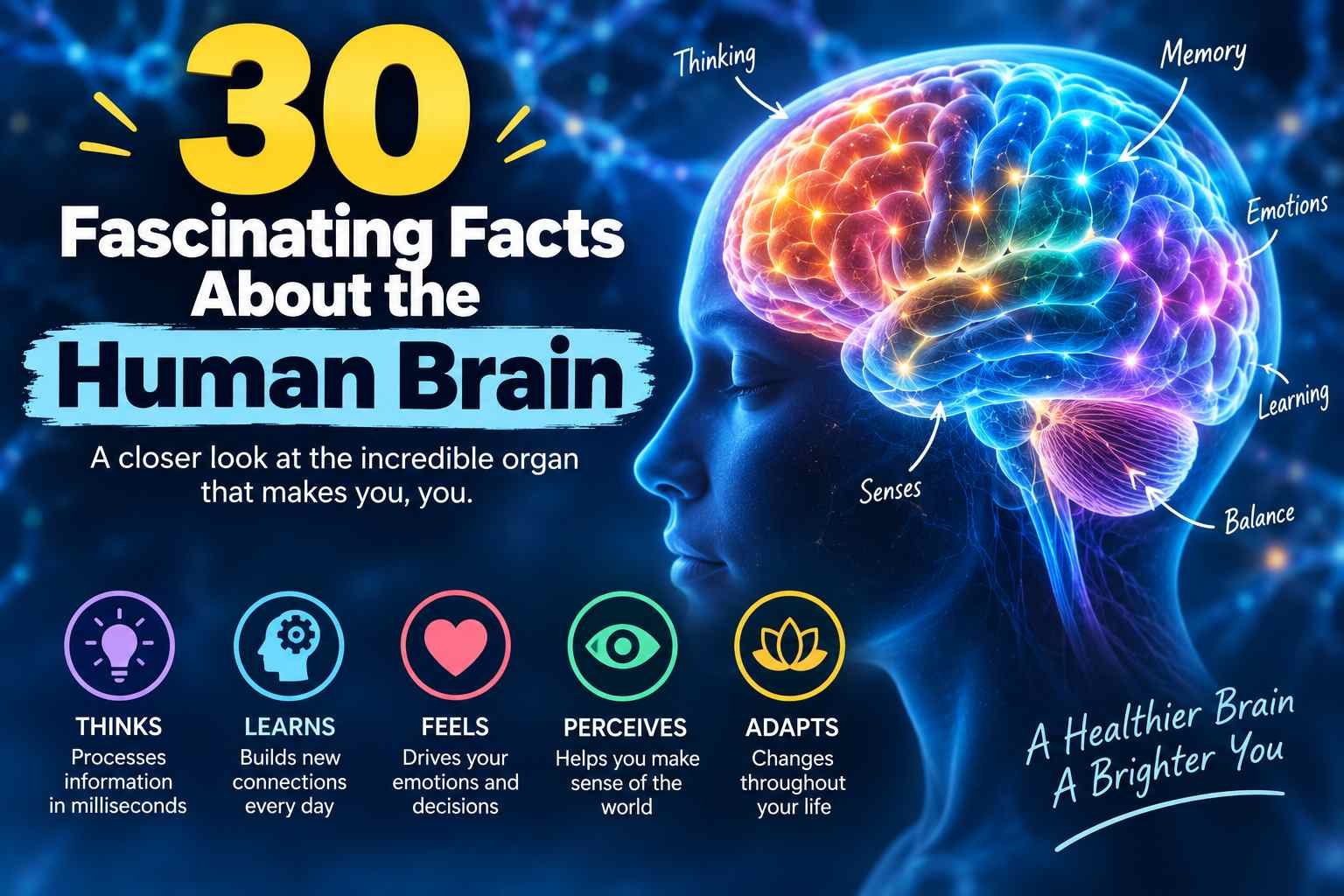
The human brain is one of the most extraordinary organs in the body. It helps you think, learn, remember, dream, recognize faces, experience emotions, and even perform automatic tasks like breathing. Although it weighs only around three pounds, this incredible organ manages an astonishing amount of information every second.
But how much do we really know about our brains? From the surprising way memories are formed to the reason your brain keeps working while you sleep, neuroscience is full of fascinating discoveries.
Whether you’re curious about science, love learning interesting facts, or simply want to understand yourself a little better, these 30 fascinating facts about the human brain will give you plenty to think about.
1. Your Brain Contains Around 86 Billion Neurons
Your brain is home to approximately 86 billion neurons, specialized cells that transmit information throughout the nervous system. These cells communicate through electrical and chemical signals, helping you think, move, learn, and respond to the world around you.
Neurons also connect with one another through junctions called synapses. Together, these connections form complex networks that make everything from recognizing a familiar face to solving a difficult problem possible.
2. Your Brain Uses About 20% of Your Body’s Energy
Although the brain accounts for only about 2% of your body weight, it consumes roughly 20% of the body’s energy at rest. That’s a remarkable amount of energy for such a relatively small organ.
Your brain needs this constant supply of fuel to maintain electrical activity, communicate between neurons, and regulate essential body functions. This is one reason the brain depends on a steady supply of oxygen and glucose.
Also Read-30 Amazing Facts About DNA and Genetics
3. The Brain Itself Cannot Feel Pain
Here’s a surprising fact: the brain itself has no pain receptors. This means brain tissue cannot directly sense pain in the way your skin or muscles can.
However, the tissues surrounding the brain, including the scalp, blood vessels, and protective membranes, do contain pain-sensitive structures. These can produce the pain associated with headaches. This is also why certain brain surgeries can be performed while a patient is awake under carefully controlled medical conditions.
4. You Use Far More Than 10% of Your Brain
You’ve probably heard the popular claim that humans use only 10% of their brains. It sounds exciting, but it’s a myth.
Brain imaging research shows that many different regions of the brain are active throughout the day, even when you’re resting or sleeping. Different tasks involve different networks, but there isn’t a hidden 90% waiting to be unlocked.
Your brain is already working hard to help you think, move, sense, and function.
5. Your Brain Is Mostly Water
The human brain is made up of approximately 73% water. This water helps maintain the brain’s structure and supports the chemical processes that allow brain cells to function.
Even mild dehydration can affect how you feel and perform, potentially contributing to fatigue, difficulty concentrating, or headaches. That’s why staying hydrated is important for your overall health, including your brain.
6. Your Brain Is the Fattiest Organ in Your Body
The brain is unusually rich in fat. Around 60% of its dry weight is made up of fat, including lipids that are essential for healthy brain cells.
These fats help form cell membranes and support the myelin sheaths that insulate many nerve fibers. This insulation helps electrical signals travel efficiently through the nervous system.
So, while the brain may look soft and delicate, its fat-rich structure is a vital part of how it works.
7. Your Brain Is Still Developing Into Adulthood
Brain development doesn’t stop when childhood ends. Different brain regions mature at different rates, and areas involved in planning, impulse control, and decision-making continue developing into young adulthood.
The prefrontal cortex, which plays an important role in these abilities, is among the regions that mature relatively late. There isn’t one exact birthday when every part of the brain suddenly becomes fully developed.
This ongoing development helps explain why learning, experience, and environment remain important throughout adolescence and early adulthood.
8. Your Brain Can Change Throughout Your Life
For a long time, scientists believed that the adult brain was relatively fixed. Today, we know that the brain can change in response to learning, experience, and its environment.
This ability is called neuroplasticity. Neural connections can strengthen, weaken, or reorganize as you acquire new skills or adapt to different situations.
Whether you’re learning a language, practicing an instrument, or developing a new habit, your brain is capable of adapting.
9. Your Brain Keeps Working While You Sleep
Going to sleep doesn’t mean your brain switches off. In fact, it remains active throughout the night, moving through different stages of sleep.
During sleep, the brain helps process information, regulate important functions, and support memory. REM sleep, in particular, is associated with vivid dreaming, while both REM and non-REM sleep contribute to learning and memory.
A good night’s sleep is therefore more than just a way to feel refreshed. It is an important part of keeping your brain functioning well.
10. Your Brain Can Generate Enough Electricity to Power a Small Light
The electrical activity of the brain is one of its most fascinating features. Nerve cells communicate through electrical signals, and the brain’s overall activity is associated with a small amount of electrical power.
A commonly cited estimate puts the brain’s power use at around 20 watts—roughly the power needed for a small light bulb. This doesn’t mean the brain can be plugged into a lamp, of course, but it gives you an idea of how much activity is happening inside your head.
11. Your Brain Sends Messages at Incredible Speeds
Your nervous system needs to transmit information quickly. Some nerve impulses can travel at speeds of over 100 meters per second, depending on the type of nerve fiber.
These rapid signals help you react to your surroundings, coordinate movements, and respond to unexpected events. For example, when you accidentally touch something hot, sensory signals travel through your nervous system so your body can react.
Different nerve fibers transmit information at different speeds, so there isn’t one universal speed for every brain signal.
12. Your Brain Has Two Hemispheres That Work Together
The brain is divided into two hemispheres: the left and the right. Each hemisphere has specialized functions, but they constantly communicate and cooperate.
For example, language processing often relies more heavily on networks in the left hemisphere, while spatial attention involves important contributions from the right. However, complex tasks usually require both sides.
The popular idea that someone is entirely “left-brained” or “right-brained” oversimplifies how the brain actually works.
13. Your Brain Has No Single Memory Storage Box
Memories aren’t stored in one neat location inside your head. Instead, different aspects of a memory are represented across interconnected brain networks.
The hippocampus plays a major role in forming many new memories, while other brain regions help store and retrieve information related to sights, sounds, emotions, and experiences.
Remembering a childhood birthday, for instance, may involve several different brain systems working together. Memory is a coordinated process—not simply a file saved in one place.
14. Forgetting Is a Normal Part of How Memory Works
Forgetting may feel frustrating, especially when you can’t remember where you left your keys. But forgetting isn’t always a failure of the brain.
Your brain receives an enormous amount of information every day. If you remembered every detail equally, it would be much harder to focus on what matters.
Researchers believe that forgetting can help the brain update information and extract useful patterns from past experiences. In other words, a flexible memory system needs more than just the ability to remember—it also needs ways to let go.
15. Your Brain Can Create New Connections When You Learn
Learning something new isn’t just about collecting information. It can also change the connections between neurons.
When you repeatedly practice a skill or revisit information, certain neural pathways may become stronger or more efficient. This process is one of the foundations of learning and memory.
That’s why consistent practice often works better than trying to master everything in one sitting. Your brain benefits from opportunities to revisit, use, and reinforce what you’ve learned.
16. Your Brain Is Surprisingly Good at Recognizing Patterns
Have you ever recognized a familiar song after hearing just a few notes? Or spotted a friend in a crowded place almost instantly?
Your brain is constantly looking for patterns in the information it receives. This ability helps you recognize faces, understand language, anticipate events, and make sense of unfamiliar situations.
Pattern recognition allows the brain to use past experience to interpret new information. It can be incredibly useful, although it can sometimes lead us to see patterns where none actually exist.
17. Your Brain Helps You See the World Right-Side Up
The images formed on your retinas are inverted relative to the outside world. Yet, you don’t experience everything as upside down.
That’s because vision isn’t simply a picture being projected into your brain. Your visual system processes information about edges, movement, depth, and spatial relationships, helping you understand where things are in relation to one another.
The brain doesn’t need to physically turn an image right-side up like a photograph. It interprets visual signals in a way that supports useful perception and action.
18. Your Brain Is Active Even When You’re Daydreaming
Staring out of the window and letting your mind wander may seem like doing nothing. But your brain can remain busy even when you’re not focused on a specific task.
A network known as the default mode network is often active during certain forms of rest, self-reflection, remembering, and imagining. It may help connect past experiences with future possibilities.
So the next time your mind wanders during a quiet moment, remember that your brain may still be doing some interesting work.
19. Your Brain Can Influence How You Experience Pain
Pain is not simply a direct measurement of injury. The brain plays a central role in how pain is experienced, interpreted, and regulated.
Attention, emotions, past experiences, and expectations can all influence how painful something feels. This doesn’t mean pain is imaginary; it means pain is a complex experience shaped by signals from the body and the brain.
Understanding this connection is one reason pain science considers both physical and psychological factors.
20. Your Brain Is Involved in Every Emotion You Feel
Happiness, sadness, fear, excitement, and anger are not controlled by one single “emotion center” in the brain.
Instead, emotions emerge through interactions among multiple brain regions involved in memory, bodily responses, attention, and decision-making. The amygdala, prefrontal cortex, and other structures all contribute in different ways.
Your emotional experiences are therefore the result of a complex system working together—not a single switch being turned on or off.
21. Your Brain Helps Control Your Heartbeat and Breathing
The brain doesn’t just help you think about what to do. It also manages many essential functions automatically.
Structures in the brainstem help regulate breathing, heart rate, and other vital processes. These functions continue even when you’re asleep or not consciously thinking about them.
This constant communication between the brain and body is essential for keeping you alive and maintaining internal balance.
22. Your Brain Has a Remarkable Sense of Timing
From walking and talking to playing music, your brain needs to coordinate events in time.
Different neural networks help process timing, sequence movements, and predict what may happen next. The cerebellum, for example, plays an important role in coordinating movement and timing.
This ability helps you catch a ball, keep a rhythm, or smoothly reach for a cup without having to consciously calculate every movement.
23. Your Brain Can Process Visual Information in Milliseconds
Vision is an incredibly fast process. Your eyes collect light, convert it into signals, and send that information to the brain for processing.
Some visual information can be processed within a fraction of a second. This rapid processing helps you recognize objects, notice movement, and respond to changes in your surroundings.
However, seeing and fully understanding a scene are not exactly the same thing. The brain continues interpreting visual information after the first signals arrive.
24. Your Brain Can Adapt After an Injury
The brain is delicate, but it also has some ability to adapt when parts of it are injured.
Through neuroplasticity, surviving neural networks may reorganize and support the recovery of certain abilities. Rehabilitation can help people practice movements, communication, or other skills after a brain injury or stroke.
Recovery varies widely depending on the location and severity of the injury, as well as other factors. Neuroplasticity can support rehabilitation, but it does not guarantee a complete recovery.
25. Your Brain Uses Different Networks for Different Tasks
Reading a book, riding a bicycle, solving a math problem, and recognizing a familiar voice all involve different patterns of brain activity.
Rather than having one isolated region for every activity, the brain relies on interconnected networks. These networks coordinate information from different areas to help you perform complex tasks.
This teamwork is one reason the brain is so adaptable. It can combine sensory information, memories, emotions, and movement to help you respond to different situations.
26. Your Brain Can Be Fooled by Optical Illusions
Optical illusions reveal just how actively your brain interprets what your eyes see.
Your visual system uses context, contrast, past experience, and surrounding information to make sense of an image. Sometimes, these shortcuts lead to a perception that differs from the physical properties of the image.
An illusion isn’t necessarily a sign that your eyes are working poorly. It often demonstrates how your brain makes quick interpretations of the visual world.
27. Your Brain Plays a Major Role in Language
Speaking, reading, and understanding language require several brain systems to work together.
Networks in the frontal and temporal lobes are especially important for many language functions, while other regions help process sounds, meaning, and written words.
Language is not limited to one tiny area of the brain. It depends on communication among multiple regions, allowing you to turn thoughts into words and understand what other people are saying.
28. Exercise Can Benefit Your Brain, Too
Physical activity isn’t just good for your muscles and heart. It can also support brain health.
Regular exercise improves cardiovascular health and blood flow, and research links physical activity with benefits for aspects of memory, mood, and cognitive function. Exercise may also support the brain’s ability to adapt and maintain healthy neural connections.
You don’t necessarily need an intense workout to get moving. Walking, cycling, dancing, and other activities can all contribute to an active lifestyle.
29. Your Brain Continues to Change as You Age
The brain changes throughout life. Some abilities may become less efficient with age, while other skills and forms of knowledge can remain stable or improve through experience.
Age-related brain changes vary from person to person. Learning, social engagement, physical activity, sleep, and general health can all influence cognitive well-being.
Getting older doesn’t mean your brain stops learning. It means the brain continues to adapt while experiencing changes across different stages of life.
30. Scientists Are Still Discovering New Things About the Brain
Despite decades of research, the human brain remains one of science’s most complex subjects.
Researchers continue to investigate how memories are formed, how consciousness arises, how brain networks communicate, and why neurological conditions affect people in different ways.
New imaging tools, computational methods, and neuroscience studies are helping scientists explore questions that were once impossible to investigate. Every discovery adds another piece to our understanding of this remarkable organ.
Conclusion
The human brain is far more than a thinking machine. It is a constantly active, adaptable organ that helps shape how we move, learn, feel, remember, and experience the world around us.
From its billions of neurons to its ability to form new connections, the brain continues to surprise researchers and everyday curious minds alike. And while science has uncovered many fascinating facts, there is still plenty left to learn.
The next time you solve a problem, remember a meaningful moment, or learn something new, take a moment to appreciate the incredible work happening inside your head. Your brain is doing amazing things—even when you don’t realize it.