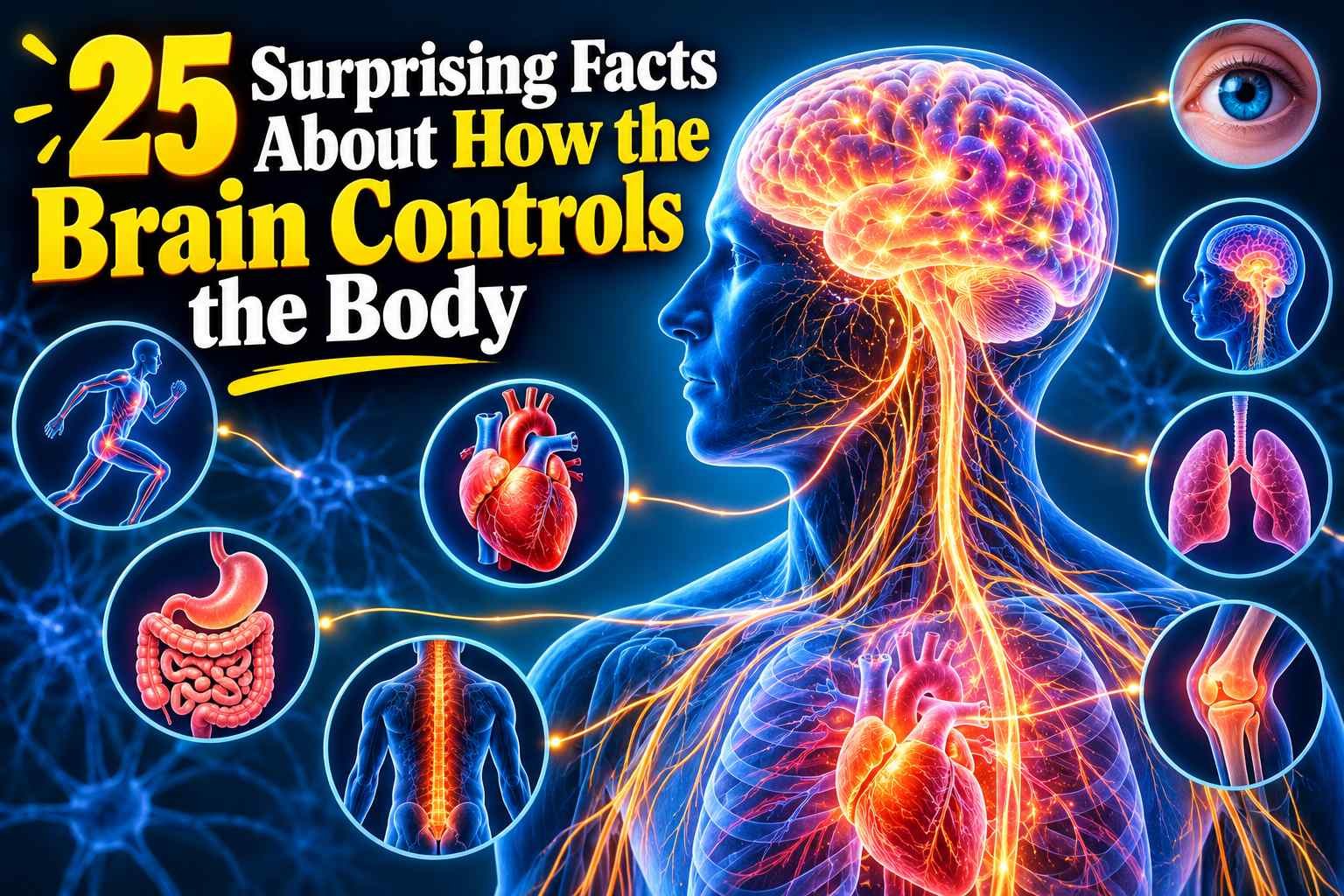
Your brain is the body’s control centre, working around the clock to manage movement, breathing, memory, emotions, and countless other activities. Even when you are sleeping, it continues coordinating essential processes that keep you alive.
What makes the brain so fascinating is how it communicates with the rest of your body. Billions of nerve cells transmit signals, process information, and help you respond to everything from a sudden sound to a change in temperature. Some actions happen consciously, while others take place automatically without you even noticing.
From the way your brain controls your heartbeat to how it helps you maintain balance and react to danger, these 25 surprising facts about how the brain controls the body reveal the incredible science behind everyday human life.
1. Your Brain Controls the Body Through Electrical and Chemical Signals
Have you ever wondered how your brain tells your hand to pick up a glass of water? The process begins with signals travelling through nerve cells called neurons.
These cells communicate using electrical impulses and chemical messengers. When your brain decides to move your hand, signals travel through the nervous system to the muscles involved in that movement.
Your muscles then contract in a coordinated way, allowing you to reach for the glass, grip it, and lift it. All of this happens so quickly that you rarely think about the complicated process taking place inside your body.
2. Your Brain Helps Keep Your Heart Beating
Your heart continues beating whether you are working, sleeping, reading, or watching television. One important part of this process is the autonomic nervous system, which helps regulate heart rate without requiring conscious effort.
The brainstem and other brain regions communicate with the heart through nerve pathways. These signals help adjust your heart rate according to your body’s needs.
For example, your heart may beat faster when you exercise or feel frightened. When you rest, the nervous system can help slow it down. The heart also has its own electrical system, so the brain does not need to send a separate command for every heartbeat.
Also-30 Fascinating Facts About the Human Brain
3. The Brainstem Helps Control Your Breathing
Breathing may feel like something you do automatically, and much of the time, it is. The brainstem contains networks that help generate the rhythm of breathing.
These networks respond to information about carbon dioxide and other chemical conditions in the blood. When your body needs to remove more carbon dioxide, your breathing can become faster or deeper.
You can also voluntarily hold your breath for a short time or change your breathing pattern while speaking. However, automatic breathing control continues to play an essential role in keeping oxygen flowing into your body.
4. The Brain Controls Movement on the Opposite Side of the Body
Here is a surprising fact: the left side of your brain generally controls voluntary movement on the right side of your body, while the right side controls movement on the left.
Many of the nerve fibres carrying movement commands cross over as they travel from the brain toward the spinal cord. This arrangement helps explain why damage to one side of the brain can affect movement on the opposite side of the body.
The brain’s two hemispheres also communicate through a thick bundle of nerve fibres called the corpus callosum. This connection helps different regions share information and coordinate complex activities.
5. Your Cerebellum Helps You Maintain Balance
Walking across a room, riding a bicycle, or standing on one foot requires precise coordination. A brain region called the cerebellum plays a major role in these activities.
The cerebellum receives information from the senses, including signals about body position and movement. It uses this information to help fine-tune muscle activity, improve timing, and maintain balance.
When you learn a physical skill, such as dancing or playing a sport, repeated practice helps your nervous system refine the movements. The cerebellum is an important part of this process, helping actions become smoother and more accurate.
6. Reflexes Can Protect You Before You Think
Imagine touching a hot pan by accident. You may pull your hand away before you have fully processed what happened.
This rapid response is called a reflex. In a simple withdrawal reflex, sensory nerves carry information to the spinal cord, which can quickly activate motor neurons and trigger the muscles to pull your hand away.
The brain also receives information about the painful stimulus, so you become consciously aware of what happened. Reflexes do not mean the brain is uninvolved in every part of the response; rather, the spinal cord can organise certain protective actions without waiting for a conscious decision.
7. Your Brain Helps Regulate Body Temperature
Your body needs to keep its internal temperature within a relatively narrow range for its organs to function properly. A brain region called the hypothalamus plays a major role in this regulation.
When you become too hot, the body can increase sweating and widen blood vessels near the skin’s surface to help release heat. When you become cold, you may begin shivering, which produces heat through muscle activity.
The hypothalamus helps coordinate these responses using information about temperature inside the body and from the surrounding environment. This automatic balancing process is one example of homeostasis, the body’s ability to maintain stable internal conditions.
8. Your Brain Helps You Feel Hungry and Full
Hunger is not simply a feeling that begins in your stomach. The brain receives signals from the digestive system, hormones, and the body’s energy stores to help regulate appetite.
The hypothalamus is especially important in coordinating hunger and fullness. Hormones such as ghrelin and leptin contribute to this signalling system, although appetite involves many other brain regions and biological processes.
After eating, signals from your digestive tract help inform the brain that food has arrived. Over time, the brain combines these signals with memories, habits, emotions, and the sight or smell of food to influence when and how much you want to eat.
9. Your Brain Coordinates Digestion Without You Thinking About It
Digestion involves far more than the stomach breaking down food. The movement of food through the digestive tract, the release of digestive juices, and the absorption of nutrients require careful coordination.
The autonomic nervous system helps regulate many digestive functions. The digestive tract also has its own extensive network of nerve cells, known as the enteric nervous system, which can coordinate many local digestive activities.
The brain and digestive system communicate in both directions. Stress and emotions can affect digestive sensations, while signals from the gut can influence appetite and feelings of discomfort. This two-way communication is often called the gut-brain connection.
10. Your Brain Processes What Your Eyes See
Your eyes collect light, but they do not independently create the complete visual experience you perceive. They convert light into electrical signals that travel through the optic nerves to the brain.
The occipital lobe, located at the back of the brain, plays a central role in processing visual information. Other brain regions help interpret shapes, movement, colours, faces, and the position of objects.
This is why seeing is more than simply receiving an image. Your brain actively organises incoming information to help you understand what is happening around you and decide how to respond.
11. Your Brain Helps You Recognize Sounds and Understand Speech
When someone calls your name, your brain processes the sound and helps you identify the words. This process begins when the ears convert sound vibrations into signals that travel along the auditory pathways.
The brain processes features such as pitch, timing, and sound patterns. Different regions work together to help you recognize familiar voices, understand speech, and identify where a sound is coming from.
Understanding language also involves attention, memory, and context. For example, you can often understand a sentence even when some background noise makes individual words difficult to hear.
12. Your Brain Helps You Feel Pain
Pain is an important warning system that can alert you to injury or possible harm. Specialized sensory nerve endings detect potentially damaging stimuli and send signals through the nervous system.
The brain processes these signals and creates the conscious experience of pain. It also considers factors such as attention, emotion, previous experiences, and the circumstances surrounding an injury.
Interestingly, brain tissue itself does not have the pain receptors needed to feel pain in the same way as skin or other tissues. Headaches can still occur because pain-sensitive structures around the brain, including blood vessels, membranes, muscles, and nerves, can generate pain signals.
13. Your Brain Helps You Control Your Body’s Movements With Precision
Simple actions such as writing your name, buttoning a shirt, or picking up a coin require many muscles to work together.
The motor cortex, located in the frontal lobe, helps plan and initiate voluntary movements. Signals travel through pathways in the brain and spinal cord to activate the appropriate muscles.
Other regions, including the cerebellum and basal ganglia, contribute to timing, coordination, and the selection of movements. Sensory feedback helps the brain adjust your actions as they happen.
This combination allows you to make movements that are both purposeful and adaptable, rather than relying on a fixed sequence of muscle contractions.
14. Your Brain Can Adjust Your Heart Rate During Stress
When you feel frightened, nervous, or excited, your body may prepare for action. The sympathetic branch of the autonomic nervous system helps coordinate this response.
Your heart rate can increase, breathing may become faster, and blood flow can be redirected to support physical activity. Hormones such as adrenaline also contribute to these changes.
This response is useful when you need to react quickly to a challenge. However, prolonged stress can affect sleep, mood, digestion, and overall well-being, which is why relaxation and recovery are important parts of maintaining good health.
15. Your Brain Helps Coordinate Sweating
Sweating is one of the body’s main ways of cooling itself. As sweat evaporates from the skin, it carries heat away and helps lower body temperature.
The hypothalamus helps regulate this process, while the autonomic nervous system activates sweat glands. Sweating can increase during exercise, hot weather, or emotional situations such as nervousness.
Your body does not sweat at the same rate in every situation. Temperature, physical activity, hydration, and individual differences all influence how much sweat you produce.
16. Your Brain Controls the Pupils of Your Eyes
The pupils are the dark openings in the centres of your eyes. They change size to regulate how much light enters.
In bright conditions, the pupils generally become smaller. In dim conditions, they become larger to allow more light to enter the eyes. These changes are controlled by muscles in the iris, with signals travelling through pathways involving the brain and autonomic nervous system.
Pupil size can also change with attention, emotions, and certain medications. This makes the pupils useful not only for adjusting vision but also as one of several clues researchers use when studying how the brain responds to different situations.
17. Your Brain Helps You Swallow and Cough
Swallowing seems simple, but it requires precise timing between muscles in the mouth, throat, and oesophagus. The nervous system coordinates these movements so food and liquid travel toward the stomach.
The brainstem contains important networks involved in swallowing and coughing. A cough helps clear irritants or material from the airways, while swallowing helps protect the respiratory system by directing food and drink away from the windpipe.
These actions are largely automatic, although swallowing also begins with voluntary movements. Their coordination demonstrates how the brainstem supports everyday functions that are essential for safety and survival.
18. Your Brain Helps Coordinate Hormones
The nervous system and endocrine system work together to regulate many body functions. The hypothalamus links these systems by communicating with the pituitary gland, which influences the release of several hormones.
Hormones help regulate growth, reproduction, metabolism, stress responses, and other processes. For example, during a stressful situation, the brain can activate pathways that lead to the release of hormones involved in preparing the body to respond.
The brain does not directly control every hormone-producing gland in the same way. Instead, it uses a combination of neural signals, hormonal feedback, and communication between organs to help maintain balance.
19. Your Brain Continues Working While You Sleep
Sleep may look like a period of inactivity, but your brain remains busy. During sleep, it cycles through different stages that involve changes in brain activity, body functions, and responsiveness to the environment.
Sleep supports learning, memory, attention, and emotional regulation. It also interacts with processes that help maintain normal brain function.
The brain continues to regulate breathing and other essential functions while you sleep. Meanwhile, your body may move, your eyes may shift rapidly during REM sleep, and you may experience dreams.
A good night’s sleep is therefore not wasted time. It is an important part of maintaining the systems that help you think, move, and function during the day.
20. Your Brain Helps You Maintain Blood Pressure
Blood pressure must be regulated so blood can deliver oxygen and nutrients to the body’s tissues. The brainstem helps coordinate rapid adjustments through the autonomic nervous system.
Special sensors in blood vessels detect changes in pressure and send information to the brain. In response, the nervous system can adjust heart rate and the narrowing or widening of blood vessels.
These changes help maintain circulation when you stand up, exercise, or encounter other situations that affect blood pressure. The kidneys, hormones, and other systems also play important roles in long-term blood pressure regulation.
21. Your Brain Uses Sensory Feedback to Correct Mistakes
Have you ever reached for a cup and adjusted your hand at the last moment because it was farther away than you expected? Your brain uses sensory feedback to refine movements as you perform them.
Information from your eyes, muscles, joints, and skin helps the nervous system estimate where your body is and what is happening around it. The brain compares this information with the intended movement and makes corrections when needed.
This feedback system is important for walking, catching a ball, typing, and countless other activities. Without it, movements would be less accurate and much harder to adapt to changing conditions.
22. Your Brain Can Learn New Movement Skills
Learning to ride a bicycle, play a musical instrument, or perform a sport involves changes in the nervous system. Through practice, the brain becomes better at coordinating the signals needed for a particular action.
This ability is connected to neuroplasticity, the brain’s capacity to change its connections and activity in response to learning and experience.
At first, a new skill may require intense concentration. With practice, some parts of the movement can become more automatic, allowing you to perform them with less conscious effort. However, improvement depends on the task, the quality of practice, and individual differences.
23. Your Brain Helps Coordinate Immune and Stress Responses
The brain communicates with the immune system through nervous pathways, hormones, and chemical messengers. Stress, sleep, and emotional experiences can influence some aspects of immune function.
For example, prolonged stress can affect hormonal patterns and inflammatory processes. Adequate sleep and healthy daily habits help support normal functioning across multiple body systems.
This does not mean that thoughts alone can cure an infection or replace medical treatment. Instead, it shows that the brain, hormones, and immune system interact in complex ways that scientists continue to study.
24. Your Brain Does Not Work Alone
Although the brain is often called the body’s control centre, it depends on a network of organs and systems to function properly.
The spinal cord carries information between the brain and much of the body. Peripheral nerves transmit sensory signals and deliver commands to muscles and organs. Meanwhile, the heart supplies oxygen-rich blood, the lungs bring in oxygen, and the digestive system provides nutrients.
Many organs also have local control mechanisms of their own. The heart has its own electrical rhythm, and the digestive tract can coordinate many movements locally. The brain works with these systems rather than issuing every instruction by itself.
25. Your Brain Uses Energy Around the Clock
The adult brain accounts for roughly 2% of body weight but uses about 20% of the body’s energy at rest. This reflects the constant work involved in maintaining nerve cells, transmitting signals, and processing information.
The brain needs a steady supply of oxygen and glucose delivered by the bloodstream. A disruption in this supply can quickly affect brain function, which is why blood flow to the brain is so important.
Sleep, nutrition, hydration, and physical activity all contribute to overall health, although no single habit can guarantee perfect brain performance. The brain is an energy-demanding organ that works continuously to help the body function.
Conclusion
The brain controls and coordinates far more than our thoughts and memories. It helps regulate breathing, heart rate, body temperature, movement, digestion, balance, and the many automatic responses that keep us alive.
Its work depends on constant communication among neurons, the spinal cord, sensory systems, muscles, organs, and hormones. Some actions happen consciously, while others are managed automatically in the background.
These 25 surprising facts show just how closely the brain is connected to every part of the body. By understanding this relationship, we can better appreciate the importance of sleep, regular activity, good nutrition, and seeking medical care when something does not feel right.
Frequently Asked Questions (FAQs)
1. How does the brain control the human body?
The brain communicates with the body through the spinal cord, peripheral nerves, hormones, and other signalling systems. These pathways help control movement, interpret sensory information, and regulate automatic functions such as breathing and heart rate.
2. Which part of the brain controls breathing and heartbeat?
The brainstem contains important networks that help regulate breathing and cardiovascular functions. The heart also has its own electrical conduction system, while the autonomic nervous system adjusts its activity according to the body’s needs.
3. Does the brain control all body functions?
The brain coordinates many essential functions, but it does not act alone. The spinal cord, peripheral nerves, endocrine system, heart, digestive tract, and other organs also have important roles in controlling and regulating the body.
4. How does the brain send messages to muscles?
Motor neurons carry signals from the brain and spinal cord toward muscles. At the connection between a motor neuron and a muscle fibre, chemical signalling helps trigger muscle contraction and movement.
5. Why is the brain important for survival?
The brain helps coordinate essential processes, including breathing, circulation, movement, sensory awareness, and responses to danger. It also supports learning, decision-making, memory, and communication, all of which help people interact with their environment.