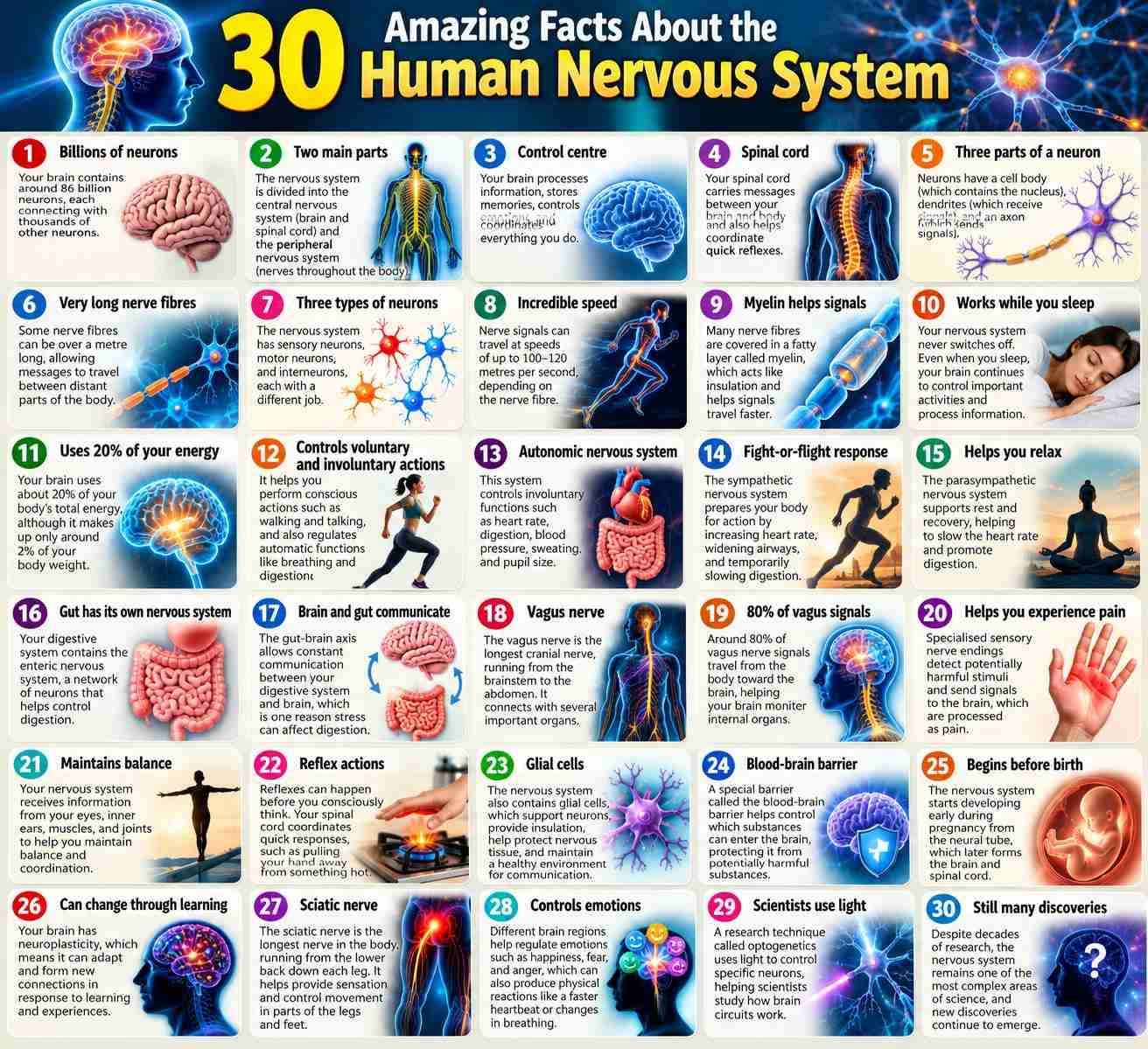
The human body is an incredible machine, and one of the most fascinating systems working behind the scenes is the nervous system. It helps us think, move, feel emotions, recognize sounds, remember experiences, and respond to everything happening around us.
From the moment you wake up in the morning until you fall asleep at night, your nervous system is constantly working. It sends messages between your brain and different parts of your body, controls automatic functions such as your heartbeat, and helps you react when something unexpected happens.
But how much do you really know about this remarkable system? Did you know that the brain contains around 86 billion neurons, that some nerve fibres can extend over a metre, or that your digestive system has its own network of neurons?
The nervous system is full of surprising details that make the human body even more interesting. So, let’s explore 30 amazing facts about the human nervous system and discover how this complex communication network works.
1. Your Nervous System Contains Billions of Neurons
One of the most amazing facts about the nervous system is the enormous number of nerve cells inside your body.
These cells are called neurons, and they are responsible for receiving and transmitting information. The human brain alone contains approximately 86 billion neurons.
Each neuron communicates with other neurons through electrical and chemical signals, creating a vast network that helps you think, move, learn, and respond to your surroundings.
sspwellnesscenter_org_23_fun_facts_about_the_nervous_system (1).pdf
2. The Nervous System Has Two Main Parts
The human nervous system is divided into two major sections:
- Central Nervous System (CNS): Includes the brain and spinal cord.
- Peripheral Nervous System (PNS): Includes the nerves located outside the brain and spinal cord.
The central nervous system processes information and coordinates responses, while the peripheral nervous system connects it with the rest of the body.
Together, these two parts help control almost everything you do, from walking and talking to breathing and digesting food.
Also Read-30 Fascinating Facts About the Human Brain
3. Your Brain Is the Control Centre of Your Body
Think of your brain as the main control centre of your body.
It receives information from your senses, processes it, stores memories, and sends instructions to different body parts. It also plays an important role in emotions, decision-making, language, and movement.
Even when you’re relaxing, your brain is busy managing essential activities. It’s constantly processing information and coordinating the functions that keep you alive.
4. The Spinal Cord Connects Your Brain to Your Body
Your spinal cord is one of the most important parts of your nervous system.
It is a long bundle of nervous tissue that runs through the vertebral canal of your backbone. It carries messages between the brain and much of the body.
The spinal cord also helps coordinate certain reflex actions, allowing you to react quickly without waiting for the brain to process every detail.
hellodoctor_com_ph_brain_ns_interesting_facts_about_the_nerv.pdf
5. Neurons Have Three Main Parts
Neurons may look different depending on their function, but a typical neuron has three important parts:
- Cell body: Contains the nucleus and other structures needed for the cell to function.
- Dendrites: Receive signals from other cells.
- Axon: Carries electrical impulses away from the cell body.
These parts work together to help neurons communicate with one another. Without this communication, the nervous system couldn’t perform its many important tasks.
6. Some Nerve Fibres Can Be Over a Metre Long
You might imagine that nerve cells are extremely small, but some have surprisingly long extensions.
Certain neurons have axons that can reach approximately one metre in length. These long fibres allow messages to travel between distant parts of the body.
For example, some nerve fibres extend from the lower spinal cord toward the feet. It’s impressive to think that a single nerve cell can help connect such distant locations.
7. There Are Three Main Types of Neurons
Not every neuron performs the same job.
The nervous system has three commonly described functional types of neurons:
- Sensory neurons: Carry information from sensory receptors toward the central nervous system.
- Motor neurons: Carry instructions from the central nervous system to muscles and certain glands.
- Interneurons: Connect neurons and help process information within the central nervous system.
These different types work together to help you sense the world, make decisions, and perform movements.
8. Nerve Signals Can Travel at Remarkable Speeds
Your nervous system communicates incredibly quickly.
Some nerve impulses can travel at speeds of around 100 to 120 metres per second, depending on the type of nerve fibre.
This fast communication helps you respond to situations such as touching something hot or catching an object before it falls.
However, not all nerve signals travel at the same speed. Their speed depends on factors such as the size of the nerve fibre and whether it has a protective myelin covering.
9. Myelin Helps Nerve Signals Travel Faster
Some nerve fibres are covered with a special fatty substance called myelin.
Myelin acts like insulation around an electrical wire. It helps nerve impulses travel more efficiently along the axon.
Without healthy myelin, communication between nerve cells can become slower or disrupted. This is why myelin plays an important role in maintaining normal nervous system function.
10. Your Nervous System Works Even While You Sleep
Going to sleep doesn’t mean your nervous system switches off.
Your brain continues to control important activities, including breathing, heart rate, and sleep-related processes. It also remains responsive to certain sounds and changes in your surroundings.
During sleep, the brain is involved in memory processing and other important functions. So, even when you’re resting peacefully, your nervous system is still working behind the scenes.
11. Your Brain Uses Around 20% of Your Body’s Energy
Here’s a surprising fact about the human brain.
Although the brain represents only about 2% of an adult’s body weight, it uses roughly 20% of the body’s energy at rest.
This energy supports activities such as maintaining nerve cells, processing information, and transmitting signals.
In other words, your brain is a relatively small organ with a very demanding energy requirement.
12. Your Nervous System Controls Both Voluntary and Involuntary Actions
Some actions happen because you consciously decide to perform them, while others occur automatically.
Voluntary actions include walking, writing, speaking, and picking up objects.
Involuntary actions include regulating your heartbeat, controlling digestion, and adjusting certain breathing processes.
Your nervous system coordinates both types of activity, allowing you to control your movements while maintaining essential body functions automatically.
13. The Autonomic Nervous System Controls Automatic Body Functions
The autonomic nervous system is responsible for regulating many activities that happen without conscious effort.
These include:
- Heart rate
- Digestion
- Blood pressure
- Sweating
- Certain aspects of breathing
- Pupil size
It helps maintain the body’s internal balance and allows different organs to work together throughout the day.
14. Your Body Has a Fight-or-Flight Response
Have you ever noticed your heart beating faster when you feel frightened or face a stressful situation?
This is partly due to the sympathetic nervous system.
It prepares your body for action by increasing heart activity, widening the airways, and temporarily slowing certain digestive processes.
This response is commonly known as the fight-or-flight response because it helps prepare you to deal with a perceived challenge or threat.
15. Another Part of Your Nervous System Helps You Relax
While the sympathetic nervous system prepares your body for action, the parasympathetic nervous system supports rest and recovery.
It helps slow the heart rate in appropriate situations, promotes digestion, and supports the body’s resting state.
Both systems work together to maintain balance. One prepares the body for action, while the other helps it return to a calmer condition.
16. Your Gut Has Its Own Nervous System
This is one of the most interesting facts about the human nervous system.
Your digestive tract contains a network of neurons known as the enteric nervous system. It helps coordinate digestive activities, including the movement of food through the intestines and the release of digestive substances.
Although it communicates with the brain, the enteric nervous system can also manage many digestive processes locally.
That’s one reason scientists often describe the digestive nervous system as the body’s second brain.
17. Your Brain and Gut Constantly Communicate
Your brain and digestive system are connected through a communication network called the gut-brain axis.
This connection involves nerves, hormones, and chemical signals that travel between the digestive system and the brain.
It helps explain why stress can sometimes affect digestion and why certain digestive problems may be associated with changes in mood or discomfort.
The relationship works in both directions: your brain influences your gut, and your gut sends information back to your brain.
18. The Vagus Nerve Is the Longest Cranial Nerve
The vagus nerve is one of the most important nerves in your body.
It begins in the brainstem and travels through the neck and chest toward the abdomen. Along the way, it connects with several important organs, including the heart, lungs, and digestive system.
The vagus nerve plays a major role in the parasympathetic nervous system and helps regulate several automatic body functions.
19. Most Vagus Nerve Signals Travel From the Body Toward the Brain
Here’s something particularly interesting about the vagus nerve.
Research commonly cited in discussions of the vagus nerve suggests that approximately 80% of its nerve fibres are sensory, carrying information from internal organs toward the brain.
This means the vagus nerve doesn’t simply carry instructions from the brain to the body. It also helps the brain monitor what’s happening inside the body.
It is an important part of the continuous communication between your brain and internal organs.
20. Your Nervous System Helps You Experience Pain
Pain is an important warning signal produced through the nervous system.
Specialized sensory nerve endings called nociceptors detect potentially harmful stimuli, such as extreme heat, pressure, or tissue damage.
They send signals through nerve pathways toward the spinal cord and brain, where the information is processed and experienced as pain.
This protective system helps you recognize potential injuries and respond accordingly.
21. Your Nervous System Helps You Maintain Balance
Have you ever wondered how you can walk, run, or stand without constantly falling over?
Your nervous system plays a major role in maintaining balance and coordination.
It receives information from your eyes, inner ears, muscles, and joints. The brain processes these signals and makes adjustments to your posture and movements.
This complex coordination allows you to walk on uneven ground, turn around, and perform everyday activities.
22. Reflex Actions Can Happen Before You Consciously Think
Imagine accidentally touching a hot cooking pan.
You may pull your hand away almost immediately, sometimes before you consciously recognize the pain.
This is called a reflex action. In many protective reflexes, sensory information travels to the spinal cord, where a quick response is coordinated through a reflex pathway.
The brain receives information too, but the initial response doesn’t need to wait for conscious decision-making.
23. The Nervous System Contains Supporting Cells Called Glial Cells
Neurons aren’t the only important cells in your nervous system.
Another group of cells, known as glial cells, provides support to neurons and helps maintain a healthy environment for nerve communication.
Different types of glial cells have different jobs. Some provide insulation, others help protect nervous tissue, and some support the maintenance and functioning of neurons.
Without these supporting cells, the nervous system couldn’t work properly.
24. The Brain Has a Protective Barrier
Your brain is protected by more than just your skull.
It also has a special structure called the blood-brain barrier, which helps control which substances can move from the bloodstream into brain tissue.
This barrier protects the brain from many potentially harmful substances while allowing essential nutrients to pass through.
It is an important part of the body’s natural defence system.
25. The Nervous System Begins Developing Before Birth
The human nervous system starts developing very early during pregnancy.
A structure called the neural tube forms during the early stages of embryonic development. It eventually develops into the brain and spinal cord.
As development continues, nerve cells grow, connect, and form the networks needed for the nervous system to function.
The process continues after birth, as the brain develops and its connections become more refined.
26. Your Nervous System Can Change Through Learning
Your brain and nervous system are not completely fixed.
They have an ability called neuroplasticity, which means they can change and adapt in response to learning, experiences, and practice.
For example, when you learn to play a musical instrument, practise a new language, or develop a physical skill, your brain can strengthen and reorganize connections between neurons.
This ability helps you acquire new skills and adapt to changing circumstances.
27. The Sciatic Nerve Is the Longest Nerve in Your Body
The sciatic nerve is the longest and one of the largest nerves in the human body.
It begins in the lower back and travels through the buttock and down the back of each leg. Its branches help provide sensation and control movement in parts of the legs and feet.
Because of its length and location, irritation or compression of this nerve can sometimes cause pain that travels from the lower back down the leg.
28. Your Nervous System Helps Control Your Emotions
Your nervous system does much more than control physical movements.
Different brain regions and neural networks are involved in emotional experiences such as happiness, fear, sadness, excitement, and anger.
These networks also interact with hormones and other body systems, which is why emotions can sometimes produce physical reactions such as sweating, a faster heartbeat, or changes in breathing.
Your feelings and physical responses are closely connected.
29. Scientists Can Study and Control Specific Neurons Using Light
Modern neuroscience has developed some fascinating research techniques.
One example is optogenetics, a method that uses light-sensitive proteins to control the activity of selected cells.
Scientists can use this technique to activate or inhibit particular neurons and study how they influence behaviour and body functions.
It has become an important research tool for understanding how different brain circuits work.
30. Neuroscience Is Still Discovering New Things About the Nervous System
Despite decades of research, the nervous system remains one of the most complicated areas of science.
Scientists continue to investigate how memories are formed, how the brain processes information, how nerve cells communicate, and how neurological conditions develop.
The study of the nervous system is called neuroscience, and new technologies are helping researchers understand the brain and nerves in increasingly detailed ways.
There is still much to discover about the system that allows us to think, feel, learn, and interact with the world.
Conclusion
The human nervous system is truly remarkable. It controls our movements, processes information from our senses, regulates automatic body functions, and helps us experience thoughts and emotions.
From billions of neurons and incredibly fast nerve signals to the gut-brain connection and the body’s natural reflexes, every part of this system has an important role to play.
Perhaps the most fascinating thing is that your nervous system never stops working. Even while you’re sleeping, it continues managing essential functions and responding to information from inside and outside your body.
The next time you walk, laugh, learn something new, or pull your hand away from a hot object, remember the extraordinary network of nerves and brain cells working behind the scenes.