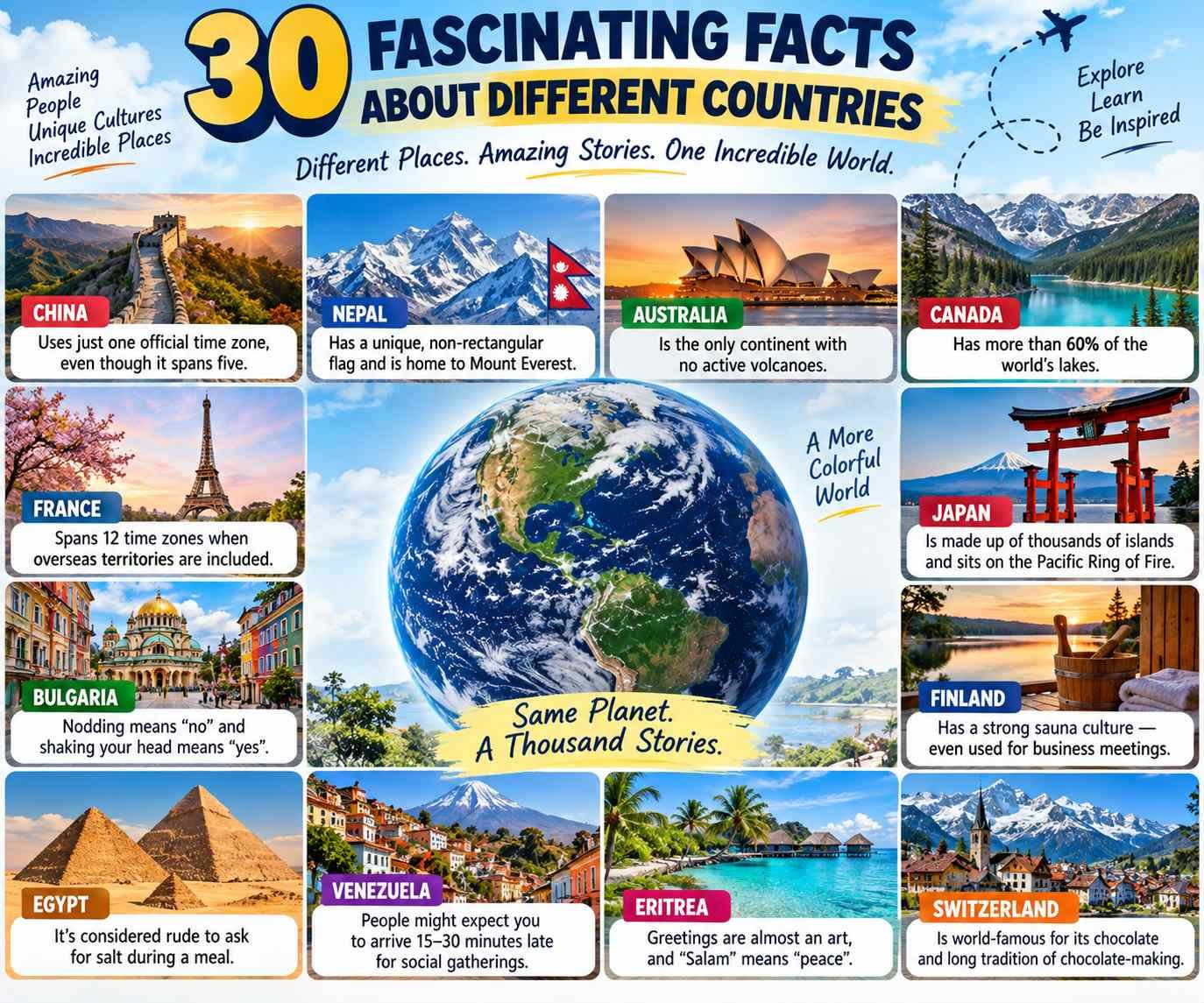
One of the best things about our world is that no two countries are exactly alike. Every nation has its own history, traditions, geography, food, languages, customs, and little quirks that make it interesting.
Some country facts are so unusual that they sound almost made up. Did you know that China uses a single official time zone despite stretching across a huge part of the continent? Or that Nepal has a national flag that isn’t rectangular? And then there are countries where an everyday gesture can mean something completely different from what you’re used to.
So, if you enjoy geography trivia or simply love discovering strange things about the world, you’re in the right place. Here are 30 fascinating facts about different countries that might surprise you.
1 China Uses Just One Official Time Zone
China is geographically wide enough to span roughly five traditional time zones, but the entire country officially follows China Standard Time.
That means the clock shows the same official time in Beijing as it does in China’s far western regions, even though sunrise and sunset can occur at very different times.
2 Nepal Has a Non-Rectangular National Flag
Most national flags are rectangles. Nepal decided to do things differently.
Its flag consists of two joined triangular pennants, making it the only national flag that isn’t rectangular or square. The unusual design has become one of the country’s most recognizable symbols.
Also Read-25 Strange Facts That Sound Completely Impossible
3 Canada Has an Incredible Number of Lakes
Canada is famous for its lakes—and for good reason.
The sample article notes that Canada contains more than 60% of the world’s lakes, including the five Great Lakes shared with the United States. It also describes Canada as having upwards of two million lakes.
That’s a lot of places to go fishing, kayaking, or simply enjoy the view.
4 France Spans More Time Zones Than You Might Expect
If overseas territories are included, France spans 12 time zones.
That’s because French territories are scattered across different parts of the world, including the Pacific, Indian, Atlantic, and other regions. So while metropolitan France is much smaller geographically, the wider French territory reaches across an enormous range of longitudes.
5 China and Russia Each Border 14 Countries
China and Russia are enormous countries, and their size is reflected in the number of international borders they share.
According to the sample source, both countries are bordered by 14 countries. China and Russia also share a border with each other.
6 Australia Has No Active Volcanoes on Its Mainland
Australia has evidence of ancient volcanic activity, but the mainland currently has no active volcanoes.
That doesn’t mean Australia is free from geological surprises. The country still has fascinating rock formations and volcanic remnants from activity that happened thousands or millions of years ago.
7 New Zealand Was an Early Pioneer of Women’s Voting Rights
New Zealand became the first self-governing country to grant women the right to vote in national elections, doing so in 1893.
Australia followed in 1902 at the federal level, although voting rights for Indigenous Australians were subject to significant restrictions for many years.
8 Guatemala Recognizes Many Indigenous Languages
Spanish is Guatemala’s official language, but the country’s linguistic landscape is much richer than that.
The sample source notes that 23 languages are officially recognized by the government, including Spanish and Indigenous languages from Maya, Xinca, and Garifuna communities.
It’s a great reminder that a country’s linguistic identity can be much more diverse than its most widely spoken language.
9 South Sudan Became Independent in 2011
South Sudan declared independence from Sudan on July 9, 2011, becoming the world’s newest internationally recognized sovereign state at the time.
Its independence followed decades of conflict and a referendum in which voters overwhelmingly supported separation.
10 Switzerland Has a Famous Chocolate Tradition
Switzerland is almost impossible to discuss without mentioning chocolate.
Modern Swiss chocolate-making has a long history, and the country became particularly famous for developing smooth, refined chocolate-making techniques. The sample source notes that chocolate production in Switzerland dates back to the 19th century and highlights Rodolphe Lindt’s contribution to conching.
11 Spain Has a Distinctive Greeting Tradition
In Spain, a common social greeting between women, and between women and men depending on the relationship and setting, can involve touching cheeks and making a kissing gesture on both sides.
The sample source emphasizes that this isn’t necessarily an actual kiss and that professional situations commonly use handshakes instead.
So if you’re visiting Spain, don’t be surprised if greetings look a little different from what you’re accustomed to.
12 In South Korea, Red Ink Has a Cultural Meaning
In South Korea, traditionally writing someone’s name in red ink can be considered inappropriate.
The practice is associated with writing the names of deceased people, so using red ink for a living person’s name may carry an uncomfortable meaning.
It’s a small cultural detail, but one that can be useful to know.
13 Finland Has a Strong Sauna Culture
Saunas are deeply connected with Finnish culture.
The sample source describes sauna-going as a regular part of life in Finland and notes that saunas have even been used for informal interactions involving business partners, Parliament, and the military.
In Finland, a sauna can be much more than simply a place to relax.
14 Bulgaria Has an Unusual Head Gesture
Here’s a country fact that can genuinely confuse visitors.
The sample source explains that traditional Bulgarian head gestures can differ from the conventions many foreigners expect: an upward movement of the chin can indicate “no,” while a sideways movement can be used to indicate “yes.”
So a familiar-looking gesture may not always mean what you think it means.
15 Fijians May Raise Their Eyebrows to Say Yes
In Fiji, raising the eyebrows can be used as a way of indicating agreement or a positive response.
The sample source specifically notes that visitors shouldn’t automatically interpret the gesture as judgment or confusion.
A tiny facial movement can carry a surprisingly clear message.
16 Hungary Has a Unique Toasting Tradition
In many places, clinking glasses during a toast is completely normal. Hungary has a different cultural history surrounding the gesture.
The sample source explains that some Hungarians traditionally avoid clinking beer glasses, a custom connected with the memory of the 1848 Hungarian Revolution and Austria’s victory.
The tradition has historical roots rather than simply being a random rule.
17 Germany Has a Strong Handshake Tradition
Handshakes are an important part of greetings in Germany.
The sample source notes that Germans commonly shake hands when entering or leaving a room and may greet each person individually rather than giving a general hello to the group.
It’s a simple gesture, but knowing the local custom can make social situations much easier.
18 In Egypt, Asking for Salt Can Be Considered Rude
Here’s an etiquette fact that could easily catch a visitor off guard.
The sample source explains that asking for salt or pepper during a meal in Egypt can be interpreted as suggesting that the food wasn’t seasoned properly.
Of course, customs can vary between people and settings, but it’s an interesting example of how dining etiquette differs around the world.
19 Iran’s Traditional Weekend Is Different From Many Countries
Iran’s official weekend structure differs from the Saturday-Sunday pattern common in many countries.
The sample source notes that Friday is the official weekend day, while many businesses also close on Thursday. Saturday and Sunday are generally working days.
That can be important to remember when scheduling international communication.
20 Venezuela Has a More Flexible Social Punctuality Tradition
In some Venezuelan social settings, arriving a little later than the scheduled time may be more culturally acceptable than it would be elsewhere.
The sample source says that people may expect guests to arrive 15–30 minutes later for social gatherings, while professional meetings still call for punctuality.
As always, the context matters.
21 In Eritrea, Greetings Can Be Very Important
Greeting people warmly is an important part of social interaction in Eritrea.
The sample source describes handshakes and the greeting “Salam”, meaning “peace,” while also noting that cheek-to-cheek greeting customs can occur in some situations.
It’s a nice example of how a simple hello can play a meaningful role in building relationships.
22 China’s Geography Makes Its Single Time Zone Especially Interesting
China’s single official time zone becomes even more remarkable when you consider its enormous east-to-west span.
The sample source points out that the country stretches roughly 4,800 kilometers across, meaning people in the west can experience sunrise and sunset much later by the clock than people in the east.
Nature follows the Sun; the clocks simply agree to disagree.
23 Bhutan Is a Mountainous Country Between India and China
Bhutan sits in the eastern Himalayas between India and China.
Its landscape rises dramatically from lower southern areas toward some of the highest mountains in the Himalayas. Bhutan is also known for its distinctive cultural traditions and mountain monasteries.
24 Bhutan Has a Remarkable Forest Landscape
Bhutan is notable for its extensive forest cover and mountainous terrain.
Its geography ranges from subtropical areas in the south to high Himalayan environments in the north, creating a remarkable variety of ecosystems within a relatively small country.
25 Lesotho Is Completely Surrounded by South Africa
Lesotho is one of the world’s most unusual geographical countries because it is completely surrounded by South Africa.
That makes it an enclave country: to travel from Lesotho to another country by land, you have to cross South African territory.
26 Nepal Is Home to Mount Everest
Nepal contains part of the Himalayas and is home to Mount Everest, the highest point on Earth above sea level.
The mountain reaches approximately 8,849 meters above sea level and attracts climbers and trekkers from around the world.
27 Japan Is Made Up of Thousands of Islands
Japan isn’t just one island.
It is an archipelago made up of thousands of islands, with the Japanese government’s current classification counting more than 14,000 islands. The country’s four traditional main islands are Honshu, Hokkaido, Kyushu, and Shikoku, alongside many smaller islands.
28 Japan Sits on an Active Geological Zone
Japan lies along the Pacific Ring of Fire, where several tectonic plates interact.
This geological setting helps explain why Japan experiences earthquakes, volcanic activity, and tsunamis. Its dramatic mountains and volcanic landscapes are also part of this geological story.
29 Nepal’s Flag Reflects a Very Different Design Tradition
Nepal’s flag isn’t simply unusual because of its shape.
Its two triangular sections contain symbols of the Moon and Sun, giving the flag a design unlike the rectangular national flags used almost everywhere else.
It’s one of those small geography facts that makes a country instantly recognizable.
30 Every Country Has Its Own Cultural Details
Perhaps the most fascinating fact about different countries is that geography is only part of the story.
A greeting in Spain, a sauna invitation in Finland, a gesture in Bulgaria, a name written in South Korea, or a toast in Hungary can all carry meanings that aren’t obvious to outsiders. The sample sources repeatedly emphasize how understanding local customs can help people communicate respectfully across cultures.
And that’s what makes traveling and learning about the world so rewarding: there is always something new to discover.
Conclusion
The world is full of countries that are far more interesting than a line on a map. Each one has its own combination of geography, history, traditions, languages, customs, and everyday habits.
From China’s enormous single time zone and Canada’s countless lakes to Nepal’s extraordinary flag and Lesotho’s unique geography, these facts show just how diverse our planet really is.
And honestly, that’s probably the best part of learning about different countries. The more you explore, the more you realize how much there is still left to learn.
1 thought on “30 Fascinating Facts About Different Countries”