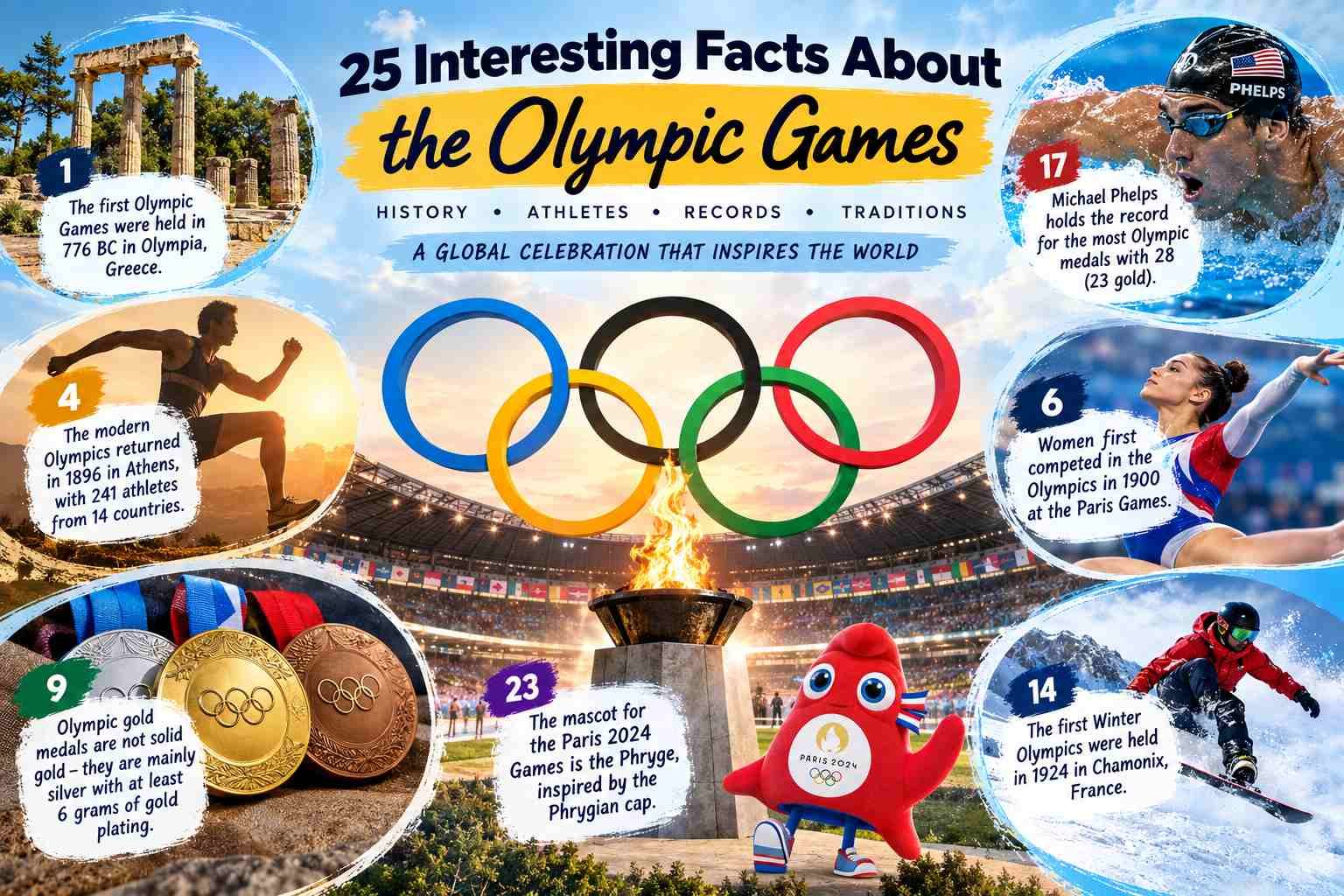
The Olympic Games are more than just a global sporting event. They are a celebration of human strength, determination, teamwork, and the incredible things athletes can achieve. Every few years, millions of people around the world come together to watch their favorite athletes compete for Olympic glory.
But did you know that the ancient Olympics began with a single footrace? Or that tug-of-war was once an official Olympic sport? The history of the Olympics is filled with surprising moments, unusual competitions, and fascinating records that many people have never heard of.
Whether you’re a sports fan, a history lover, or simply curious about the world, these 25 interesting facts about the Olympic Games will help you discover the stories behind one of the most famous sporting events on Earth.
1. The First Recorded Olympic Games Were Held in 776 BC
The history of the Olympic Games goes back more than 2,700 years. The first recorded ancient Olympic Games took place in Olympia, Greece, in 776 BC. The event was part of a religious festival held in honor of Zeus, the king of the Greek gods.
Although historians believe athletic contests may have existed even earlier, 776 BC is the traditional starting point of the recorded Olympic history. The ancient Games were held every four years and continued for centuries.
2. The Ancient Olympics Started With Just One Event
Imagine watching the Olympics with only one competition on the schedule! That’s how the ancient Games began. The earliest recorded Olympics featured a single footrace called the stadion, a sprint of roughly 190 to 200 meters.
Over time, more events were introduced, including wrestling, boxing, discus throwing, and chariot racing. What began as a small athletic contest gradually developed into a major sporting festival.
Also Read-30 Fascinating Facts About Different Countries
3. The Ancient Olympic Games Were Held to Honor Zeus
The original Olympic Games were not simply sporting competitions. They were deeply connected to religion in ancient Greece. Athletes and visitors gathered at Olympia to honor Zeus, and the festival included religious ceremonies alongside athletic events.
This connection explains why Olympia was considered a sacred place and why the Games held such importance in Greek culture.
4. The Modern Olympics Returned in 1896
After the ancient Olympic tradition faded, the Games were revived in the 19th century through the efforts of French educator and historian Baron Pierre de Coubertin.
The first modern Olympic Games were held in Athens, Greece, in 1896. Around 241 athletes from 14 countries participated in nine sports. The event marked the beginning of the modern international Olympic movement.
5. The First Modern Olympic Champion Won a Triple Jump
The first modern Olympic champion was American athlete James Brendan Connolly. He won the triple jump at the 1896 Athens Olympics.
Here’s an interesting twist: Connolly had to leave Harvard to compete, and the university reportedly did not approve his request for a leave of absence. His decision became part of Olympic history when he returned with a medal.
6. Women First Competed in the Olympics in 1900
The first modern Olympics in 1896 were open only to men. Women made their Olympic debut at the 1900 Paris Games, competing in a small number of sports, including tennis and golf.
Since then, women’s participation has expanded dramatically. The Olympics have gradually become a much more inclusive event, with women competing across a wide range of sports.
7. Tug-of-War Was Once an Olympic Sport
Tug-of-war may remind you of school sports days, but it was once a serious Olympic competition. The sport appeared at the Summer Olympics from 1900 to 1920.
Teams pulled against each other in a test of strength and coordination. Although tug-of-war is no longer part of the Olympic programme, its unusual place in Olympic history still surprises many fans.
8. Live Pigeon Shooting Was Once an Olympic Event
One of the strangest events in Olympic history took place at the 1900 Paris Games: live pigeon shooting.
Unlike modern shooting competitions, this event involved shooting actual birds. It was held only once as an Olympic medal event and was never included again. Today, Olympic shooting uses targets rather than live animals.
9. Olympic Gold Medals Are Not Made of Solid Gold
Winning an Olympic gold medal is a dream for many athletes, but the medal itself is not a solid piece of gold.
Modern Olympic gold medals are primarily made of silver and coated with gold. Under Olympic requirements, the gold plating must contain at least six grams of pure gold. The last solid-gold Olympic medals were awarded in 1912.
10. The Marathon Distance Was Standardized at the 1908 Olympics
The modern marathon distance is 42.195 kilometers, or 26 miles and 385 yards. But why such an unusual distance?
At the 1908 London Olympics, the marathon course was extended so that it could start at Windsor Castle and finish in front of the royal box at the stadium. That distance later became the official marathon standard.
11. The Olympic Games Once Included Art Competitions
From 1912 to 1948, the Olympics included competitions in art. Athletes weren’t the only ones who could win medals—artists could, too!
The categories included architecture, literature, music, painting, and sculpture. The works had to be inspired by sport. Even Pierre de Coubertin, the founder of the modern Olympic movement, won a gold medal in literature in 1912.
12. The Olympic Rings Were Designed in 1913
The five interlocking Olympic rings are among the most recognizable symbols in the world. They were designed by Pierre de Coubertin in 1913.
The rings represent the unity of the world’s inhabited continents and the meeting of athletes from around the globe. Their blue, yellow, black, green, and red colors, displayed on a white background, became an enduring symbol of the Olympic movement.
13. The Olympic Games Have Been Canceled Because of World Wars
The Olympics are normally held every four years, but world events have sometimes interrupted the tradition.
The 1916 Summer Olympics were canceled because of World War I. The 1940 and 1944 Summer and Winter Games were also canceled during World War II. These cancellations are a reminder that even a major international sporting event can be affected by global conflict.
14. The First Winter Olympics Were Held in 1924
The Olympic Games are not just about summer sports. The first Winter Olympics took place in Chamonix, France, in 1924.
The event featured winter sports such as skiing, skating, and ice hockey. It eventually developed into a major international competition in its own right, bringing together athletes who compete on snow and ice.
15. The Olympic Flame Was First Lit at the 1928 Games
The Olympic flame is one of the most meaningful traditions of the Games. It was first lit during the opening ceremony of the 1928 Amsterdam Summer Olympics.
Today, the flame is lit at Olympia, Greece, before each edition of the Games. Its journey to the host city is part of the ceremony and symbolizes continuity between the ancient and modern Olympics.
16. The Olympic Torch Relay Began in 1936
The torch relay, now a familiar part of the Olympic build-up, was introduced at the 1936 Berlin Games.
The relay connects Olympia with the host city through a journey involving torchbearers. While its beginnings are tied to the 1936 Games, the tradition has since become one of the Olympics’ most recognizable ceremonies.
17. Michael Phelps Holds the Record for the Most Olympic Medals
American swimmer Michael Phelps is the most decorated Olympian in history. Across four Olympic Games from 2004 to 2016, he won 28 medals, including 23 gold medals.
His achievements across multiple swimming events made him one of the most celebrated athletes in Olympic history.
18. The Youngest Olympic Gold Medalist Was Just 13
Marjorie Gestring of the United States won gold in springboard diving at the 1936 Berlin Olympics when she was only 13 years old.
Her achievement remains one of the most remarkable examples of youth success in Olympic history. It also shows that Olympic champions can emerge at a very young age.
19. One Athlete Won Medals at Both Summer and Winter Olympics in the Same Year
Christa Luding-Rothenburger of East Germany achieved a rare Olympic feat in 1988. She won a silver medal in speed skating at the Calgary Winter Olympics and a bronze medal in cycling at the Seoul Summer Olympics.
The Winter and Summer Games were later staggered, beginning in 1994, making this same-year achievement a unique chapter in Olympic history.
20. The Olympic Games Were Postponed for the First Time in 2020
The Tokyo 2020 Summer Olympics were postponed because of the COVID-19 pandemic and held in 2021.
Despite the one-year delay, the event retained the name “Tokyo 2020.” It was an unusual moment in Olympic history, as the Games continued under extraordinary public-health restrictions and without regular spectator attendance at most venues.
21. London Has Hosted the Summer Olympics Three Times
London has hosted the Summer Olympic Games in 1908, 1948, and 2012.
The 2012 Games made London the first city to host the Summer Olympics three times. The city has played an important role in Olympic history across different eras.
22. The 2016 Olympics Were the First Held in South America
The 2016 Summer Olympics took place in Rio de Janeiro, Brazil. It was the first time the Olympic Games were held in South America.
The Rio Games also marked the first Olympic appearances of Kosovo and South Sudan, while the Refugee Olympic Team made its debut.
23. The Olympic Mascot Is Designed by the Host
Olympic mascots are more than cute characters used on posters and souvenirs. They are designed to reflect the culture, history, or identity of the host country.
For the Paris 2024 Games, the mascots were called the Phryges, inspired by the Phrygian cap—a symbol associated with liberty and freedom in France.
24. The Olympic Motto Means “Faster, Higher, Stronger – Together”
The Olympic motto is Citius, Altius, Fortius – Communiter, which translates from Latin as “Faster, Higher, Stronger – Together.”
The word “Together” was added to the motto in 2021. It highlights the importance of solidarity and collective effort alongside athletic achievement.
25. The Olympic Games Bring Together Athletes From Around the World
One of the most remarkable things about the Olympics is the sheer variety of people and nations it brings together.
Athletes from different countries, cultures, and backgrounds compete in the same event, each representing years of dedication and training. The Olympic Games are not only about medals and records—they also create opportunities for cultural exchange and shared experiences through sport.
Conclusion
The Olympic Games have come a long way from a single footrace in ancient Greece to a global sporting celebration featuring thousands of athletes and dozens of sports. Along the way, the Olympics have seen unusual competitions, historic achievements, changing traditions, and moments that have shaped sports history.
These 25 interesting facts about the Olympic Games reveal just how much there is to learn beyond the medals and ceremonies. Whether it’s the story behind the Olympic rings, the history of tug-of-war, or Michael Phelps’ extraordinary medal record, every fact offers another glimpse into the fascinating world of the Olympics.
The next time you watch the Games, remember that you’re not just watching athletes compete—you’re witnessing a tradition that has evolved over thousands of years.