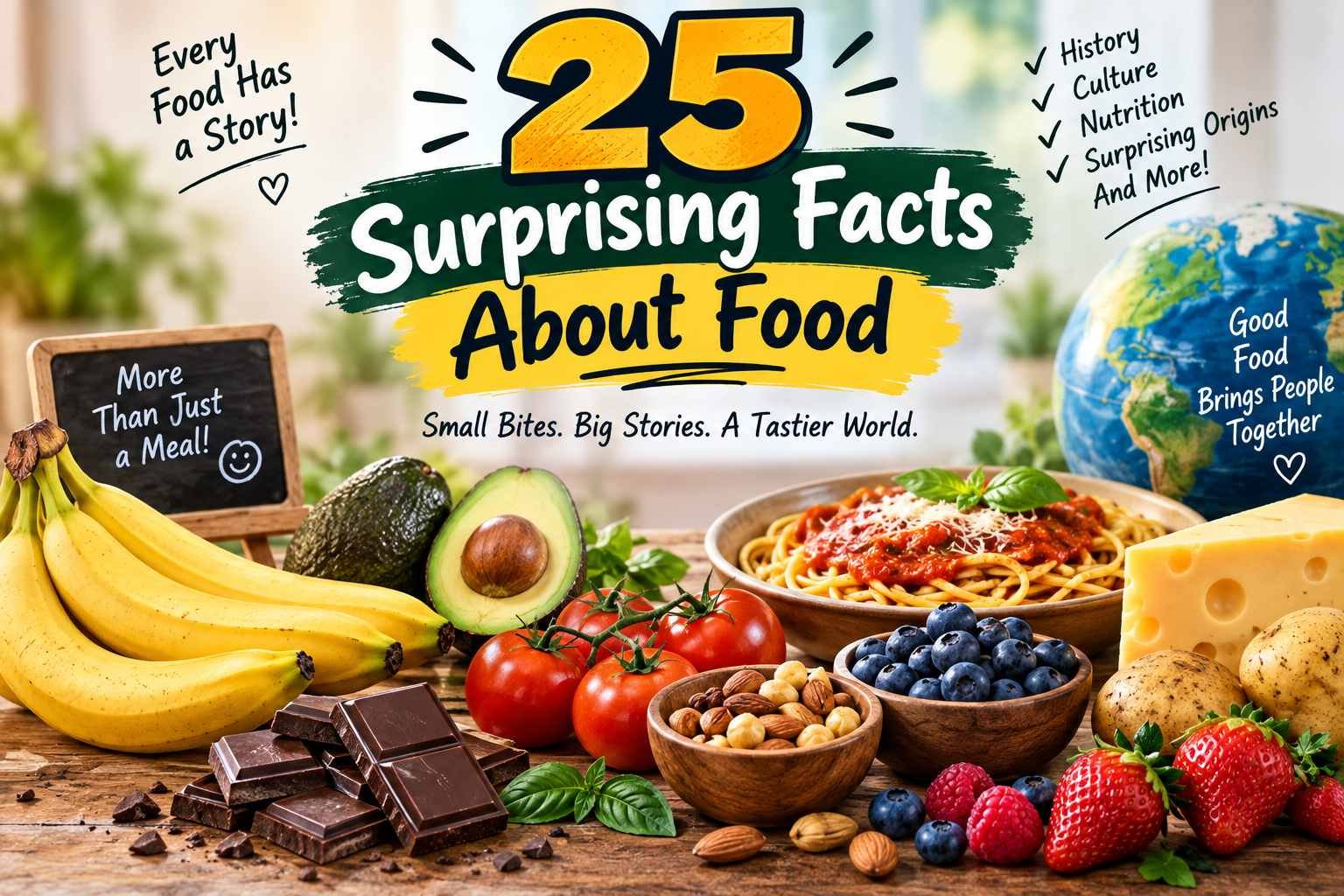
Food is something we think about every day. We shop for it, cook it, share it, and, of course, enjoy it. But how often do we stop and wonder where our favorite foods came from or what makes them so unusual?
From fruits that aren’t really what they seem to be to dishes with surprising origins, the world of food is packed with stories that can make you look at your plate a little differently. Here are 25 surprising food facts that are fun, fascinating, and sometimes hard to believe.
1. Bananas are technically berries
Here’s a food fact that sounds completely backwards: bananas are classified as berries in botanical terms. Their structure fits the scientific definition of a berry because they develop from a single flower and contain seeds within their fruit.
So while strawberries get all the attention when we talk about berries, bananas can technically join the club too.
2. Watermelons come in more varieties than you might expect
When you picture a watermelon, you probably imagine a large green fruit with bright red flesh. But there are actually more than 1,200 varieties of watermelon, grown in dozens of countries.
Some varieties even have yellow flesh instead of the familiar pink or red interior. China is also the world’s leading watermelon producer according to the sample source.
Also Read-30 Interesting Facts About Famous Landmarks
3. McDonald’s isn’t the oldest fast-food burger chain
Many people associate the beginning of fast food with McDonald’s, but the story goes back further.
White Castle was founded in 1921 in Kansas and is credited by the source as the first fast-food burger chain. McDonald’s would come later, becoming one of the world’s most recognizable fast-food brands.
4. Many people actually prefer lightly toasted bread
Toast seems simple enough, but apparently people have strong opinions about how brown it should be.
A 2019 YouGov survey cited in the sample found that about 66 percent of Americans preferred their toast lightly toasted, while a smaller group preferred their bread somewhat to very darkly toasted.
So if you like your toast golden rather than almost burnt, you’re certainly not alone.
5. Only about one-fifth of Americans drink their coffee black
Coffee preferences can be surprisingly specific. According to the survey cited in the sample, only 20 percent of Americans preferred their coffee black, while another 19 percent didn’t drink coffee at all.
Most coffee drinkers preferred some amount of milk, ranging from a light tan color to a much paler cup.
Apparently, for many people, coffee isn’t really complete until something gets added to it.
6. Girl Scout cookies started as homemade treats
The famous Girl Scout cookie tradition has surprisingly humble beginnings.
The selling of Girl Scout cookies began as early as 1917. During the 1920s, Girl Scouts baked sugar cookies, packaged them in waxed paper bags, and sold them door to door to raise money for troop activities.
What began with homemade cookies eventually became a much-loved annual tradition.
7. The biggest U.S. ice cream market isn’t necessarily where you’d expect
You might assume Florida would be the biggest ice cream market because of its warm weather. Surprisingly, the sample source points to the Great Lakes region, including Illinois, Indiana, Michigan, Ohio, and Wisconsin.
In 2020, U.S. ice cream makers produced just over 1 billion gallons of ice cream.
That’s enough ice cream to make almost anyone’s freezer look seriously undersized.
8. Broccoli can contain more vitamin C than an orange
Oranges have long been associated with vitamin C, but broccoli deserves some attention too.
According to the sample source, a cup-sized serving of broccoli provides 81 milligrams of vitamin C, which is more than the amount listed for a whole orange. It also provides fiber and protein while being relatively low in calories.
Maybe broccoli deserves a little more credit at the dinner table.
9. Nobody is completely certain where Boston cream pie originated
Despite its name, Boston cream pie isn’t technically a pie in the traditional sense. It’s actually a cake filled with cream and covered with chocolate.
The Boston Parker House Hotel is often credited with its creation, but the sample source notes that there isn’t solid proof establishing exactly where it originated.
One thing, however, isn’t really in dispute: it sounds delicious.
10. Apples became deeply rooted in American history
Apples have been part of American food culture for centuries. According to the sample source, early settlers planted apple trees in the Massachusetts Bay Colony, and apple orchards can now be found across the United States.
Apples are also naturally free of fat, sodium, and cholesterol and provide fiber.
11. Lasagna may have an older connection to Greece than you thought
Lasagna is strongly associated with Italian cuisine, but its history may go back further.
The sample source explains that the name is connected to laganon, a fermented noodle-like food associated with ancient Greece. The dish later became part of Italian cuisine and eventually spread around the world.
So that comforting plate of lasagna has a history that’s more complicated than its Italian reputation suggests.
12. Most of the world’s vanilla comes from Madagascar
Vanilla is one of those flavors that seems ordinary until you discover how special its production is.
The sample source states that around 80 percent of the world’s vanilla comes from Madagascar, which is also a major source of vanillin used for vanilla flavoring.
That little bottle of vanilla extract suddenly seems a lot more interesting.
13. Chocolate has been connected with rituals and medicine for centuries
Chocolate wasn’t always the sweet treat we know today.
The sample source credits the Olmec civilization of ancient Mesoamerica with being among the earliest people to turn cacao into a chocolate drink. It was used during rituals and also as a form of medicine.
Modern chocolate may be a dessert, but cacao has a much deeper history.
14. Ketchup was once used as medicine
Today, ketchup is usually found beside fries, burgers, and sandwiches. But in the 1830s, ketchup was promoted as a treatment for diarrhea and other gastrointestinal problems, according to the sample source.
It’s probably safe to say that ketchup’s career has changed quite a bit over the years.
15. Ghana and Côte d’Ivoire are major cocoa producers
Chocolate lovers might be surprised to learn just how important West Africa is to the cocoa industry.
The sample source states that Côte d’Ivoire and Ghana together account for more than half of the world’s cocoa production.
So the next time you enjoy chocolate, there’s a good chance its story connects back to cocoa-growing regions in this part of the world.
16. Mustard is one of the world’s oldest condiments
Mustard may look simple, but humans have been enjoying it for a very long time.
The sample source describes mustard as one of the world’s oldest condiments and notes that Romans used ground mustard mixed with spices and oil as a glaze for wild boar.
That’s quite a journey from ancient Roman meals to the familiar yellow bottle on today’s tables.
17. French fries may not be French
The name gives one impression, but their history is more complicated.
According to the sample source, historians have linked the origins of fried potatoes to Belgium, where potatoes were reportedly being fried as far back as the late 1600s.
So your next plate of fries might deserve a little Belgian appreciation.
18. Blueberries have been studied for their effects on memory
Blueberries aren’t just colorful additions to cereal or pancakes. The sample source describes research in which young and older adults who consumed blueberries showed increased blood flow to certain brain areas along with improvements in memory and attention-related tasks.
That doesn’t make blueberries a magic food, but it certainly gives this little fruit an interesting scientific story.
19. Milk is consumed on a truly enormous scale
Milk is one of the most widely consumed foods around the world, and the numbers are enormous.
The sample source says worldwide milk consumption was projected at 223 billion liters in 2016, while the European Union produced more than 163 million metric tons of cow’s milk that year.
That’s a lot of milk—far more than could ever fit in your refrigerator.
20. Spain is a major olive oil producer
Olive oil has been an important part of Mediterranean cuisine for centuries. The sample source identifies Spain as the world’s largest producer of olive oil, with production accounting for more than half of global output in the cited figures.
From salads to cooking, olive oil has become a kitchen staple far beyond the Mediterranean.
21. Food waste is a huge problem
Not every food story is funny or surprising in a lighthearted way.
The sample source reports that the United States wastes more than 100 billion pounds of food each year, representing a huge amount of discarded meals and economic value.
It’s a reminder that food isn’t just something to enjoy—it is also something worth appreciating and not wasting unnecessarily.
22. There are thousands of types of potatoes
Think you know potatoes? Think again.
The sample source states that there are more than 4,000 different types of potatoes around the world, with Peru particularly known for its many varieties. Different potatoes can have different textures, making some better suited for salads while others work well for mashed potatoes or dumplings.
And apparently, the largest recorded potato weighed almost 5 kilograms. That’s one serious potato!
23. Quinoa isn’t technically a grain
Quinoa is often grouped with rice, wheat, and other grains, but botanically it is different.
The sample source describes quinoa as a pseudograin because the part we eat is actually a seed from a leafy plant. It grows in the Andes of South America and was an important food for the Incas.
It’s a great example of how everyday food names don’t always tell the whole scientific story.
24. Rice has been feeding people for thousands of years
Rice is one of the world’s most important staple foods. The sample source notes that it has been cultivated in Asia for more than 5,000 years and is eaten by billions of people.
It is commonly grown in flooded fields known as paddies and can be boiled, steamed, fried, or used in dishes such as risotto.
Few foods have had such a lasting place in human diets.
25. Wheat is one of the oldest cultivated food crops
Wheat has been part of human diets for an incredibly long time. According to the sample source, early farmers were growing wheat more than 10,000 years ago.
Today, wheat is used to make everything from bread and flour to pasta, cakes, biscuits, and breakfast cereals. It is also grown on every continent except Antarctica.
It’s hard to imagine modern food without it.
Conclusion
Food is much more than something we eat when we’re hungry. Behind almost every ingredient is a story involving history, culture, science, farming, and sometimes a surprising twist.
Who would have guessed that bananas could be berries, that French fries might have Belgian roots, or that ketchup once had a completely different reputation? These little details make everyday foods much more fascinating.
The next time you sit down for a meal, take a closer look at what’s on your plate. You might be eating a piece of history without even realizing it.