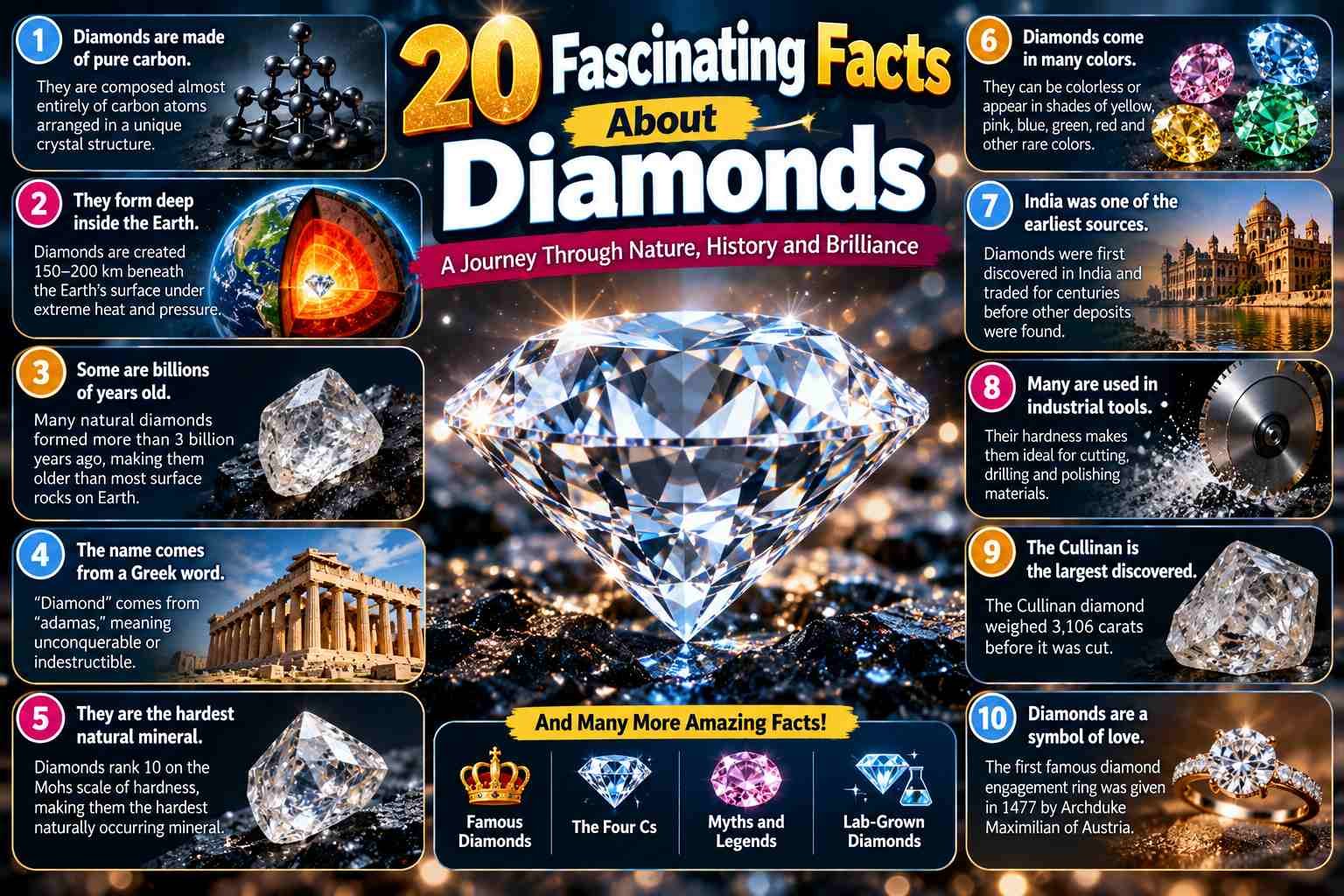
Diamonds have fascinated people for thousands of years. Known for their brilliant sparkle, incredible hardness, and timeless beauty, these precious gemstones are often associated with love, luxury, and commitment. From engagement rings to royal jewellery, diamonds hold a special place in cultures around the world.
But there is much more to diamonds than their dazzling appearance. Did you know that most natural diamonds formed deep inside the Earth billions of years ago? Or that diamonds are used in industrial tools because of their exceptional hardness? Some diamonds are even found in unusual colors, including pink, blue, yellow, and green.
Whether you love jewellery, enjoy learning about gemstones, or are simply curious about the natural world, these 20 fascinating facts about diamonds will help you discover what makes them so extraordinary.
1. Diamonds Are Made Almost Entirely of Carbon
One of the most surprising facts about diamonds is that they are made almost entirely of carbon, the same chemical element found in graphite, which is used in ordinary pencils.
So, how can two materials made from the same element look and behave so differently? The answer lies in the arrangement of their atoms. In a diamond, carbon atoms form a strong, three-dimensional crystal structure that gives the gemstone its remarkable hardness and distinctive properties.
2. Diamonds Form Deep Inside the Earth
Natural diamonds are formed deep beneath the Earth’s surface, where extremely high pressure and temperatures allow carbon atoms to crystallize under the right conditions.
Many natural diamonds form in the Earth’s mantle, often at depths of around 150–200 kilometres or more. They can remain underground for millions or even billions of years before geological processes bring them closer to the surface.
This remarkable journey is one reason diamonds are so fascinating to scientists and gemstone enthusiasts.
3. Some Diamonds Are Billions of Years Old
A diamond may look small, but its history can stretch back billions of years. Some natural diamonds formed more than three billion years ago, making them older than many familiar geological features on Earth.
These ancient gemstones preserve clues about the conditions that existed deep inside our planet long before humans appeared.
Scientists study diamonds and the tiny mineral inclusions trapped inside them to learn more about the Earth’s interior and its geological history.
4. The Word “Diamond” Has Ancient Greek Roots
The word diamond comes from the ancient Greek word adamas, commonly translated as “unconquerable” or “invincible.”
The name reflects the gemstone’s reputation for exceptional hardness and durability. Throughout history, people have admired diamonds not only for their appearance but also for their resistance to scratching.
Today, diamonds remain popular symbols of strength, endurance, and lasting commitment.
5. Diamonds Are the Hardest Naturally Occurring Mineral
Diamonds rank 10 on the Mohs scale of mineral hardness, making them the hardest naturally occurring mineral on this scale.
This means diamonds can scratch many other minerals, including quartz. However, hardness does not mean a diamond is impossible to damage.
Diamonds can chip or break if struck at certain angles because they have natural cleavage planes. Their exceptional scratch resistance makes them useful for jewellery and a wide range of industrial applications.
6. Diamonds Are Not Always Colorless
When people imagine a diamond, they usually picture a clear, sparkling gemstone. However, natural diamonds can occur in a variety of colors.
Depending on their formation and the elements or structural changes involved, diamonds may appear yellow, blue, pink, green, brown, or even red.
Colorless diamonds are popular in traditional engagement rings, while fancy-colored diamonds attract collectors because of their unusual beauty and, in some cases, exceptional rarity.
7. India Was One of the Earliest Sources of Diamonds
India has an important place in the history of diamonds. It was one of the earliest known sources of the gemstones, and diamonds from the region were traded for centuries before major diamond deposits were discovered elsewhere.
Several famous historical diamonds have Indian origins, including the Koh-i-Noor and the Hope Diamond, although their histories involve complex journeys across different countries and rulers.
India’s long connection with diamonds helped establish the gemstone’s reputation as a symbol of wealth, prestige, and royal power.
8. Diamonds Can Be Used for Industrial Purposes
Although diamonds are famous for jewellery, many are also used in industrial applications.
Their hardness makes them valuable in cutting, drilling, grinding, and polishing tools. Diamond particles can help process materials that would quickly wear down ordinary tools.
Industrial diamonds may be natural or laboratory-grown. Some are used as tiny abrasive particles, while specially manufactured diamond components can serve in advanced technologies.
This shows that diamonds are useful far beyond rings, necklaces, and earrings.
9. Diamonds Are Carried Toward the Surface by Volcanic Activity
Diamonds generally form far below the Earth’s surface, so how do people find them?
Certain volcanic processes transport diamonds upward through the Earth’s crust. These diamonds may be found in volcanic rocks such as kimberlite, which can preserve evidence of their journey from deep underground.
Over time, weathering and erosion can also release diamonds from their original rock formations, allowing them to collect in river sediments and other deposits.
10. One Carat Equals 200 Milligrams
Diamond weight is measured in carats, but a carat is much lighter than many people imagine.
One carat equals 200 milligrams, or 0.2 grams. That means a five-carat diamond weighs one gram.
Carat weight is an important factor when evaluating a diamond, but it does not tell the whole story. Two diamonds with the same carat weight can look different in size and have very different prices depending on their cut, color, and clarity.
11. The Four Cs Help Determine Diamond Quality
If you have ever shopped for a diamond, you may have heard of the Four Cs. These are the main characteristics commonly used to describe diamond quality.
- Cut: How well the diamond’s facets are proportioned and arranged to reflect light.
- Color: How much color is present in a diamond, particularly when grading colorless diamonds.
- Clarity: The presence and visibility of internal features called inclusions and surface characteristics called blemishes.
- Carat: The diamond’s weight.
Understanding these four characteristics can help buyers compare diamonds more confidently. The most suitable diamond depends on personal taste, budget, and the qualities that matter most to the buyer.
12. The Round Brilliant Cut Is Especially Popular
The round brilliant cut is one of the most popular diamond cuts, particularly for engagement rings.
Its carefully arranged facets are designed to reflect light and create the bright sparkle that many people associate with diamonds.
Other popular cuts include princess, oval, emerald, pear, cushion, and marquise. Each has a distinctive appearance, so the best choice depends on the style someone prefers.
Remember that a diamond’s shape describes its overall outline, while its cut quality refers to the proportions and arrangement of its facets.
13. The Cullinan Diamond Was an Extraordinary Discovery
The Cullinan Diamond is famous for its enormous size. Discovered in South Africa in 1905, the rough diamond weighed approximately 3,106 carats.
It was later cut into several major gemstones and smaller stones. Two of the most famous are the Cullinan I and Cullinan II, which became part of the British Crown Jewels.
The discovery remains an important chapter in diamond history and demonstrates how a single rough stone can be transformed into several remarkable polished gems.
14. The Hope Diamond Is Famous for Its Blue Color
The Hope Diamond is one of the world’s best-known gemstones. It weighs 45.52 carats and is famous for its deep blue appearance.
Its history includes several owners and a journey through different collections before it became part of the collection at the Smithsonian National Museum of Natural History in Washington, D.C.
The diamond is also surrounded by stories of a supposed curse. These tales have helped make it even more famous, but there is no reliable evidence that the gemstone brings bad luck.
15. The First Famous Diamond Engagement Ring Dates to 1477
Diamonds have long been associated with romance, and one of the best-known historical examples dates to 1477.
Archduke Maximilian of Austria gave Mary of Burgundy a diamond engagement ring. The event is often cited as an early, influential example of a diamond being used for an engagement.
Diamond engagement rings became much more widespread centuries later. Today, they remain a popular way to mark engagements, anniversaries, and other important occasions.
16. Diamonds Are the Birthstone for April
Diamond is the traditional birthstone for people born in April.
Birthstones are gemstones associated with particular months, and many people choose jewellery featuring their birthstone as a personal keepsake or gift.
Because diamonds are admired for their sparkle and durability, they are a popular choice for April birthday presents. They can be set in rings, pendants, earrings, and bracelets.
17. Laboratory-Grown Diamonds Are Real Diamonds
Not every diamond comes from a mine. Laboratory-grown diamonds are produced using technology that recreates conditions needed for diamond formation.
Two common methods are high-pressure, high-temperature (HPHT) and chemical vapor deposition (CVD).
Laboratory-grown diamonds have essentially the same chemical composition and crystal structure as natural diamonds. They are different from simulants such as cubic zirconia, which may look similar but are made from different materials.
Natural and laboratory-grown diamonds can both be beautiful choices, depending on a buyer’s preferences and budget.
18. Diamonds Can Glow Under Ultraviolet Light
Some diamonds display a phenomenon called fluorescence. When exposed to ultraviolet light, they emit visible light, often blue.
The effect varies from one diamond to another. Some show little or no fluorescence, while others display a stronger glow.
Fluorescence is one characteristic gemologists may record when examining a diamond. Its effect on appearance depends on the individual stone, so it should be considered alongside the other qualities rather than treated as automatically good or bad.
19. Diamonds Have Been Connected With Myths and Legends
For centuries, diamonds have inspired stories about supernatural powers, protection, and good fortune.
Some ancient cultures believed diamonds could protect their owners from harm. During the Middle Ages, certain people even believed gemstones could help heal illnesses, although those claims were not supported by modern scientific evidence.
Other legends linked diamonds to divine tears or fragments of falling stars. These stories reveal how people once tried to explain the mysterious origins and extraordinary appearance of precious gemstones.
20. A Diamond’s Sparkle Depends on More Than Its Size
A large diamond does not automatically sparkle more than a smaller one.
Its appearance depends on several factors, including cut quality, proportions, lighting, cleanliness, and how the stone interacts with light. A well-cut diamond can return light to the viewer in a bright, lively way.
Dust, oil, and fingerprints can reduce a diamond’s brilliance, so regular, appropriate cleaning can help maintain its appearance.
The next time you see a sparkling diamond, remember that its beauty is the result of both natural crystal structure and skilled cutting.
Conclusion
Diamonds are much more than beautiful gemstones. Their ancient origins, remarkable hardness, colorful varieties, and fascinating history make them an interesting subject for anyone curious about nature, science, or jewellery.
From the deep layers of the Earth to carefully designed engagement rings, diamonds connect geology, technology, culture, and human emotion. They can also serve practical purposes in industrial tools and modern manufacturing.
Whether you are interested in famous diamonds, the science behind their sparkle, or the history of diamond jewellery, these 20 fascinating facts about diamonds offer a closer look at what makes these gemstones so special.
Frequently Asked Questions (FAQs)
1. What are diamonds made of?
Diamonds are made almost entirely of carbon atoms arranged in a strong, three-dimensional crystal structure. This arrangement gives them their exceptional hardness.
2. How old are natural diamonds?
Many natural diamonds are hundreds of millions to billions of years old. Some of the oldest known diamonds formed more than three billion years ago.
3. What is the largest diamond ever discovered?
The Cullinan Diamond, discovered in South Africa in 1905, is widely recognized as the largest gem-quality rough diamond ever found. It weighed approximately 3,106 carats before cutting.
4. Are laboratory-grown diamonds real diamonds?
Yes. Laboratory-grown diamonds have essentially the same chemical composition and crystal structure as natural diamonds. They are distinct from diamond simulants such as cubic zirconia.
5. What are the Four Cs of diamonds?
The Four Cs are cut, color, clarity, and carat weight. Together, they help describe a diamond’s characteristics and are widely used when evaluating diamond quality.