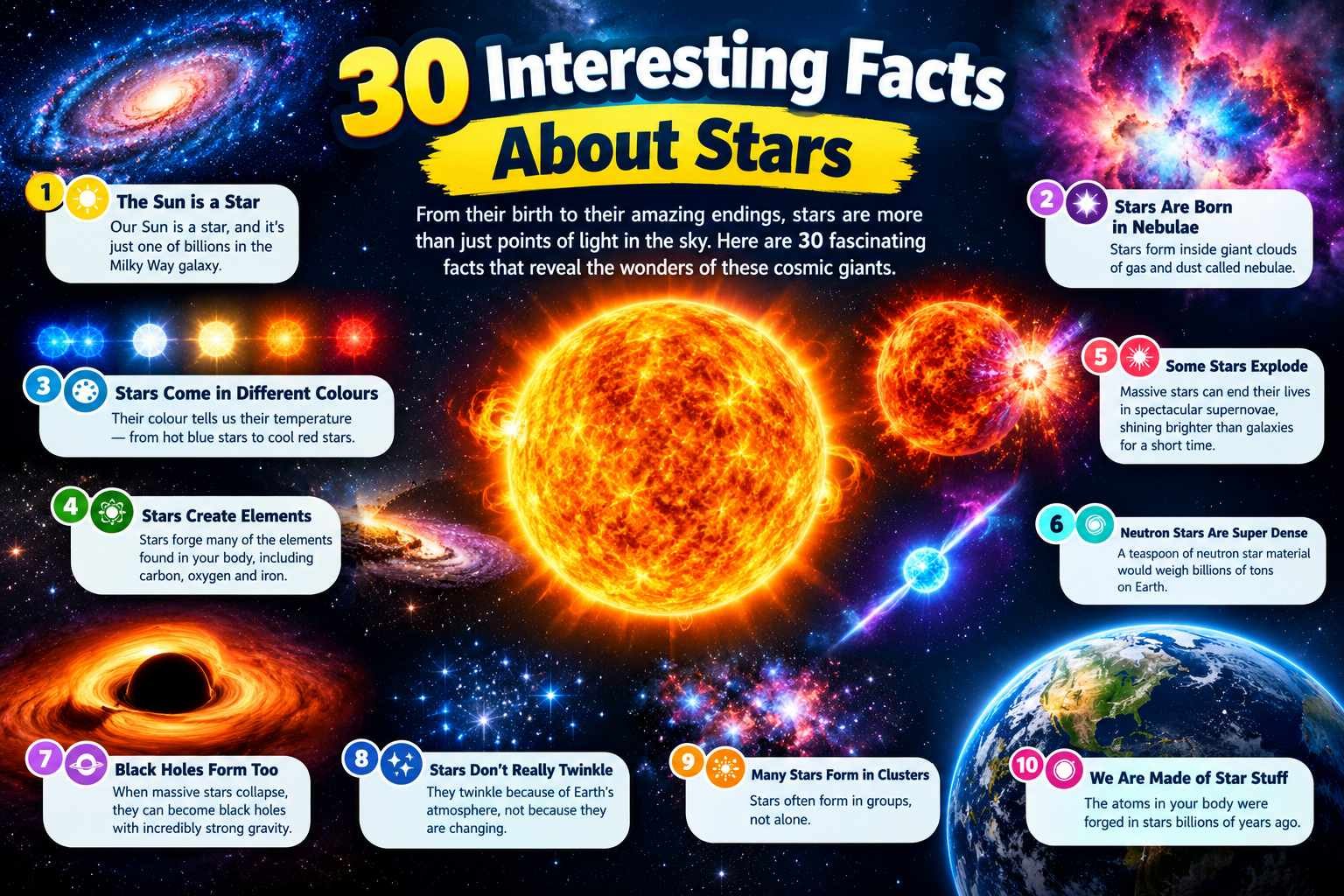
Have you ever looked up at the night sky and wondered what makes stars shine? These distant objects may appear as tiny points of light, but many are enormous balls of hot gas that release incredible amounts of energy. Some are much larger than our Sun, while others are surprisingly small, dense, or incredibly bright.
Stars are also responsible for creating many of the chemical elements found throughout the universe. They are born inside clouds of gas and dust, change over millions or billions of years, and eventually reach different endings depending on their mass.
From the science behind starlight to the most extreme stars astronomers have discovered, these 30 interesting facts about stars will help you explore the fascinating world beyond our planet.
1. The Sun Is a Star
When we look at the night sky, stars appear as tiny points of light. But did you know that our Sun is also a star? It looks much larger and brighter than other stars because it is far closer to Earth.
The Sun is the centre of our solar system and provides the light and heat that make life on Earth possible. Without its energy, our planet would be far too cold for most life as we know it.
Although the Sun is often described as an average star, it is enormous compared with Earth. More than 1.3 million Earths could fit inside the Sun by volume.
Also Read-30 Fascinating Facts About Planet Earth
2. Stars Are Born in Giant Clouds of Gas and Dust
Stars do not simply appear in space. They form inside enormous clouds of gas and dust called nebulae. Gravity pulls material within these clouds together, creating denser regions that gradually become hotter.
As a developing star gathers more material, its central region becomes increasingly hot and dense. When the conditions become extreme enough, nuclear fusion begins, and the object starts producing energy as a star.
One famous example of a stellar nursery is the Orion Nebula. Located roughly 1,300–1,500 light-years from Earth, it contains regions where new stars are forming.
3. Stars Come in Different Colours
Have you ever noticed that some stars look blue, while others appear white, yellow, orange, or red? These colours provide clues about a star’s surface temperature.
Blue stars are generally much hotter than red stars. White and yellow stars fall between these extremes, although a star’s apparent colour can also be affected by Earth’s atmosphere and viewing conditions.
Our Sun appears yellowish or white depending on the conditions and how it is observed. Its surface temperature is about 5,500°C, while some blue stars have surface temperatures exceeding 30,000°C.
4. The Biggest Stars Do Not Always Live the Longest
It may seem logical that larger stars would live longer because they contain more material. Surprisingly, the opposite is often true.
Massive stars use their nuclear fuel much faster than smaller stars. They can shine with enormous brightness but may exhaust their fuel after only millions of years.
Smaller red dwarf stars consume their fuel much more slowly. Some may continue shining for hundreds of billions or even trillions of years, far longer than the current age of the universe.
5. Stars Can Explode in Powerful Supernovae
Some massive stars end their lives in spectacular explosions called supernovae. These events occur when a star’s core can no longer support itself against gravity, causing a dramatic collapse followed by an explosive release of energy.
For a short period, a supernova can shine as brightly as an entire galaxy. The explosion also spreads material into space, helping enrich the gas clouds from which future stars and planets may form.
Not every star ends this way. Stars like our Sun are expected to expand into giant stars before eventually leaving behind a white dwarf.
6. Many Elements in Your Body Were Forged in Stars
Here is a remarkable connection between humans and the universe: many of the elements found in your body were created through cosmic processes involving stars.
Stars produce helium and, during later stages of stellar evolution, can create heavier elements through nuclear reactions. Explosions, stellar winds, and other events spread these elements into space.
Elements such as carbon, oxygen, and iron became part of the material that eventually formed planets and living things. In that sense, the matter in our bodies carries a history that stretches far beyond Earth.
7. Some Stars Become Neutron Stars
When certain massive stars collapse, their cores can become neutron stars. These are among the densest objects known in the universe.
A neutron star can contain more mass than the Sun compressed into a sphere only about 20 kilometres across. A small amount of neutron-star material would weigh an extraordinary amount under Earth’s gravity, although such material could not simply be brought to Earth and kept in the same state.
Neutron stars are fascinating because they pack enormous gravity, magnetic fields, and density into a remarkably small space.
8. Some Dying Stars Leave Behind Black Holes
Black holes can form when the cores of some massive stars collapse under gravity. The resulting object has a region called the event horizon, beyond which nothing—not even light—can escape to the outside universe.
A black hole itself does not shine like a normal star. However, gas and dust falling toward it can become extremely hot and emit powerful radiation before crossing the event horizon.
Astronomers study these surroundings to learn about black holes, their growth, and their influence on nearby stars and galaxies.
9. Stars Do Not Really Twinkle in Space
Stars often appear to twinkle when viewed from Earth. Their light passes through moving layers of air in our atmosphere, which bend the light in changing ways.
This effect makes a star’s apparent position and brightness fluctuate. Astronomers call it atmospheric scintillation.
From space, where there is no Earth’s atmosphere to cause this effect, stars generally appear much steadier. Planets often twinkle less than stars because they appear as tiny disks rather than perfect points of light.
10. The Night Sky Contains Far More Stars Than You Can See
On a clear, dark night away from city lights, you may see thousands of stars. But that is only a tiny fraction of the stars in our galaxy, let alone the observable universe.
The Milky Way is estimated to contain roughly 100 billion to 400 billion stars. Beyond it, the observable universe contains enormous numbers of other galaxies, each with its own stars.
Light pollution makes many stars invisible from cities. Travelling to a dark-sky location can reveal a much richer view of the night sky.
11. The Closest Star to Earth After the Sun Is Proxima Centauri
The nearest star to Earth after the Sun is Proxima Centauri, a small red dwarf located about 4.24 light-years away.
That distance is so vast that even light takes more than four years to travel from Proxima Centauri to us. With current spacecraft technology, a journey there would take far longer than a human lifetime.
Proxima Centauri is part of the Alpha Centauri star system and has at least one known planet, Proxima Centauri b. Scientists continue to study this nearby system to better understand planets around other stars.
12. Sirius Is the Brightest Star in the Night Sky
Sirius, also known as the Dog Star, is the brightest star visible in Earth’s night sky. It lies about 8.6 light-years away and is located in the constellation Canis Major.
Sirius appears so bright partly because it is relatively close to Earth and also because it emits much more light than the Sun. It is actually a binary system consisting of Sirius A and a faint white dwarf companion, Sirius B.
For centuries, Sirius has played a role in cultural traditions, calendars, and navigation. Its brilliance makes it one of the easiest stars to identify on a clear night.
13. Stars Have Different Sizes
Not all stars are similar in size. Some are smaller than the Sun, while others expand to hundreds or even more than a thousand times the Sun’s radius.
Red dwarf stars are relatively small and cool. At the other extreme, red supergiants can become so enormous that, if placed in our solar system, their outer layers could extend beyond the orbit of Mars or even farther, depending on the star.
Measuring the size of distant stars is difficult, so estimates for the largest known stars can change as astronomers gather better observations.
14. The Sun Is About 4.6 Billion Years Old
Our Sun formed approximately 4.6 billion years ago from a cloud of gas and dust. It is currently in the main stage of its life, fusing hydrogen into helium in its core.
The Sun is expected to remain in this stable phase for roughly another five billion years. After that, it will expand into a red giant before eventually shedding its outer layers and leaving behind a white dwarf.
This long life has provided Earth with a relatively steady source of energy, allowing life to develop and evolve over billions of years.
15. Stars Can Exist in Pairs or Larger Groups
Although we often imagine a star as a solitary object, many stars belong to systems containing two or more stars bound together by gravity.
Binary stars orbit a common centre of mass. Some systems contain three or more stars, while many stars are also found in clusters where they formed from the same cloud of gas and dust.
Studying binary stars helps astronomers estimate stellar masses, which are among the most important properties for understanding how stars evolve.
16. The Colour of a Star Can Reveal Its Temperature
Astronomers learn a great deal about stars by examining the light they emit. A star’s colour and spectrum can provide information about its surface temperature, chemical composition, and movement.
Blue stars are usually hotter than yellow or red stars. Scientists also study the absorption lines in starlight to identify elements such as hydrogen, helium, sodium, and calcium.
This technique, known as spectroscopy, allows researchers to investigate stars that are too distant to visit or examine directly.
17. Some Stars Spin Extremely Fast
Stars rotate at different speeds. Our Sun rotates roughly once every 25 days near its equator, although its rotation period varies with latitude.
Some neutron stars spin far faster. Known as pulsars when their radiation beams sweep across Earth, certain neutron stars rotate many times per second.
Their rapid rotation, strong magnetic fields, and regular pulses make them valuable tools for studying extreme physics and testing theories about gravity.
18. Stars Can Be Much Brighter Than the Sun
The Sun provides enough light to illuminate our entire planet, but many stars produce far more energy.
Some massive stars release hundreds of thousands or even millions of times the Sun’s luminosity. They can be visible across enormous distances, although their actual brightness depends on their size, temperature, and stage of evolution.
A star that appears faint in our sky may be intrinsically very bright but extremely distant. Astronomers distinguish between apparent brightness and intrinsic luminosity to understand this difference.
19. The Orion Nebula Is a Stellar Nursery
The Orion Nebula is one of the best-known regions of star formation in the sky. Located in the constellation Orion, it contains gas and dust where young stars are forming.
Powerful telescopes have revealed young stellar objects, disks of material around developing stars, and regions illuminated by hot newborn stars.
Studying the Orion Nebula helps astronomers understand how stars form and how their radiation affects the surrounding clouds. It also offers a glimpse of processes that may have occurred when our own Sun and solar system were born.
20. A Light-Year Measures Distance, Not Time
The term light-year can sound like a unit of time, but it is actually a measure of distance. It describes how far light travels in one year—about 9.46 trillion kilometres.
Because space is so vast, ordinary kilometres become inconvenient when measuring distances between stars. Light-years provide a more practical way to describe these enormous gaps.
For example, when you see Proxima Centauri, you are seeing light that began its journey roughly 4.24 years ago. Looking into space also means looking back in time.
21. White Dwarfs Are the Dense Remains of Sun-Like Stars
When a star similar to the Sun reaches the end of its life, it eventually sheds its outer layers. Its remaining core becomes a white dwarf.
A white dwarf is roughly Earth-sized but can contain a substantial fraction of the Sun’s mass. This makes it incredibly dense compared with ordinary matter.
White dwarfs no longer sustain the same core hydrogen fusion that powered them earlier in life. They gradually cool over time, although the universe is not old enough for any to have cooled completely into hypothetical black dwarfs.
22. Red Giants Can Swallow Nearby Planets
As a Sun-like star runs low on hydrogen in its core, it begins to change. Its outer layers expand enormously, turning it into a red giant.
When our Sun reaches this stage billions of years from now, it will expand enough to engulf Mercury and Venus. Earth’s exact fate is more complicated because the Sun will lose mass as it evolves, but Earth is expected to become uninhabitable long before then.
Red giants demonstrate how a star’s changing size and brightness can dramatically affect the planets orbiting it.
23. Some Stars Are Older Than Our Sun
The Sun is about 4.6 billion years old, but many stars in the Milky Way formed earlier. Some stars in the galaxy’s oldest populations are more than 10 billion years old.
Astronomers estimate stellar ages using a combination of brightness, temperature, chemical composition, and models of stellar evolution. Measuring a star’s age precisely can be difficult, especially for isolated stars.
The oldest stars provide valuable clues about the early history of the Milky Way and the conditions in the universe when the first generations of stars formed.
24. Stars Help Scientists Understand the Universe’s History
Stars act like cosmic records. Their chemical composition can reveal what material existed when they formed, while their ages help astronomers reconstruct the history of galaxies.
The oldest stars often contain fewer heavy elements than younger stars because they formed before many generations of stars had enriched the galaxy with elements created through nuclear fusion and stellar explosions.
By studying different generations of stars, scientists can trace how galaxies evolved and how the ingredients needed to form planets became more common over time.
25. Some Stars Change Their Brightness
Not every star shines with a perfectly constant brightness. Variable stars become brighter or fainter for several reasons, including changes in their size, temperature, or surface activity.
Some stars pulsate, expanding and contracting over regular periods. Others change brightness because they are part of binary systems in which one star passes in front of the other from our point of view.
Astronomers use these changes to learn about stellar structure, estimate distances, and discover planets or companion stars that might otherwise be difficult to detect.
26. Stars Are Held Together by Gravity
A star is an enormous ball of hot plasma held together by gravity. Gravity pulls its material inward, while pressure generated by the hot interior helps resist collapse.
For much of a star’s life, energy produced by nuclear fusion in its core helps maintain this balance. When the available fuel changes or runs low, the balance can shift and the star begins to evolve toward its next stage.
This ongoing competition between gravity and internal pressure explains much of a star’s structure, stability, and life cycle.
27. Some Stars Are Born in Clusters
Stars often form in groups rather than individually. When a large cloud of gas collapses under gravity, it can fragment into many dense regions, each potentially forming a star.
Young star clusters allow astronomers to study stars of different masses that formed at roughly the same time and from similar material. Comparing them helps researchers understand how mass influences stellar development.
Over millions of years, many clusters gradually disperse as their stars move through the galaxy and interact gravitationally with their surroundings.
28. The Sun Will Not Become a Black Hole
Because the Sun is a star, it is natural to wonder whether it could eventually collapse into a black hole. The answer is no: it does not have enough mass to end its life that way.
Instead, the Sun is expected to expand into a red giant, shed its outer layers, and leave behind a white dwarf. Black holes formed through ordinary stellar evolution generally require much more massive progenitor stars, although the exact outcome depends on several factors.
This is reassuring in one sense: our Sun’s future is well studied, even though the changes it will undergo are far beyond the timescale of human civilization.
29. Stars Help Create New Stars and Planets
When stars lose material through stellar winds or explode as supernovae, they return gas and heavier elements to space. This material can mix with interstellar clouds and become part of new generations of stars and planets.
Our solar system formed from a cloud enriched by material from earlier generations of stars. Elements found in Earth’s rocks, oceans, and living organisms have a long cosmic history.
The process is part of a cycle: stars form from gas, evolve, return material to space, and help provide the ingredients for future planetary systems.
30. We Are Still Discovering New Things About Stars
Even after centuries of astronomy, stars continue to surprise scientists. New telescopes and instruments allow researchers to detect faint stars, measure stellar motion, study atmospheres, and investigate extreme objects such as neutron stars.
Observations from space telescopes and ground-based observatories are improving our understanding of how stars are born, how they evolve, and how their planets form.
Every new discovery adds another piece to the larger story of the universe. The stars that appear as tiny points of light in the night sky are actually complex worlds of physics, chemistry, and cosmic history.
Conclusion
Stars are far more than beautiful lights scattered across the night sky. They are enormous, evolving objects that produce energy, create chemical elements, and help shape the galaxies around them.
From the long-lived red dwarfs to massive stars that end in supernovae, each type of star follows a different path. Studying them helps scientists understand the origins of planets, the history of the Milky Way, and the ingredients that make life possible.
The next time you look at the stars, remember that each point of light may have its own remarkable story—and that the light reaching your eyes may have travelled for years, centuries, or even much longer.
Frequently Asked Questions (FAQs)
1. What is a star?
A star is a massive, luminous sphere of hot plasma held together by gravity. Most stars produce energy through nuclear fusion in their cores, where hydrogen is converted into helium.
2. What is the closest star to Earth?
The Sun is the closest star to Earth. The nearest star beyond the Sun is Proxima Centauri, located approximately 4.24 light-years away.
3. Why do stars have different colours?
A star’s colour mainly depends on its surface temperature. Blue stars are generally hotter, while red stars are cooler. White and yellow stars fall between these broad categories.
4. How are stars born?
Stars form inside clouds of gas and dust. Gravity pulls material together, increasing the temperature and pressure in the developing core. When conditions allow sustained hydrogen fusion, a star begins its main phase of life.
5. Do all stars eventually explode?
No. The ending of a star depends largely on its mass. Sun-like stars generally become red giants and later white dwarfs, while sufficiently massive stars may explode as supernovae and leave behind neutron stars or black holes.
1 thought on “30 Interesting Facts About Stars You Should Know”