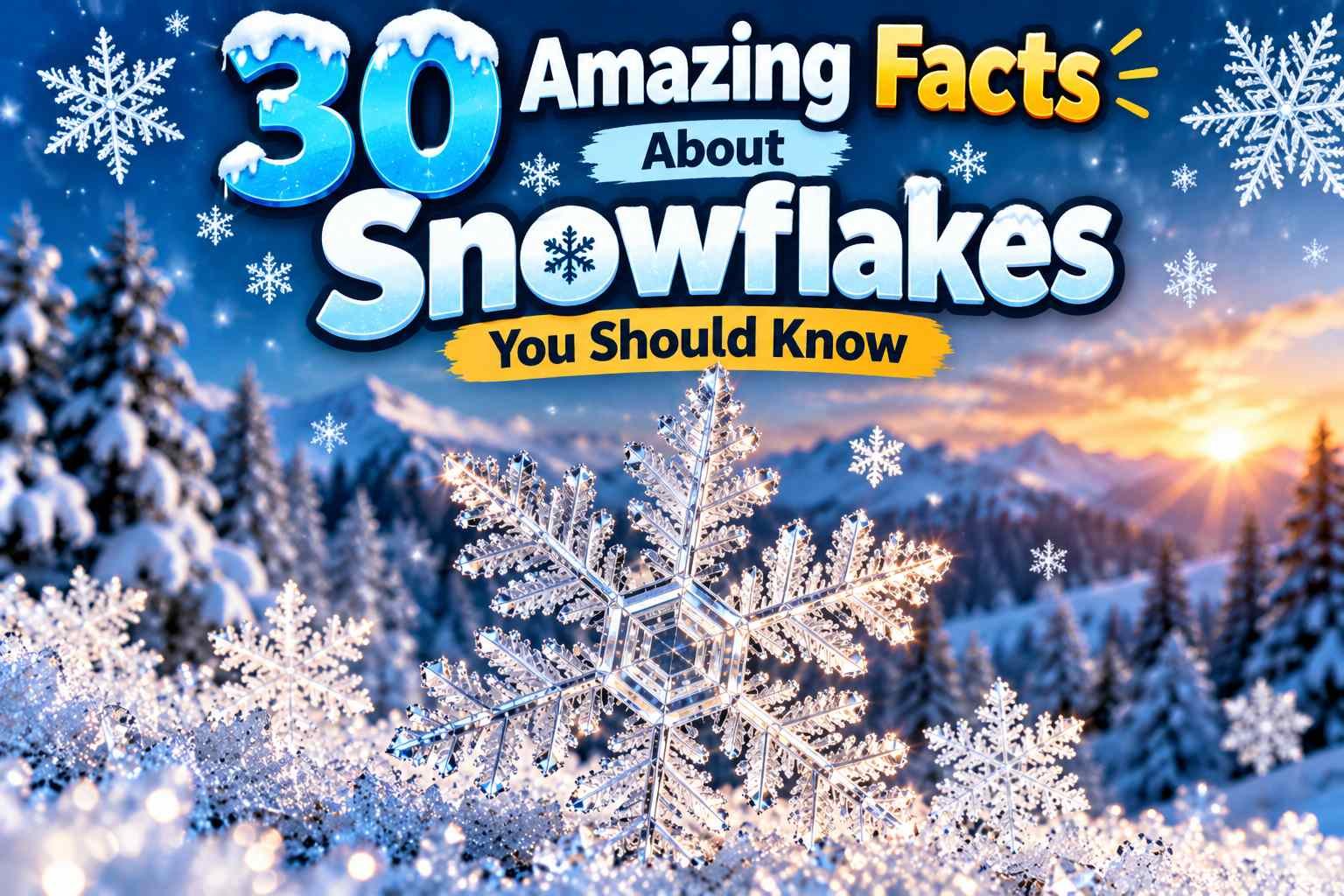
Snowflakes are among nature’s most beautiful little wonders. They drift quietly from the sky, cover trees and rooftops, and transform winter landscapes into something magical. Although they may look simple at first glance, each snowflake has a fascinating structure shaped by the conditions in which it forms.
But how much do you really know about snowflakes? They usually have six-sided patterns, can develop an incredible variety of shapes, and are formed through a process that begins high inside clouds. Some snowflakes are made of several ice crystals joined together, while others grow into delicate, branch-like designs.
From the science behind their formation to surprising discoveries about their shapes, these 30 amazing facts about snowflakes reveal why these tiny ice crystals have fascinated scientists and nature lovers for generations.
1. Snowflakes Are Made of Ice Crystals
Every snowflake begins with ice crystals that form inside clouds. When water vapor changes directly into ice under suitable conditions, tiny crystals begin to grow.
As they move through the cloud, more water vapor can attach to their surfaces, gradually creating the delicate shapes we recognize as snowflakes. Some snowflakes contain a single crystal, while others are made of several crystals joined together.
2. Most Snowflakes Have Six Sides
Have you ever noticed that snowflakes often look like tiny six-pointed stars? This happens because water molecules arrange themselves into a hexagonal crystal structure when water freezes under ordinary atmospheric conditions.
As the crystal grows, this structure influences its overall shape. The result can be a simple six-sided plate or a complicated branching pattern with many delicate arms.
3. Snowflakes Come in Many Different Shapes
Snowflakes do not all look alike. Some resemble flat plates, others look like long needles, and some develop beautiful, tree-like branches.
Scientists classify snow crystals into different forms based on their appearance. Common types include plates, columns, needles, and branching dendrites.
The shape depends largely on the temperature and humidity inside the cloud, which can change as a crystal grows.
4. Snowflakes Form High Inside Clouds
Snowflakes generally develop inside cold clouds, where water vapor can freeze onto tiny ice particles.
As a crystal grows, it may encounter different temperatures and moisture levels. These changing conditions influence how quickly its branches develop and which patterns appear.
Once the snowflake becomes heavy enough to fall, it begins its journey toward the ground. Whether it reaches the surface as snow depends on the temperature and conditions along the way.
5. Snowflakes Are Not the Same as Frozen Raindrops
Snowflakes and frozen raindrops may both fall during cold weather, but they form differently.
Snowflakes grow as ice crystals in clouds. Sleet, by contrast, forms when raindrops or partially melted snow freeze into small ice pellets before reaching the ground.
Recognizing the difference helps explain why winter precipitation can look so different from one storm to another.
6. Snowflakes Can Join Together to Form Larger Flakes
A single snow crystal is usually tiny. However, as crystals fall through a cloud, they can collide and stick together.
This process creates an aggregate snowflake, which may look much larger than an individual crystal. When conditions are suitable, several crystals can combine into a fluffy, delicate cluster.
This is one reason snow sometimes falls in large, soft flakes rather than as separate, tiny crystals.
7. The Largest Reported Snowflake Was Enormous
One of the most famous snowflake records comes from Fort Keogh, Montana, in the United States, in January 1887.
According to historical reports, a snowflake measured approximately 15 inches (38 centimetres) across and 8 inches (20 centimetres) thick.
Such a measurement is extraordinary because it likely describes a large cluster of ice crystals rather than one perfectly formed crystal. The account is widely repeated, although it dates from a period when modern scientific measurement methods were not available.
8. Temperature Changes the Shape of Snowflakes
Temperature plays a major role in determining how snow crystals grow.
Under some conditions, crystals develop thin, flat plates. Under others, they form columns, needles, or elaborate branches. Even small changes in temperature can influence the pattern.
Humidity also matters because it affects how much water vapor is available for crystal growth. Together, temperature and humidity help create the remarkable variety of snowflake designs.
9. Humidity Helps Snowflakes Grow
Temperature is only part of the story. The amount of water vapor in the surrounding air also affects a snowflake’s development.
When enough water vapor is available, a crystal can grow quickly and develop intricate branches. In drier conditions, growth may be slower, resulting in simpler shapes.
This relationship between moisture and temperature explains why snowflakes can look dramatically different even when they form during the same storm.
10. Wilson Bentley Helped Reveal the Beauty of Snowflakes
Wilson A. Bentley was an American farmer and photographer who became famous for photographing individual snow crystals.
In 1885, he successfully photographed a snowflake through a microscope, helping people see details that were difficult to observe with the naked eye. He went on to photograph thousands of snow crystals throughout his life.
His work helped popularize the idea that snowflakes have extraordinary variety and showed how photography could be used to study delicate natural structures.
11. Not Every Snowflake Is Completely Unique
You may have heard the saying that no two snowflakes are alike. It is a useful way to describe their remarkable variety, but it is not an absolute scientific rule.
In 1988, atmospheric scientist Nancy Knight reported finding two very similar snow crystals while studying precipitation. Her discovery challenged the idea that identical snowflakes could never occur.
Because simple crystals can share the same basic structure, and even complex crystals may look extremely similar, it is more accurate to say that exact matches are possible, although uncommon.
12. Snowflakes Can Have Delicate Branching Patterns
Some of the most recognizable snowflakes have branching arms that resemble tiny trees. These are often called dendritic snow crystals.
Their branches develop as water vapor attaches to the growing crystal, with the growth pattern influenced by the surrounding conditions.
The resulting designs can be surprisingly elaborate. Under a microscope, even a tiny snowflake may reveal a detailed pattern of lines, branches, and repeating shapes.
13. Snow Is Considered a Mineral
This fact may sound surprising, but natural snow meets the scientific definition of a mineral because it consists of naturally formed solid ice with an ordered crystal structure and a definite chemical composition.
Snow is not just a pile of frozen water droplets. Its crystals form through a process that creates an organized arrangement of water molecules.
The next time you see fresh snow covering the ground, you are looking at a collection of tiny natural ice crystals.
14. Snowflakes Are Usually White, but Snow Can Look Blue
Fresh snow generally appears white because its many ice crystals scatter visible light in different directions.
However, thick snow and ice can sometimes look blue. This happens because light travels through the material and is absorbed and scattered differently depending on its wavelength.
The effect is especially noticeable in deep snow or dense glacial ice. Under certain environmental conditions, snow may also appear pink, red, or green because of algae, minerals, or other materials.
15. Snowflakes Are Not Always Perfectly Symmetrical
Snowflakes are famous for their balanced, six-sided designs, but nature does not always produce perfect patterns.
A crystal may grow unevenly if one side encounters different temperatures, moisture levels, or airflow than another. It can also collide with other crystals or become damaged while falling.
These influences can create irregular shapes. Even when a snowflake begins with a symmetrical structure, its final appearance may be far from perfect.
16. A Snowflake’s Journey to the Ground Can Take a Long Time
Snowflakes do not fall at exactly the same speed. Their descent depends on their size, shape, density, and the movement of the surrounding air.
A delicate crystal may drift slowly, while a heavier cluster can fall more quickly. Winds and rising air currents can also carry snowflakes sideways or keep them suspended inside clouds.
This means a snowflake’s journey from cloud to ground can vary considerably depending on the weather.
17. Snowflakes Are Different From Hail
Snowflakes, hailstones, and sleet are all forms of frozen precipitation, but they develop through different processes.
Snowflakes grow from ice crystals inside clouds. Hail forms when strong thunderstorm updrafts carry ice particles through supercooled water droplets, allowing layers of ice to build up. Sleet consists of small ice pellets that form when falling precipitation freezes.
Although all three can occur in cold weather, their structures reveal very different atmospheric conditions.
18. The Word “Crystal” Has Ancient Greek Roots
The English word crystal comes through Latin from the ancient Greek word krystallos, which was associated with both ice and clear rock crystal.
The connection is understandable: transparent ice and clear crystals can have a similar appearance.
Snow crystals demonstrate this relationship beautifully. Their delicate geometric forms show how ordinary water can create structures that look like tiny works of art.
19. Snowflakes Can Develop More Than One Type of Structure
A snow crystal does not always keep the same appearance throughout its growth.
As it moves through a cloud, it may encounter changing temperatures and humidity. One part of its growth may produce a flat plate, while another may develop more complex branches.
These changes can create snowflakes with several structural features in a single crystal, making their shapes even more interesting to study.
20. Snowflakes Are Important to Winter Weather
Snowflakes are more than a beautiful part of winter. Their formation and growth help scientists understand clouds and precipitation.
By studying snow crystals, researchers can learn about the temperature, moisture, and other conditions present inside clouds. These observations can contribute to better understanding of snowfall and winter storms.
The next time snow begins to fall, remember that each tiny crystal carries clues about the atmosphere in which it formed.
21. Snow Reflects a Large Amount of Sunlight
Fresh, clean snow can reflect a substantial portion of the sunlight that reaches it. This property is known as albedo.
Because snow is highly reflective, snow-covered landscapes can appear much brighter than darker ground. Snow also affects the Earth’s energy balance by sending more incoming sunlight back toward the atmosphere and space.
As snow melts, the darker surfaces underneath can absorb more sunlight, contributing to further warming.
22. Snowflakes Can Be Damaged During Their Fall
Although snow crystals can look delicate and perfectly formed, they may change shape as they fall.
Collisions with other crystals, contact with water droplets, and changes in temperature can alter their structure. Some crystals break into smaller pieces, while others stick together to form clusters.
By the time a snowflake reaches the ground, it may look quite different from the crystal that first began growing inside the cloud.
23. Snowflakes Can Form Several Distinct Crystal Types
Scientists have documented many varieties of snow crystals, including plates, stellar dendrites, columns, needles, and capped columns.
These categories help researchers describe and compare crystal shapes. However, the exact number of classifications depends on the system being used, and many crystals show features that overlap between categories.
This variety is part of what makes snowflake research so fascinating: a simple material can form an enormous range of structures.
24. Snowflakes Are Not the Same as Frost
Snow and frost both involve ice, but they form under different conditions.
Snow usually develops in clouds and falls to the ground as precipitation. Frost forms when water vapor turns directly into ice on a sufficiently cold surface, such as grass, windows, or leaves.
That is why you can wake up to a frosty morning even when no snow has fallen overnight.
25. Snow Can Fall Even When the Ground Is Above Freezing
Snowfall does not always mean the ground must be below 0°C (32°F).
Snow can form in cold clouds and fall through air that is slightly warmer than freezing. If the flakes do not melt completely before reaching the surface, snow may still be observed.
Whether it settles depends on factors such as the temperature profile of the atmosphere, the intensity of snowfall, and the temperature of the ground.
26. Some Snowflakes Look Like Tiny Needles
Not all snow crystals resemble stars. Some grow into long, narrow shapes that look like tiny needles.
These forms develop under particular combinations of temperature and humidity. Their elongated structure gives them a very different appearance from flat plates or branching dendrites.
When needle-like crystals fall together, they can also become entangled or join into clusters, changing the texture of the snowfall.
27. Snow Crystals Can Help Scientists Study the Atmosphere
A snow crystal is like a tiny record of the conditions in which it grew.
Its shape, branches, and surface features can provide clues about the temperature and humidity it encountered. Scientists use observations of snow crystals to improve their understanding of cloud processes and precipitation.
Although a single crystal cannot tell the entire story of a storm, studying many crystals can reveal useful patterns about the atmosphere.
28. Snow Can Make the Environment Quieter
Have you ever noticed how peaceful a landscape can feel after fresh snow?
A layer of fresh, fluffy snow can absorb some sound, particularly when its porous structure traps air between ice crystals. This can reduce certain sounds and make an outdoor environment seem quieter.
The effect depends on the snow’s depth, density, moisture content, and the type of sound traveling through it.
29. Snowflakes Have Inspired Art and Design
The symmetrical patterns and delicate branches of snowflakes have inspired artists, photographers, architects, and designers for generations.
Their six-sided structure works beautifully in decorative patterns, winter ornaments, clothing, and seasonal artwork. Each crystal’s intricate details also make snowflakes popular subjects for macro photography.
The appeal is easy to understand: snowflakes combine simple geometric principles with an extraordinary variety of natural designs.
30. Every Snowfall Is a Little Different
Even when snowflakes share the same basic crystal structure, the weather conditions that shape them are constantly changing.
Temperature, humidity, wind, and the path through the cloud all influence how crystals grow and combine. As a result, each snowfall contains a changing mixture of crystal shapes and sizes.
This variety is part of the magic of snow. What looks like a simple blanket of white is actually made up of countless tiny crystals, each with its own formation history.
Conclusion
Snowflakes may be small, but they reveal some remarkable things about nature. Their six-sided structures, delicate branches, and changing shapes demonstrate how temperature and humidity can influence the growth of ice crystals.
From Wilson Bentley’s pioneering photographs to modern atmospheric research, snowflakes have helped people appreciate the connection between everyday weather and the science behind it.
The next time you see snow falling, take a closer look if conditions allow. Those tiny white flakes are more than winter decorations—they are fascinating examples of crystal growth happening right before your eyes.
Frequently Asked Questions (FAQs)
1. Why do snowflakes have six sides?
Snowflakes generally have six-sided patterns because water molecules form a hexagonal crystal structure when ice develops under ordinary atmospheric conditions.
2. Are all snowflakes unique?
Not necessarily. Snowflakes come in an enormous variety of shapes, and exact duplicates are considered uncommon. Researchers have documented crystals that were virtually identical.
3. How are snowflakes formed?
Snowflakes form inside clouds when water vapor freezes onto tiny ice particles. As the crystals grow, they develop different shapes depending on temperature, humidity, and other atmospheric conditions.
4. What was the largest snowflake ever reported?
A famous historical report describes a snowflake measuring approximately 15 inches (38 centimetres) wide and 8 inches (20 centimetres) thick at Fort Keogh, Montana, in January 1887. The reported size may have referred to a cluster of ice crystals.
5. Why do snowflakes look white?
Snowflakes and snow usually appear white because their many ice crystals scatter visible light in different directions. Thick snow and ice can sometimes look blue because of the way light travels through them.