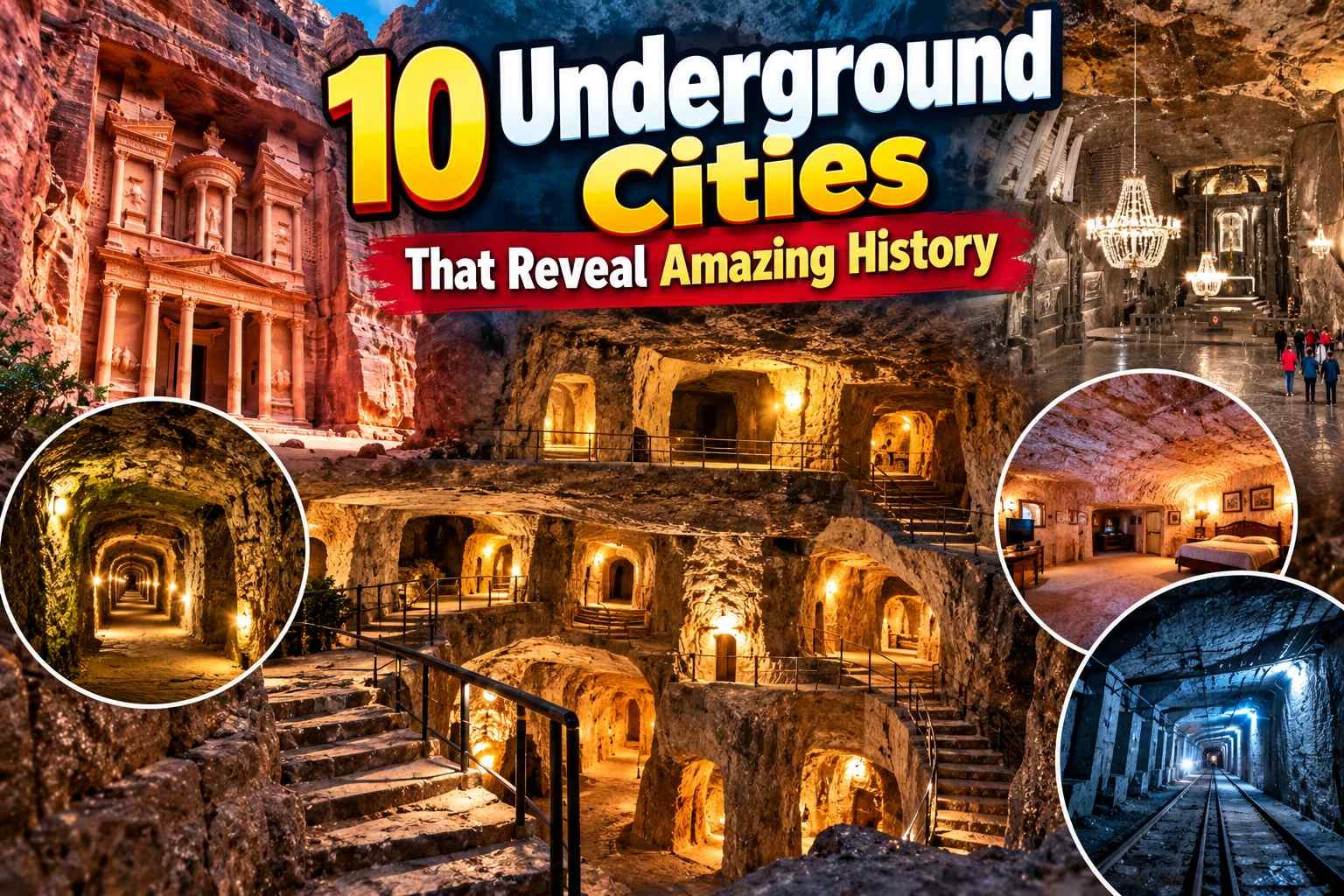
What if some of the world’s most fascinating cities were hiding beneath our feet? While modern cities are known for their towering buildings, busy streets, and crowded markets, some remarkable places tell their stories through tunnels, chambers, underground homes, and ancient passageways.
People have built underground settlements for many reasons. Some needed protection from invading armies, while others searched for valuable resources or created hidden places to live. Over time, these underground spaces developed into complex networks with rooms, wells, chapels, storage areas, and even places for animals.
From the remarkable underground settlement of Derinkuyu in Türkiye to the historic caves of Naours in France, these places reveal how people adapted to difficult circumstances and used their surroundings in extraordinary ways.
Let’s explore 10 underground cities and historic underground settlements that offer a fascinating glimpse into the past.
1. Derinkuyu, Türkiye: The Underground City That Could Shelter Thousands

Imagine discovering an entire hidden world behind a wall inside your own home. That is the kind of discovery associated with Derinkuyu, an extraordinary underground settlement in Cappadocia, Türkiye.
This multilevel city was carved into soft volcanic rock and contains narrow passageways, chambers, storage areas, and ventilation shafts. Historical accounts describe spaces for living, religious activities, and storing food and supplies. The settlement is often estimated to have been capable of sheltering thousands of people, with some accounts suggesting a capacity of around 20,000.
Derinkuyu’s most fascinating feature is how its design helped people seek refuge during periods of danger. Its passages and defensive features reveal the ingenuity required to create a place where communities could remain protected underground.
Today, Derinkuyu offers a remarkable glimpse into the lives of people who used the landscape itself to build a hidden refuge.
2. Naours, France: A Hidden Settlement Beneath the Countryside

Beneath the French village of Naours lies an underground network that began as a limestone quarry. Over time, people transformed parts of it into a place where they could shelter from invading forces.
The complex eventually included hundreds of chambers and galleries, along with wells, chapels, bakeries, and stables. These features made it more than a simple hiding place. It was a community space designed to help people and their animals survive dangerous periods above ground.
Naours was used during conflicts across the region, including the Thirty Years’ War in the 17th century. During the First World War, soldiers also visited the site and left inscriptions on its walls. Those marks remain valuable clues to the people who passed through its chambers.
Naours shows how an abandoned quarry could become a refuge and later an important historical site.
3. Nushabad, Iran: An Underground Refuge With Multiple Levels

In Iran, near the city of Kashan, the underground settlement of Nushabad reveals how people developed hidden spaces for protection. Also known as Ouyi, this remarkable complex extends through multiple levels beneath the surface.
Its passages connect chambers and rooms that could provide shelter during raids or other threats. Accounts of the site describe ventilation channels, water-related features, and carefully arranged routes through the underground spaces.
The settlement’s design helped people move between areas while remaining hidden from danger. Some entrances were connected to locations above ground, allowing access from different parts of the settlement.
Nushabad is a striking example of practical underground architecture. Rather than building upward, its creators used the space below ground to develop a refuge shaped by the challenges of their time.
4. Petra, Jordan: The Ancient City Carved Into Rock

Petra is one of the world’s most celebrated archaeological sites, famous for its magnificent buildings carved directly into rose-colored sandstone cliffs. Located in Jordan, it was developed by the Nabataeans and became an important center for trade.
Although Petra is often described as a lost city, much of what visitors see today is carved into rock or built among the surrounding landscape rather than forming a conventional underground city. Its tombs, temples, monuments, and rock-cut chambers reveal the extraordinary skills of its builders.
The site also contains evidence of sophisticated water management, including channels and systems designed to collect and direct water in an arid environment. This was essential for a settlement located in a dry region.
Petra’s hidden spaces and rock-cut architecture continue to fascinate archaeologists and visitors. Its history demonstrates how people adapted to the landscape and created enduring monuments from the rock around them.
5. Pendleton’s Underground Chinatown, Oregon, USA: A Hidden Part of Local History

Beneath parts of Pendleton, Oregon, lies a lesser-known chapter of American history connected to the Chinese community that lived in the town during the 19th century.
Chinese immigrants helped build railroads and contributed to local economies, but many faced discrimination, exclusion, and violence. Historical accounts describe underground spaces associated with Pendleton’s Chinatown, including passages and rooms that became part of the community’s history.
These spaces are often linked to the need for safety and movement in a hostile social environment. They offer a reminder that underground places were not always built by ancient civilizations or for military purposes. Sometimes, they were connected to the everyday struggles of people trying to find security and a place in society.
Pendleton’s underground history is a reminder that architecture can reveal difficult stories about migration, inequality, and resilience.
6. Wieliczka Salt Mine, Poland: A World Carved Out of Salt

Some underground places were created not primarily for shelter, but to extract resources that people considered valuable. The Wieliczka Salt Mine in Poland is one of the most remarkable examples.
Salt was essential for preserving food and was an important commodity for centuries. Mining at Wieliczka developed over a long period, creating a vast underground complex of chambers, passages, and remarkable works carved from salt.
One of its best-known features is St. Kinga’s Chapel, an underground space decorated with salt sculptures and elaborate details. The mine also reflects the economic importance of salt production, which contributed to the wealth of the region.
Although Wieliczka is technically a mine rather than a city, its extensive chambers and human-made spaces make it an extraordinary underground destination. It demonstrates how an industry could transform the landscape beneath a town.
7. Montreal’s RESO, Canada: A City Beneath a Modern City

Not every underground city belongs to the ancient world. Montreal, Canada, is home to a vast underground pedestrian network commonly known as RESO.
The network links shopping centers, office buildings, hotels, public spaces, and metro stations through a series of indoor passages. It is especially useful during the city’s cold winters, when walking between buildings outdoors can be uncomfortable.
Unlike underground settlements created for protection from invading armies, Montreal’s network developed to support modern urban life. It helps people travel between important destinations while staying sheltered from the weather.
The system shows how underground architecture continues to evolve. What once meant hidden chambers and emergency shelters can now mean convenient transport connections and everyday city living.
8. Coober Pedy, Australia: Homes Built Underground to Escape the Heat

In the dry landscape of South Australia, the town of Coober Pedy is famous for its opal mining and underground homes, often called dugouts.
The region can experience extreme summer temperatures, making underground living an appealing option. Rooms built into the ground can remain cooler than buildings exposed to the intense heat above the surface.
Many dugouts contain everyday living spaces, and some underground properties include bedrooms, kitchens, and other household facilities. This approach to housing reflects a practical response to the local climate and the town’s mining history.
Coober Pedy is not an ancient underground city in the traditional sense, but it offers a fascinating modern example of how people adapt their homes to challenging environmental conditions.
9. The Paris Catacombs, France: A Vast Network Beneath the Streets

Beneath the streets of Paris lies one of the world’s most famous underground sites: the Paris Catacombs.
The tunnels began as underground quarries that supplied stone for buildings across the city. In the late 18th century, parts of the network were adapted into an ossuary as authorities sought a solution to problems caused by overcrowded cemeteries.
Today, the catacombs are known for their carefully arranged human remains and their eerie atmosphere. They offer a very different perspective on Paris, a city often associated with grand boulevards, museums, and elegant architecture.
The catacombs are not a residential underground city, but their extensive tunnels reveal how the spaces beneath a major city can take on unexpected roles as its population and needs change.
10. Berlin’s Underground Bunkers, Germany: History Beneath the City

Berlin’s underground spaces tell powerful stories about war, fear, and the changing politics of Europe. The city has a network of bunkers, shelters, tunnels, and other structures connected to different periods of its history.
During the Second World War, underground shelters were used to protect civilians from bombing. Later, during the Cold War, bunkers and reinforced spaces reflected fears of a possible conflict between East and West.
Some of these structures can be explored through guided tours that explain how they were built, what they were intended to do, and how people experienced life during periods of uncertainty.
Berlin’s underground history is not simply about engineering. It also offers a sobering reminder of how international conflicts shape cities and the lives of the people who live in them.
Final Thoughts
Underground cities and historic subterranean spaces reveal a side of human history that is easy to overlook. Some were created to protect communities from danger, others grew out of mining and industry, and many reflect the ingenuity people used to adapt to their surroundings.
From Derinkuyu’s multilevel chambers to Coober Pedy’s climate-friendly homes and Montreal’s modern pedestrian network, each place tells a different story about life beneath the surface.
These destinations also remind us that history is not always visible in monuments and buildings above ground. Sometimes, the most fascinating clues to the past are hidden in tunnels, carved chambers, and spaces that remained out of sight for generations.
Frequently Asked Questions (FAQs)
1. What is an underground city?
An underground city is a network of human-made spaces below ground that may include rooms, tunnels, storage areas, shelters, or living spaces. Some are ancient settlements, while others are modern urban networks.
2. Which is one of the most famous underground cities in the world?
Derinkuyu in Cappadocia, Türkiye, is among the best-known underground settlements. It contains multiple levels of chambers and passageways that were used as a refuge.
3. Why did people build underground cities?
People built underground spaces for several reasons, including protection from enemies, shelter from harsh weather, storage, mining, and access to resources. The purpose varied depending on the location and historical period.
4. Are underground cities still used today?
Yes. Some underground spaces remain in use for tourism, transport, housing, and other purposes. Montreal’s RESO is a modern pedestrian network, while Coober Pedy is known for homes built underground.
5. Can visitors explore underground cities?
Many underground sites welcome visitors through guided tours or designated routes. Access varies by location, and some areas may be closed for preservation or safety reasons, so visitors should check official visitor information before travelling.