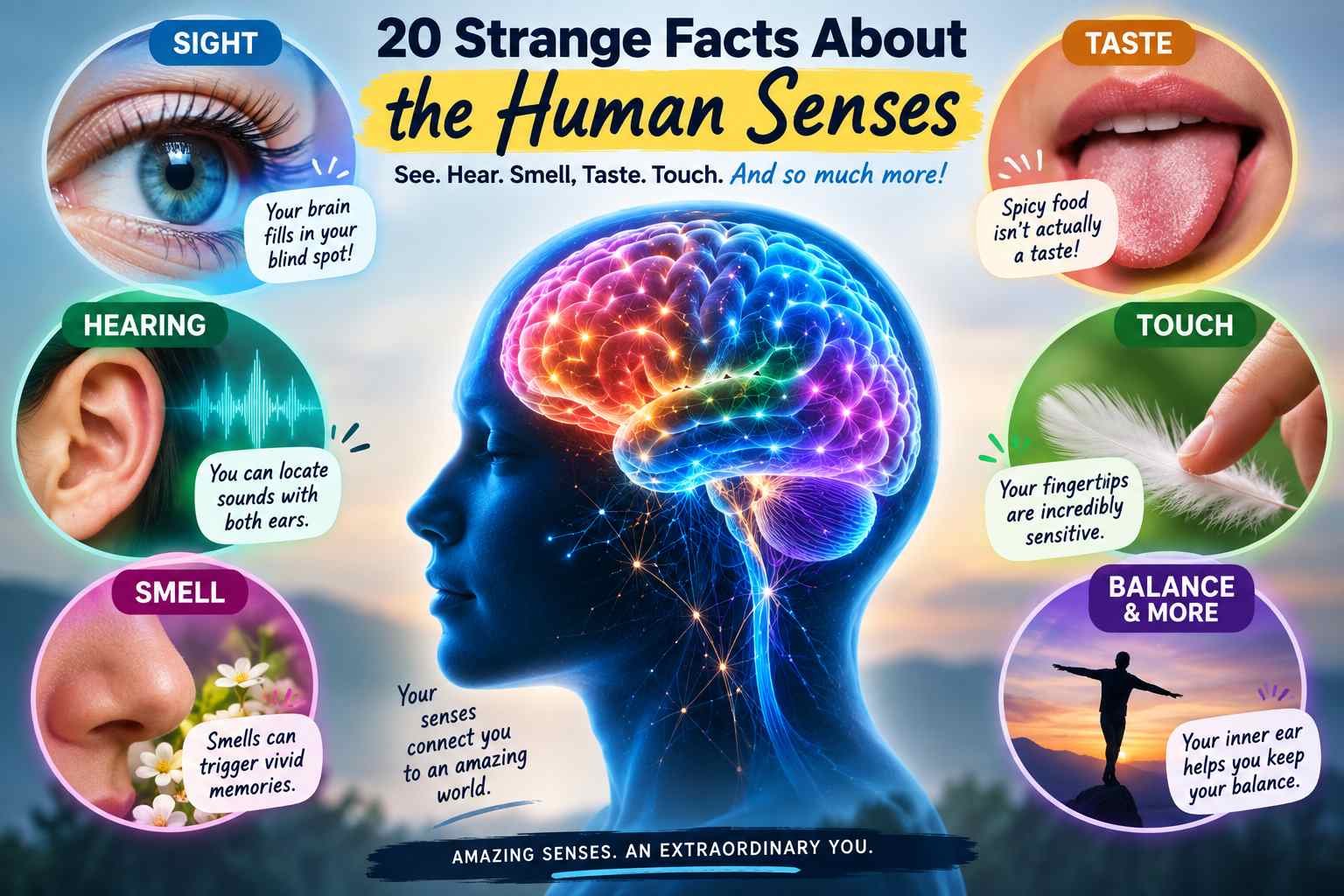
Our senses help us understand the world around us every single day. We see colors, hear music, smell fresh food, taste our favorite meals, and feel the warmth of sunlight on our skin. Most of the time, these abilities seem so ordinary that we barely stop to think about them.
But there is a lot more to the human senses than meets the eye. Did you know that spicy food is not technically a taste, your brain can fill in gaps in your vision, and humans have more than just the traditional five senses? Even something as simple as touching an object involves surprisingly complex processes inside your body.
The five familiar senses—sight, hearing, smell, taste, and touch—are only part of the story. Scientists also study balance, body position, temperature, pain, and other sensory abilities that help us interact with the world. Exactly how many senses humans have depends on how they are classified.
Ready to discover some of the strangest things about how your senses work? Here are 20 fascinating facts about the human senses that might change the way you experience everyday life.
1. Humans Have More Than Five Senses
Most of us learned about the five basic senses in school, but the human sensory system is much more complicated than that. Scientists also recognize abilities such as proprioception, which helps you know where your body parts are, and equilibrioception, which helps you maintain balance.
You can close your eyes and still touch your nose because your brain receives information about your body’s position. You don’t need to look at your feet to know where they are, either. These lesser-known senses work quietly in the background, helping you move through the world without constantly thinking about every action.
2. Spicy Food Is Not Actually a Taste
Love eating spicy food? Here’s a surprising fact: spiciness is not considered one of the basic tastes.
When you eat a hot chili pepper, a chemical called capsaicin activates receptors that normally respond to heat. Your nervous system interprets this stimulation as a burning sensation. That’s why spicy food can make your mouth feel hot even when the food itself is not particularly warm.
In other words, that fiery feeling is more closely related to pain and temperature perception than to tasting something sweet or salty.
Also Read-30 Fascinating Facts About the Human Brain
3. Your Sense of Smell Helps Create the Taste of Food
Think about eating your favorite meal while having a blocked nose. The food may suddenly seem bland, even if you can still detect basic tastes such as sweet or salty.
That’s because what we commonly call flavor is a combination of taste, smell, and other sensations. As you chew, aromatic molecules travel from the back of your mouth into your nasal cavity, where smell receptors detect them.
This process is called retronasal olfaction. It helps explain why food can taste so different when you have a cold—and why your nose plays a much bigger role in eating than you might expect.
4. Your Brain Can Fill In Your Blind Spot
Each of your eyes has a natural blind spot where the optic nerve exits the retina. This area does not contain the photoreceptors needed to detect light.
So why don’t you see a permanent black hole in everything you look at?
Your brain uses surrounding visual information to fill in the missing area, creating a more continuous picture of the world. You usually don’t notice this happening because the brain automatically processes the information.
It’s a fascinating reminder that what you see is not simply a perfect recording of the outside world. Your brain actively helps construct your visual experience.
5. Your Inner Ear Helps You Keep Your Balance
Your ears do much more than help you hear sounds. Deep inside each inner ear is a vestibular system that plays a major role in balance and spatial orientation.
This system includes fluid-filled semicircular canals that respond to rotational movements of your head. Other structures detect changes in head position and linear acceleration.
When you spin around and suddenly stop, the fluid inside your inner ear continues moving briefly. This can create the familiar dizzy feeling that makes it seem as though the room is still spinning.
Your inner ear is essentially helping your brain figure out how your head is moving—even when your eyes are closed.
6. Your Sense of Smell Is Closely Connected to Memory
Have you ever smelled a particular perfume and suddenly remembered someone from years ago? Or caught the scent of freshly baked bread and been reminded of your childhood home?
Smell has a strong connection with parts of the brain involved in emotion and memory, including the amygdala and hippocampal regions.
That connection helps explain why certain smells can bring back vivid personal memories or powerful emotions. A familiar scent may remind you of a person, a place, or a moment you haven’t thought about in years.
Sometimes, one tiny whiff is enough to take your mind on a journey through the past.
7. Your Fingertips Are Extremely Sensitive to Touch
Your fingertips are packed with specialized sensory receptors that help you detect fine details. They allow you to feel tiny changes in texture, shape, and pressure.
That’s why you can recognize a coin in your pocket or distinguish between different fabrics without looking at them.
Not every part of your skin is equally sensitive, though. Areas such as the fingertips and lips are especially good at detecting small differences in touch, while other areas are less precise.
This sensitivity makes your hands remarkably useful tools for exploring the world—even when your eyes aren’t helping.
8. Your Brain Can Make It Difficult to Tickle Yourself
Trying to tickle yourself usually doesn’t produce the same reaction as being tickled by another person. But why?
Your brain constantly predicts the sensory consequences of your own movements. When you move your hand to tickle yourself, your brain can anticipate the touch and reduce its impact.
When someone else tickles you, the sensation is less predictable, so it may feel more intense or surprising.
This is one example of how the brain uses expectations to influence the way you experience touch. It doesn’t mean every person responds to tickling in exactly the same way, but it helps explain why self-tickling is usually less effective.
9. You Can Recognize Objects Without Looking at Them
Imagine reaching into your bag and finding your keys without taking them out. You can often recognize their shape and texture simply by feeling them.
This ability is known as stereognosis—the recognition of familiar objects through touch, without relying on vision.
Your brain combines information about an object’s texture, shape, size, and other features to help identify it.
It’s a useful skill that you probably use more often than you realize, whether you’re searching through a pocket, handling coins, or finding something in a dark room.
10. Your Eyes Don’t See the World Exactly as a Camera Does
It might seem as though your eyes work like cameras, capturing everything in front of you. In reality, vision is an active process involving both your eyes and your brain.
Your eyes detect light and send signals through the optic nerves. Your brain then processes those signals to help you recognize shapes, movement, depth, and color.
Your visual experience can also be influenced by context, expectations, and surrounding information. That’s why optical illusions can trick even people with perfectly healthy eyesight.
What you see is the result of your brain interpreting sensory information—not simply a photograph of reality.
11. Hearing Is Really About Detecting Vibrations
When you hear a song, a bird chirping, or someone calling your name, your ears are detecting vibrations.
Sound waves travel through the air and cause your eardrum to vibrate. Tiny bones in the middle ear transmit these vibrations to the inner ear, where specialized sensory cells help convert them into electrical signals.
Your brain then interprets those signals as sounds.
The process happens so quickly and automatically that you rarely think about the physical vibrations behind every sound you hear.
12. Your Brain Uses Both Ears to Locate Sounds
Have you ever heard someone call your name from behind you and immediately turned toward them?
Your brain can estimate where a sound is coming from by comparing the information received by your two ears. A sound may reach one ear slightly earlier or appear slightly louder than it does at the other.
These tiny differences help your brain determine the direction of the sound source.
Your head and outer ears also influence the sound reaching each ear, giving your brain additional clues about where a sound is coming from.
It’s a clever system that helps you locate sounds without needing to turn your head first.
13. Your Sense of Balance Can Make You Feel Dizzy
Your sense of balance depends on more than just your inner ears. Your brain combines information from your eyes, vestibular system, and body-position sensors to understand how you’re moving.
When these signals don’t agree, you may feel dizzy or disoriented.
For example, reading a book in a moving car can create a mismatch between what your eyes see and what your inner ear detects. For some people, this can contribute to motion sickness.
Your brain is constantly combining sensory information to help you stay upright and understand where you are in space.
14. Humans Can Experience More Than One Sensation at the Same Time
Your senses don’t always operate separately. They often work together to create a complete experience.
Think about biting into a crunchy apple. You experience its taste, smell, texture, and the sound it makes as you chew—all at once.
The brain combines information from different sensory systems to help you understand what’s happening around you. This is called multisensory integration.
It’s one reason everyday experiences can feel so rich and detailed. Your brain isn’t simply collecting separate pieces of information; it’s combining them into a meaningful experience.
15. Some People Can See Sounds as Colors
Imagine hearing a piano note and automatically experiencing a particular color in your mind. For some people, this is a real and consistent experience known as synesthesia.
Synesthesia occurs when stimulation associated with one sensory or cognitive process automatically triggers an additional experience. For example, some people may associate specific letters or numbers with colors, while others may experience colors in response to sounds.
These associations are often consistent for the individual. A particular letter may always appear a certain color to them.
Synesthesia is a fascinating example of how differently people can experience the world.
16. Your Body Knows Where Its Limbs Are Without Looking
Close your eyes and slowly raise one arm. Even without seeing it, you probably know where your arm is and how it is moving.
This ability is called proprioception. Sensory receptors in your muscles, tendons, and joints provide information that helps your brain track the position and movement of your body.
Proprioception is essential for activities such as walking, typing, dancing, and reaching for objects.
Without it, even simple movements would become much more difficult because you would have to rely heavily on vision to guide your body.
17. Taste Is More Complicated Than Sweet, Sour, Salty, and Bitter
Many people learn that the tongue detects four basic tastes, but the commonly recognized list now includes a fifth: umami.
Umami is often described as a savory or broth-like taste. It is associated with substances such as glutamate, which occurs naturally in foods including tomatoes, mushrooms, and aged cheese.
Taste researchers also continue to investigate whether humans have additional taste qualities, including a possible taste for fat.
So the next time someone asks you to name the basic tastes, remember that the familiar four-item list leaves out an important part of the story.
18. Pain Is a Separate Sensory System
Pain is often grouped together with touch, but it is not simply a stronger version of touching something.
Specialized sensory nerve endings called nociceptors respond to potentially harmful stimuli, including extreme temperatures, intense pressure, and certain chemicals associated with tissue damage.
The signals they send help your nervous system detect possible injury and respond to danger.
Pain is also influenced by how the brain processes those signals, which is one reason the same physical stimulus can feel different depending on the situation.
Pain may be unpleasant, but it serves an important protective role by alerting you to potential harm.
19. Your Sense of Touch Can Detect Temperature Separately From Pressure
When you touch a warm mug, your brain receives more than one type of sensory information. You can feel the pressure of the mug against your hand and its temperature at the same time.
Different sensory receptors respond to different kinds of stimulation. Some respond to mechanical forces, while others respond to changes in temperature.
This is why touching a hot object feels different from pressing against a cool one—even if the pressure is similar.
Touch is actually a collection of related sensory abilities, not one simple sensation.
20. The Number of Human Senses Is Still a Matter of Classification
The idea that humans have exactly five senses is a useful introduction, but it isn’t a complete description of human perception.
Scientists can divide sensory abilities into smaller categories based on the kinds of receptors involved and the information those receptors detect. For example, temperature, pain, body position, and balance can be discussed as distinct sensory modalities.
This is why different scientific sources may describe humans as having different numbers of senses. There isn’t one universally agreed-upon number that captures every way the body detects information.
The fascinating part is that our bodies are constantly sensing far more than we consciously notice.
Conclusion
The human senses are much more fascinating than they might seem at first. From recognizing objects without looking to experiencing colors in response to sounds, our sensory systems reveal just how complex the human body really is.
Even the five familiar senses are full of surprises. Our brains combine sensory signals, fill in missing information, and help us make sense of the world around us. And when we look beyond sight, hearing, smell, taste, and touch, we discover additional abilities that help us balance, move, and understand where our bodies are.
The next time you smell your favorite food, hear a familiar voice, or feel a cool breeze, take a moment to appreciate the remarkable sensory systems that make those everyday experiences possible.