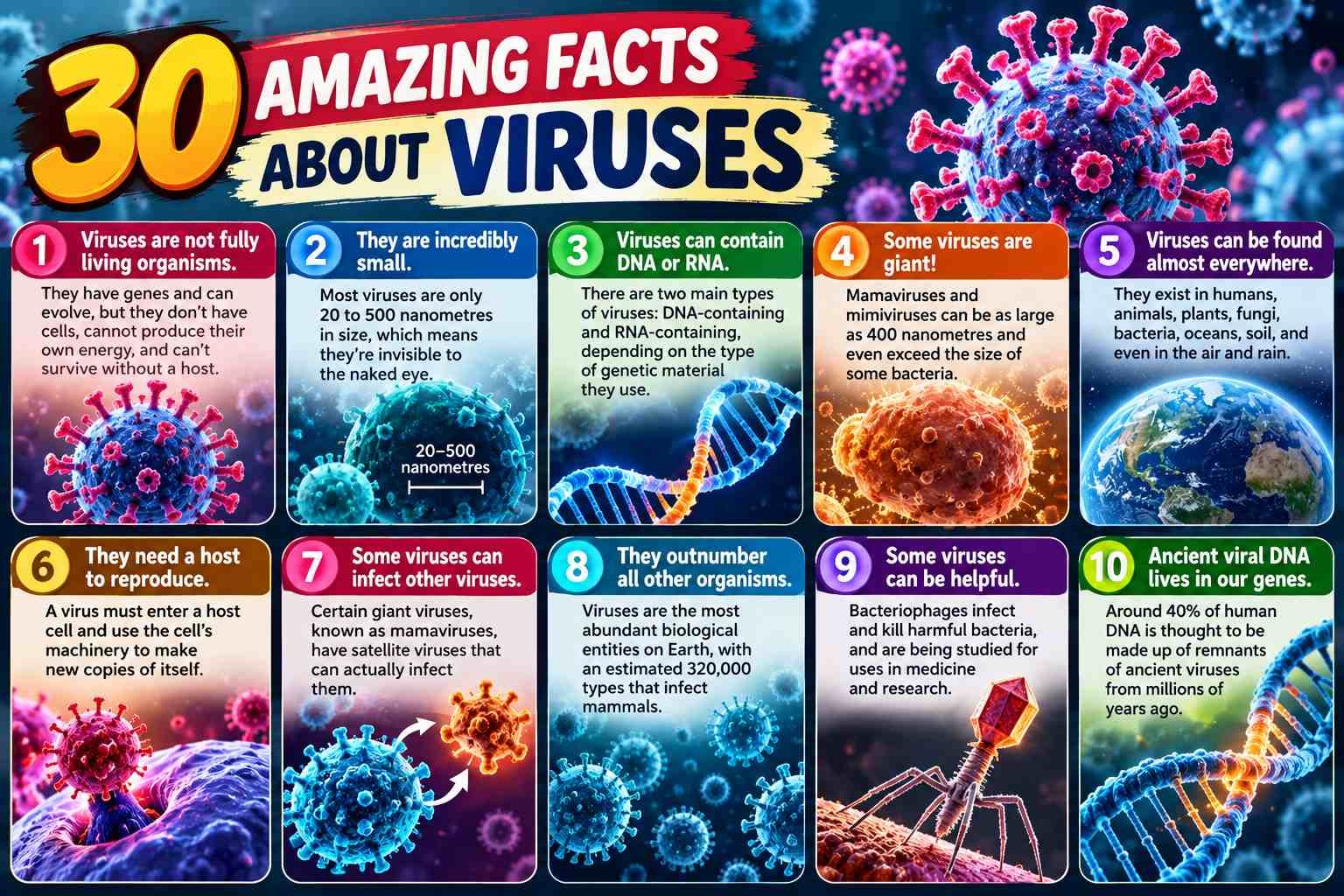
Viruses are among the tiniest biological entities on Earth, yet they can have an enormous impact on living organisms. They are found in humans, animals, plants, bacteria, fungi, oceans, soil, and even the atmosphere. What makes them especially fascinating is that scientists still debate exactly how to classify them: viruses have genes, reproduce and evolve, but they don’t have cells and cannot reproduce independently.
Some viruses cause diseases, while others can actually be useful to humans. They come in remarkably different shapes and sizes, and some are so unusual that scientists once mistook them for bacteria.
From ancient viral remnants hidden in our DNA to viruses that infect other viruses, here are 30 amazing facts about viruses that show just how fascinating the microscopic world can be.
1. Viruses Are Not Considered Fully Living Organisms
One of the strangest things about viruses is that they don’t fit neatly into the usual categories of life.
They contain genetic material and can evolve, but they don’t have cells, cannot produce their own energy, and cannot reproduce without a host. This is why scientists have long debated whether viruses should be considered living organisms.
In other words, viruses occupy a rather unusual biological grey area.
2. Viruses Need a Host to Reproduce
A virus cannot simply reproduce on its own.
Instead, it must enter a suitable host cell and use the cell’s machinery to make new copies of itself. The supplied sources describe this process as viruses essentially hijacking host cells for replication.
Without a host, a virus cannot carry out this reproductive process.
Also Read-30 Amazing Facts About DNA and Genetics
3. Viruses Don’t Have Cells
Unlike bacteria, plants, animals, and fungi, viruses aren’t made of cells.
A typical virus contains genetic material surrounded by a protective protein structure called a capsid. Some viruses also have an outer envelope.
This simple structure is one reason viruses are so different from ordinary cellular life.
4. Viruses Can Contain DNA or RNA
Viral genetic material can come in different forms.
The supplied sources divide viruses broadly into DNA-containing and RNA-containing viruses. Their genetic material carries the information needed for producing new viral particles inside suitable host cells.
That small package of genetic information can have surprisingly large consequences.
5. Viruses Are Extremely Small
Most viruses are far too small to see with the naked eye.
One of the supplied sources gives a general size range of approximately 20 to 500 nanometres, while another gives a range of about 20 to 400 nanometres.
To put that into perspective, a nanometre is one-billionth of a metre.
6. Some Viruses Are Smaller Than Others by a Huge Margin
Not all viruses are the same size.
The Amazing Facts 4U source identifies circoviruses as among the smallest, at around 20 nanometres, while mimiviruses can reach approximately 400 nanometres.
At these scales, even a difference of a few hundred nanometres can be enormous.
7. Some Viruses Are Surprisingly Large
When people think of viruses, they usually imagine something extremely tiny and simple.
But some giant viruses are large enough to rival or exceed certain bacteria in physical dimensions. The supplied sources discuss mamaviruses and mimiviruses as unusually large viruses.
Their discovery challenged scientists’ earlier ideas about how small and simple viruses had to be.
8. Some Viruses Can Infect Other Viruses
This sounds like science fiction, but it is a real phenomenon described in the supplied sources.
Certain giant viruses have been found with satellite viruses associated with them. The source notes that mamaviruses can themselves be involved in relationships with these unusual viral companions.
It is one of the strangest examples of competition and dependence in the microscopic world.
9. Viruses Are Found Almost Everywhere
Viruses aren’t restricted to hospitals or human bodies.
They can infect animals, plants, fungi, single-celled organisms, and bacteria.
That means the viral world is vastly broader than the relatively small number of viruses that commonly make headlines.
10. Viruses Can Be Found in Rain
Even rain can carry viruses.
The supplied Reader’s Digest source explains that viruses and other microorganisms can become attached to tiny atmospheric particles from sources such as soil and sea spray before returning to Earth through rain, snow, or sandstorms. Fortunately, most of these aren’t infectious to humans.
So the atmosphere is another part of the planet’s enormous microbial environment.
11. There Are Enormous Numbers of Viruses in the Oceans
The ocean is home to an extraordinary number of virus particles.
One supplied source estimates roughly one million virus particles per millilitre of seawater, with an enormous total number of viral particles across the world’s oceans.
Most of these viruses aren’t human pathogens. Many interact with marine microorganisms and play important roles in ocean ecosystems.
12. Viruses Are Among the Most Abundant Biological Entities on Earth
Viruses are incredibly numerous.
One supplied source describes them as the most plentiful microbes on the planet, with estimates of around 320,000 types that infect mammals, while only a much smaller number are known to infect humans.
So the viruses that humans commonly hear about represent only a tiny fraction of the viral world.
13. The Word “Virus” Means “Poison”
The name itself has an interesting history.
The supplied sources explain that the word virus comes from Latin and was associated with meanings such as “poison” or a poisonous/slimy substance.
The name was therefore connected with harmful substances long before modern virology existed.
14. Scientists Couldn’t See Viruses With Ordinary Microscopes
Viruses are so small that traditional light microscopes cannot reveal their detailed structures.
The supplied sources explain that scientists were able to observe virus structures after the development of powerful electron microscopes in the 20th century.
Electron microscopy opened an entirely new window into the microscopic world.
15. Tobacco Mosaic Virus Was a Major Milestone in Virology
The Tobacco Mosaic Virus (TMV) played an important role in the early history of virology.
According to the supplied source, Russian microbiologist Dmitry Ivanovsky discovered the virus in 1892, making it a landmark in the development of virus research.
This discovery helped establish that disease-causing agents could exist beyond what scientists could see with ordinary microscopes.
16. Some Viruses Are Associated With Cancer
Viruses aren’t responsible for every type of cancer, but some cancers are associated with viral infections.
Several of the supplied sources specifically note that some types of cancer are linked to viruses.
This connection has become an important area of medical and biological research.
17. Human DNA Contains Ancient Viral Remnants
Here’s one of the most fascinating facts on the list: traces of ancient viral infections remain in the human genome.
The supplied sources cite an estimate that around 40% of human DNA consists of remnants of ancient viruses, although estimates vary depending on what is counted as viral-derived material.
These remnants are evidence of ancient interactions between viruses and our ancestors.
18. Retroviruses Can Insert Genetic Material Into Host Chromosomes
Retroviruses have a particularly interesting life cycle.
The supplied sources explain that retroviruses can insert their genetic material into the chromosomes of their host cells. This ability has also made retroviral systems useful tools in scientific research, including some gene-delivery and gene-therapy approaches.
Their biology has therefore helped scientists develop new research techniques.
19. Some Viruses Can Actually Be Helpful
Not every virus is harmful to humans.
Bacteriophages, often called phages, are viruses that infect bacteria. The supplied sources note that they can kill harmful bacteria and have been studied and used in applications involving bacterial control.
This is a good reminder that the word “virus” doesn’t automatically mean “dangerous.”
20. Viruses Can Help Control Animal Populations
Viruses have sometimes been deliberately used to control populations of invasive or overabundant animals.
The supplied sources describe how myxomatosis was used in Australia to reduce rabbit populations after rabbits had multiplied dramatically and caused extensive damage to vegetation.
It’s an unusual example of a virus being used as a biological control tool.
21. Some Viruses Can Spread Without Causing Immediate Symptoms
A person can sometimes carry and transmit a virus without realizing they are infected.
The supplied sources explain the difference between asymptomatic people, who never develop noticeable symptoms, and presymptomatic people, who can transmit the virus before symptoms appear.
This is one reason controlling viral outbreaks can be complicated.
22. R0 Is Used to Describe How Quickly an Infection Can Spread
You’ve probably heard the term R0, pronounced “R naught.”
It describes the average number of people who could become infected from one infected person under particular conditions. If R0 is above one, an infection can potentially grow in a population; if it remains below one, transmission tends to decline.
However, R0 isn’t a fixed property in every real-world situation. Social behavior, immunity, environment, and public-health measures can all affect transmission.
23. Viruses and Bacteria Are Not the Same
A common misconception is that viruses and bacteria are basically the same thing.
They aren’t. Bacteria are single-celled organisms capable of living and reproducing independently, while viruses require host cells for replication.
This difference is also important when thinking about treatment.
24. Antibiotics Do Not Treat Viral Infections
Antibiotics are designed to act against bacteria, not viruses.
The supplied source emphasizes that antibiotics don’t cure viral infections such as ordinary colds and flu. Many viral infections are instead managed by the body’s immune response, while specific antiviral medicines exist for certain viruses.
That distinction is one of the basics of understanding infectious diseases.
25. You Can Sometimes Catch the Same Virus More Than Once
Getting an infection doesn’t always guarantee lifelong protection.
The supplied sources explain that immunity can weaken over time, and viruses can change in ways that allow new strains to evade existing immune protection.
That’s one reason why some infections can occur repeatedly and why certain vaccines require periodic updates or booster doses.
26. Influenza Viruses Change Over Time
Influenza is a good example of viral evolution.
The supplied sources note that many influenza variants exist and that changes in viral genetic material can make it more difficult for the immune system to recognize future strains.
This is one reason seasonal influenza vaccines are updated regularly.
27. Plants Can Get Viral Infections Too
Viruses aren’t limited to humans and animals.
Plant viruses can infect crops and other plants, sometimes causing visible changes such as discolored leaves, twisted stems, or altered flowers.
These infections can also be important for agriculture because plant diseases may affect crop production.
28. Some Viruses Have Extremely Ancient Relationships With Animals
The relationship between viruses and other organisms can go back millions of years.
One particularly unusual example involves braconid wasps. The supplied sources describe a virus associated with these wasps that suppresses the immune response of caterpillar hosts, allowing the wasp larvae to develop inside them.
The source estimates that this viral relationship is more than 100 million years old.
29. Viruses Can Be Studied Inside Amoebas
Amoebas have turned out to be interesting environments for discovering unusual microorganisms and viruses.
The supplied sources describe amoebas as something of a biological “mixing bowl,” because they consume relatively large particles and can contain different microorganisms that interact with one another.
Some discoveries made in these environments have expanded scientists’ understanding of just how diverse viruses can be.
30. Scientists Are Still Discovering How Extraordinary Viruses Are
Perhaps the biggest fact about viruses is that there is still plenty we don’t know.
Scientists continue to discover unusual viral forms, new host relationships, ancient viral remnants, and unexpected roles in ecosystems. The supplied sources themselves show how quickly the understanding of viruses has expanded—from early discoveries such as tobacco mosaic virus to giant viruses, bacteriophages, and viral genes embedded in animal genomes.
The microscopic world is clearly much more complicated than it first appeared.
Conclusion
Viruses may be microscopic, but their biology is anything but simple. They can infect humans, animals, plants, bacteria, and other organisms; they can evolve rapidly; and some have become useful tools in scientific research.
Perhaps the most fascinating part is the strange position viruses occupy in biology. They aren’t made of cells and cannot reproduce independently, yet they contain genes, replicate inside hosts, evolve, and have been interacting with living organisms for millions of years.
From ancient viral DNA hidden in our genome to viruses that attack bacteria and even satellite viruses associated with giant viruses, the world of virology is full of surprises.