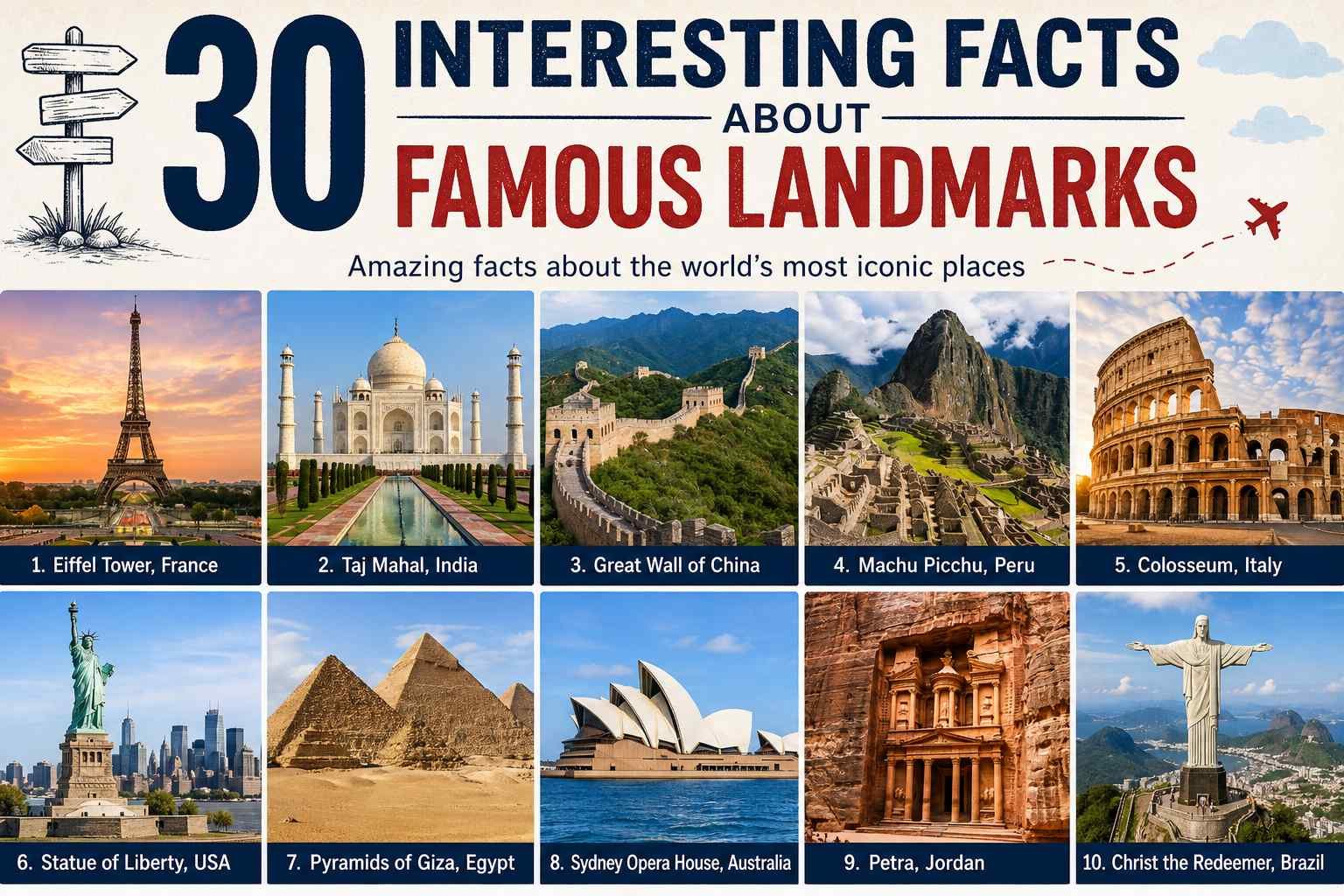
Famous landmarks have a special way of connecting us to a place. You may recognize Paris just by seeing the Eiffel Tower, think of India when you see the Taj Mahal, or picture New York Harbor when the Statue of Liberty comes into view. These incredible places are not just beautiful buildings or monuments—they also carry stories of history, culture, engineering, and human ambition.
From ancient pyramids and mysterious stone cities to modern skyscrapers and spectacular bridges, here are 30 interesting facts about famous landmarks that may surprise you.
1 The Eiffel Tower Was Meant to Be Temporary
The Eiffel Tower is one of the first landmarks that comes to mind when people think of Paris. It was constructed for the 1889 Paris World Fair, which also marked the 100th anniversary of the French Revolution.
Interestingly, the tower was originally intended to stand for only about 20 years. Instead, it became one of the world’s most recognizable landmarks.
2 The Eiffel Tower Gets Taller in Summer
Here is a fun little science fact hiding inside a famous landmark. The Eiffel Tower can become around 15 centimeters taller during hot weather because the iron expands when heated.
And when night falls, the tower becomes even more spectacular. Its sparkling lights create one of the most recognizable sights in Paris.
3 The Great Wall of China Isn’t One Single Wall
The Great Wall of China looks like one enormous continuous structure in photographs, but that’s not quite how it works.
It is actually a huge collection of walls and fortifications constructed during different periods. Together, the surviving sections extend for more than 21,000 kilometers, crossing mountains, deserts, grasslands, and other landscapes.
Also Read-50 Amazing Facts About India You Never Knew
4 The Great Wall Took More Than 2,000 Years to Build
The Great Wall wasn’t created in one construction project. Different rulers and dynasties built, repaired, and extended sections over many centuries.
Some parts were constructed using stone and bricks, while other sections used earth and even wood. The wall also contained watchtowers that helped with defense and communication.
5 You Can’t See the Great Wall From the Moon
This is one of the most persistent myths about famous landmarks.
Despite its enormous length, the Great Wall is not visible from the Moon with the naked eye. Its width is simply too small compared with the enormous distance involved.
6 The Great Pyramid Was Once the World’s Tallest Structure
The Great Pyramid of Giza was an extraordinary achievement for the ancient world. It originally stood at approximately 146 meters (480 feet) high.
Even more impressive, it remained the tallest man-made structure in the world for thousands of years.
7 The Great Pyramid Used More Than Two Million Stone Blocks
Imagine trying to build a gigantic pyramid without modern cranes, trucks, or construction equipment.
The Great Pyramid was constructed from more than two million stone blocks, with some individual blocks weighing many tons. Exactly how ancient builders organized and moved all those enormous stones remains a fascinating subject of study.
8 The Great Pyramid Is the Last Ancient Wonder Still Standing
The original list of the Seven Wonders of the Ancient World was created more than two thousand years ago.
Of those famous ancient structures, the Pyramid of Giza is the only one that still survives today. That’s one reason it remains such an extraordinary link to the ancient past.
9 The Taj Mahal Is Actually a Mausoleum
The Taj Mahal is often described as a symbol of love, but technically it is a mausoleum—a monumental tomb.
Mughal emperor Shah Jahan commissioned the magnificent structure in memory of his wife, Mumtaz Mahal. The emperor was eventually buried there as well.
10 The Taj Mahal’s Minarets Lean Slightly Outward
Look carefully at the Taj Mahal and you’ll notice its four minarets aren’t perfectly vertical.
They were designed to lean slightly outward. This clever architectural feature helps reduce the risk of the minarets falling toward the central mausoleum in the event of a major earthquake.
11 The Statue of Liberty Was Made in France
The Statue of Liberty may be one of America’s most famous symbols, but it was actually built in France.
After completion, the enormous statue was dismantled into 350 pieces, packed into 214 crates, and shipped across the Atlantic to New York. It was presented by France to the United States and officially dedicated in 1886.
12 The Statue of Liberty Has a Very Long Official Name
The famous statue is commonly called the Statue of Liberty or Lady Liberty. Its full title is “Liberty Enlightening the World.”
The statue’s seven rays are traditionally associated with the seven continents, making its design carry a broader symbolic meaning.
13 Lady Liberty Is Made From Copper
The Statue of Liberty isn’t solid copper. Its exterior is made from copper sheets attached to an iron framework.
Over time, the copper reacted with the environment and developed the familiar green color that people recognize today.
14 The Statue of Liberty and Eiffel Tower Share an Engineer
Here’s a surprising connection between two world-famous landmarks.
The French engineer Alexandre Gustave Eiffel, famous for the Eiffel Tower, was also involved in designing the iron framework of the Statue of Liberty.
15 The Leaning Tower of Pisa Started Leaning During Construction
The Leaning Tower of Pisa didn’t suddenly tilt hundreds of years after it was finished. The problem began while the tower was still being built.
The ground underneath was soft and unstable, causing the structure to start leaning. Builders attempted to compensate for the movement, but the famous tilt remained.
16 The Leaning Tower Was Built Over Nearly 200 Years
The tower took almost two centuries to complete. Construction began in the medieval period and was interrupted by various difficulties.
Today, visitors can climb hundreds of steps to reach the viewing area and enjoy the unusual experience of standing inside one of the world’s most famous leaning buildings.
17 The Colosseum Is More Than 1,900 Years Old
The Colosseum in Rome is one of the world’s most recognizable ancient amphitheaters.
Built during the Roman period, it hosted enormous public spectacles, including gladiatorial contests. Even after nearly two thousand years, its surviving structure remains one of Italy’s greatest attractions.
18 The Colosseum Was Built for Huge Crowds
The Colosseum was designed as a massive entertainment venue capable of accommodating large numbers of spectators.
Its size and carefully planned entrances, seating areas, and circulation routes demonstrate just how advanced Roman engineering and architecture could be.
19 The Sydney Opera House Took 14 Years to Build
The Sydney Opera House is famous for its dramatic roof, which resembles sails or shells rising above Sydney Harbour.
Construction took considerably longer than originally planned. The building was constructed between 1959 and 1973, taking about 14 years to complete.
20 The Sydney Opera House Has More Than One Million Roof Tiles
Those famous curved roofs aren’t simply painted surfaces.
The Opera House is covered with more than one million specially made ceramic tiles. They were manufactured in Sweden before being transported to Australia.
21 The Sydney Opera House Appears on Australian Currency
The Sydney Opera House has become such an important symbol of Australia that it has been featured on the country’s $100 banknote.
Its distinctive design makes it recognizable even to people who have never visited Sydney.
22 Petra Was Carved Into Rock
Petra in Jordan looks almost unreal when you first see it. Much of the ancient city’s architecture was carved directly into the surrounding sandstone cliffs.
The city dates back to ancient times and is widely regarded as one of the world’s remarkable archaeological landmarks.
23 Machu Picchu Was Hidden for Centuries
High in the mountains of Peru sits Machu Picchu, one of the world’s most famous archaeological sites.
The site remained largely unknown to the outside world for centuries and became widely known internationally after its rediscovery in 1911.
24 Machu Picchu Has Hundreds of Terraces
Machu Picchu wasn’t simply built on a convenient flat piece of land. The Inca builders created more than 600 terraces across the mountainous landscape.
These terraces helped control water and reduce the risk of landslides while also providing space for agriculture.
25 Some Stones at Machu Picchu Are Enormous
The Inca builders worked with remarkably large stones.
Some stones used at Machu Picchu weigh more than 50 tons. Even today, the precision of the stonework and the way the structures were built remain among the site’s most fascinating features.
26 Mount Fuji Is an Active Volcano
Mount Fuji is one of Japan’s most recognizable natural landmarks. Its snow-capped peak has become a powerful symbol of the country.
But behind its beautiful appearance is a volcano. Mount Fuji is an active volcano and has also held deep religious significance in Japan.
27 Angkor Wat Was Originally Built as a Hindu Temple Complex
Angkor Wat in Cambodia is one of the most spectacular religious monuments on Earth.
Although it is now strongly associated with Cambodia’s Buddhist heritage, the complex was originally constructed as a Hindu religious site during the 12th century. Its enormous scale and detailed sandstone architecture are remarkable.
28 The Great Barrier Reef Is Visible From Space
Not every famous landmark is made of stone or metal.
Australia’s Great Barrier Reef is one of the world’s greatest natural landmarks. The reef system covers an enormous area and contains thousands of individual reefs and hundreds of islands. Its immense scale is so impressive that it can be seen from space.
29 The Golden Gate Bridge Was Completed in 1937
The Golden Gate Bridge has become one of the defining symbols of San Francisco.
This famous suspension bridge was completed in 1937 and stretches about 1.2 miles across the Golden Gate strait. Its distinctive appearance has made it one of the world’s best-known bridges.
30 The Burj Khalifa Is More Than 160 Stories High
Moving from ancient monuments to modern engineering, the Burj Khalifa in Dubai shows just how high humans can build.
The skyscraper rises more than 2,716 feet and contains more than 160 stories. It also holds several height-related records, including the world’s highest occupied floor and one of the world’s highest observation decks.
Conclusion
From ancient pyramids and temples to giant bridges and modern skyscrapers, famous landmarks tell stories that go far beyond what we see in photographs. Some took centuries to build, some were created to honor people or beliefs, and others became famous because of extraordinary engineering.
What makes these places truly fascinating is that every landmark has a story behind it. The next time you see a picture of the Eiffel Tower, Taj Mahal, Great Wall, Machu Picchu, or Statue of Liberty, you’ll know there’s much more to discover than meets the eye.
1 thought on “30 Interesting Facts About Famous Landmarks”