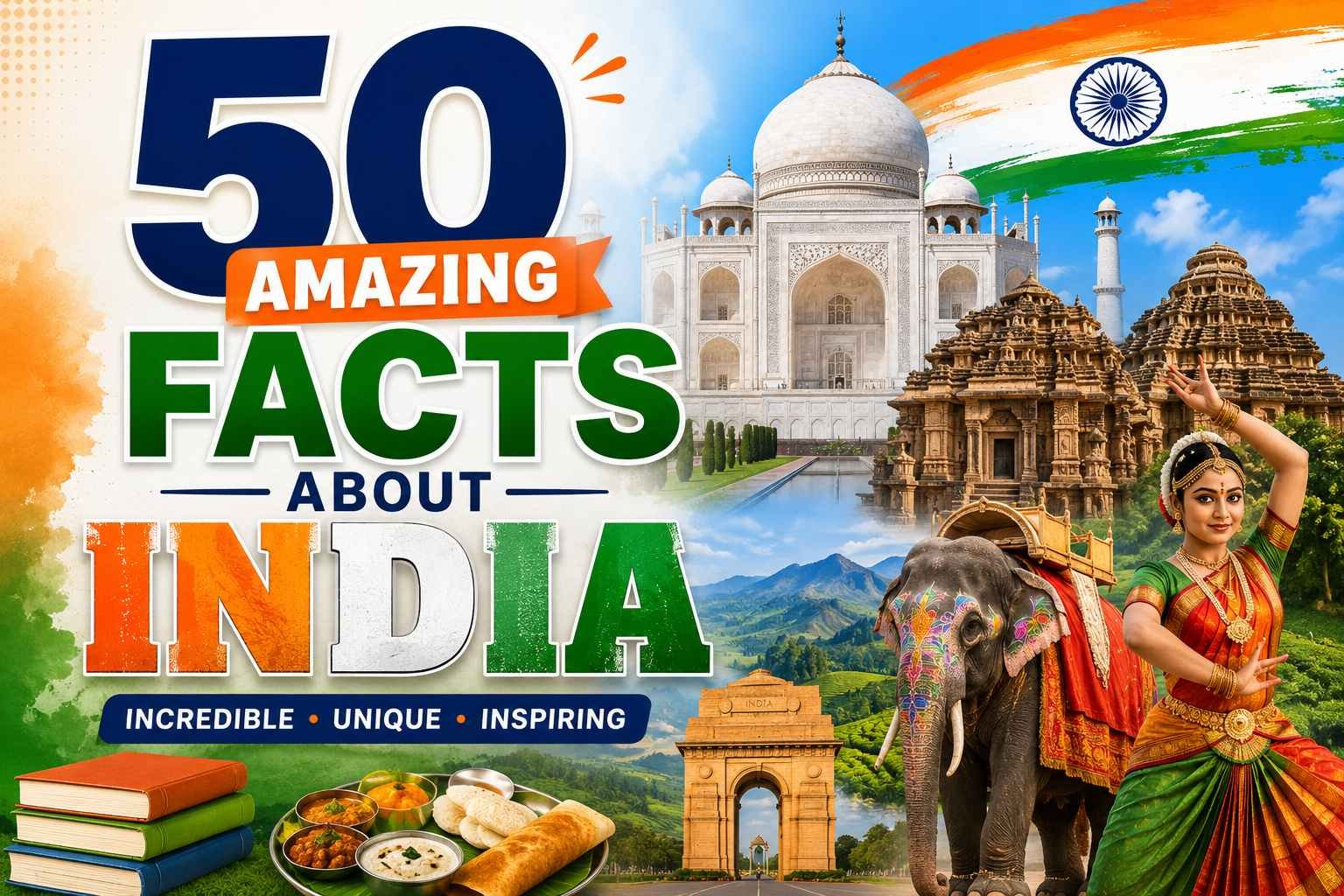
India is a country where ancient traditions, modern technology, incredible diversity and some truly surprising achievements come together. From the Himalayas and the Indian Ocean to ancient mathematics and space exploration, there is something fascinating around almost every corner.
There are many amazing facts about India that even Indians may not know. Some are connected to history and culture, while others show India’s achievements in science, technology, transport and sports.
So, let’s take a journey through 50 amazing facts about India that may surprise you.
India Has One of the World’s Largest Postal Networks
India Post has one of the most extensive postal networks in the world, with 164,999 post offices as of March 31, 2025. An impressive majority are located in rural areas, helping connect people in remote parts of the country.
India Has an Ocean Named After It
The Indian Ocean is the only ocean named after a country. It borders India to the south and has played an important role in India’s history, trade and maritime culture.
India Is Home to the World’s Tallest Mountain
Mount Everest, the world’s highest mountain above sea level, is located in the Himalayas on the border between Nepal and China. The Himalayas themselves stretch across several countries, including India.
India Has One of the World’s Oldest Living Cities
Varanasi is widely regarded as one of the world’s oldest continuously inhabited cities. Situated on the banks of the Ganges, it has been an important cultural and spiritual center for thousands of years.
India Has 28 States and 8 Union Territories
India is a huge and diverse country made up of 28 states and 8 Union Territories. Each region has its own traditions, foods, festivals, languages and landscapes.
India Has a Festival of Colors
Holi is one of India’s most famous festivals. During the celebration, people throw colored powders and water at one another, turning streets into a spectacular display of colors.
The Golden Temple Serves Free Meals
The Golden Temple in Amritsar is famous for its langar, a community kitchen where free vegetarian meals are served to visitors regardless of their religion, caste or background.
Thousands of people can eat there in a single day, making it one of the world’s most remarkable examples of community service.
India Is Home to Both Lions and Tigers
India is one of the few places where wild Asiatic lions and Bengal tigers can be found within the country. Asiatic lions are primarily found in Gujarat’s Gir landscape, while Bengal tigers live across several Indian states.
India Has a City Built Around an Unusual Idea
Auroville, located mainly in Tamil Nadu, was founded in 1968 with the vision of creating an international community where people from different countries could live together.
It was designed around ideals of human unity rather than being based on nationality.
India Has One of the World’s Largest Railway Systems
Indian Railways connects an enormous number of cities, towns and villages across the country. For millions of people, trains are not simply transportation—they are an essential part of everyday life.
India’s Railway Network Is Almost a World of Its Own
From Himalayan routes to coastal journeys and long-distance express trains, Indian Railways offers an incredible variety of landscapes.
A train journey in India can take passengers through mountains, deserts, forests, plains and coastal regions.
India Has More Than 1.4 Billion People
India is home to more than 1.4 billion people, making it one of the world’s most populous countries.
That huge population also means India has an extraordinary variety of cultures, communities, traditions and lifestyles.
India Is One of the World’s Most Linguistically Diverse Countries
India is home to hundreds of languages and dialects. The Constitution recognizes 22 languages in its Eighth Schedule, while many more are spoken throughout the country.
India Has No Single National Language
A common misconception is that Hindi is India’s “national language.” In reality, India has no national language declared by the Constitution.
Hindi and English are used for official purposes at the Union level, while states have their own official languages.
India Has the World’s Largest Postal Network
This deserves another look because the scale is remarkable. India Post currently lists 164,999 post offices, making it the world’s largest postal network. (
India Was Once Known as a Major Center of Diamond Trade
India has a very long history associated with diamonds. Ancient Indian sources mention diamonds, and India was historically an important source and trading center for these precious stones.
The Concept of Zero Has Deep Roots in Indian Mathematics
Indian mathematicians played a crucial role in developing the mathematical concept of zero as a number. The work of mathematicians such as Brahmagupta was particularly important in establishing rules for calculations involving zero.
India’s Ancient Mathematics Was Highly Advanced
Indian mathematicians made major contributions to mathematics, including work involving algebra, geometry, astronomy and trigonometry.
These ideas later travelled beyond India and influenced mathematical development elsewhere.
Yoga Originated in India
Yoga has ancient roots in India and developed as a philosophical, spiritual and physical tradition over thousands of years.
Today, yoga is practiced around the world by people from many different backgrounds.
Ayurveda Has Ancient Indian Roots
Ayurveda is a traditional system of medicine that developed in India. Its classical texts contain extensive discussions about health, diet, herbs and approaches to maintaining well-being.
Chess Has Ancient Indian Connections
The modern game of chess has historical roots in an ancient Indian game called chaturanga. The game later spread to other parts of the world and gradually evolved into the chess we know today.
India Has a Village Famous for Solar Power
Some Indian villages have become notable examples of renewable-energy adoption. Dharnai in Bihar, for example, became widely known for a solar-powered microgrid project.
India’s renewable-energy story continues to grow as solar and other clean-energy technologies expand.
India Has the World’s Largest Film Industry by Volume
India produces a huge number of films every year across multiple languages and industries.
Hindi-language Bollywood is the most internationally recognized, but major film industries also exist in Tamil, Telugu, Malayalam, Kannada, Bengali and other languages.
India Has a Film Industry Beyond Bollywood
When people say “Indian cinema,” they often think only of Bollywood. But India has many major regional film industries.
Tamil cinema, Telugu cinema, Malayalam cinema and others have developed their own stars, storytelling styles and huge audiences.
India Has Produced Some Remarkable Space Missions
India’s space program has achieved several major milestones through the Indian Space Research Organisation (ISRO).
One of the most famous was the Mars Orbiter Mission, popularly known as Mangalyaan.
Mangalyaan Reached Mars on Its First Attempt
India’s Mars Orbiter Mission successfully entered Mars orbit on September 24, 2014, on its first attempt.
ISRO describes it as India’s first interplanetary mission, and the mission successfully operated far beyond its originally designed six-month mission life.
Chandrayaan-1 Helped Discover Water on the Moon
India’s Chandrayaan-1 lunar mission was launched in 2008. One of its most important scientific achievements was helping provide evidence of water-related signatures on the Moon.
Chandrayaan-3 Made a Historic Lunar Landing
In 2023, India’s Chandrayaan-3 mission successfully landed near the Moon’s south polar region.
The achievement made India the first country to successfully land a spacecraft in that region of the Moon.
India Has Its Own Satellite Navigation System
India developed NavIC, a regional satellite navigation system designed to provide positioning, navigation and timing services over India and nearby regions.
India Has One of the World’s Largest Road Networks
India has an enormous road network connecting major cities, small towns and rural communities.
Highways, expressways, village roads and mountain routes together make road transportation one of the country’s most important forms of connectivity.
India Has a Village Where People Respect Trees
The Bishnoi community of Rajasthan is well known for its long-standing traditions of protecting nature and wildlife.
Their environmental traditions date back centuries and are often cited as an early example of community-led conservation.
India’s Chipko Movement Became Famous for Protecting Forests
The Chipko Movement became famous for villagers embracing or holding onto trees to prevent them from being cut down.
It became an important symbol of environmental activism in India.
India Has One of the World’s Highest Cricket Fan Bases
Cricket is more than just a sport in India. For millions of people, major matches become national events, bringing families and communities together in front of televisions, phones and stadium screens.
India Has Won Multiple Cricket World Cups
India’s men’s cricket team won the 1983 Cricket World Cup, creating one of the most important moments in Indian sporting history.
The team won the tournament again in 2011, this time on home soil.
India Has Dominated International Kabaddi
India has been one of the strongest nations in international kabaddi, particularly in men’s competitions.
The sport has deep cultural roots in South Asia and has grown into an international competitive sport.
India Has One of the World’s Largest Film Audiences
With hundreds of millions of cinema and streaming viewers, India represents one of the world’s most important entertainment markets.
Movies are released in numerous Indian languages, allowing audiences across the country to enjoy locally produced stories.
India Is Home to the Sundarbans
The Sundarbans, shared by India and Bangladesh, form one of the world’s largest mangrove forest regions.
The Indian portion is famous for its wildlife, waterways and Bengal tigers.
India Has the Great Indian Desert
The Thar Desert stretches across northwestern India and is one of the country’s most distinctive landscapes.
Despite its harsh climate, the region is home to millions of people, unique wildlife and vibrant cultural traditions.
India Has the Wettest Places on Earth
Parts of Meghalaya receive extraordinary amounts of rainfall. Mawsynram and nearby Cherrapunji are internationally famous for their extreme monsoon rainfall.
India Has Some of the Highest Roads in the World
The Himalayan region contains roads and mountain passes at extraordinary elevations.
These routes connect remote communities and are also popular with travelers looking for some of India’s most dramatic landscapes.
India Has a Floating Post Office
India has had a famous floating post office on Dal Lake in Srinagar, combining the country’s enormous postal network with one of Kashmir’s most recognizable landscapes.
It became a fascinating symbol of how postal services can adapt to local geography.
India Has a Railway Station With an Unusual Name
Venkatanarasimharajuvaripeta in Andhra Pradesh is famous for having one of the longest station names in the Indian railway system.
Its name is certainly a challenge for anyone trying to say it quickly!
India Has a Living Root Bridge Tradition
In Meghalaya, local communities have traditionally guided the roots of rubber fig trees to create natural bridges.
These living root bridges can continue growing stronger over time and are an incredible example of humans working with nature.
India Has Some Extraordinary Stepwells
Stepwells were traditionally built to store and access water.
Structures such as Rani ki Vav in Gujarat show how practical water-management systems could also become extraordinary works of architecture.
India Has One of the World’s Most Famous Monumental Buildings
The Taj Mahal in Agra is one of the most recognizable monuments on Earth.
Built during the Mughal era, it is famous for its white marble architecture, symmetry and detailed craftsmanship.
India Has a UNESCO World Heritage Railway
The Darjeeling Himalayan Railway is a famous mountain railway and part of the UNESCO-listed Mountain Railways of India.
Its small trains travel through the dramatic Himalayan foothills and are a favorite among railway enthusiasts.
India Has a Festival Dedicated to Elephants
In several parts of India, elephants have long been associated with religion, culture and festivals.
Ganesha Chaturthi, dedicated to Lord Ganesha, is one of India’s best-known celebrations and features elaborate artistic representations of the elephant-headed deity.
India Has a Huge Variety of Food
Indian cuisine isn’t one single cuisine. It changes dramatically from region to region.
South Indian dosa, Punjabi dishes, Bengali sweets, Gujarati cuisine, Kashmiri food and northeastern specialties can taste completely different—and all are part of India’s culinary identity.
India Has Produced Globally Recognized Scientists
Indian scientists have made important contributions to physics, mathematics, chemistry, medicine and space science.
Names such as C. V. Raman, Satyendra Nath Bose, Srinivasa Ramanujan and A. P. J. Abdul Kalam have become part of India’s scientific legacy.
India Became the First Country to Reach Mars Orbit on Its First Attempt
Perhaps one of the most remarkable modern achievements is India’s successful first attempt at reaching Mars orbit.
Mangalyaan was launched on November 5, 2013, and entered Mars orbit on September 24, 2014. ISRO notes that India achieved the feat on its maiden attempt and did so with a highly cost-effective mission.
Conclusion
India is much more than a country on a map. It is a place where ancient traditions exist alongside modern technology, where languages and cuisines change from one region to another, and where centuries-old ideas continue to influence the modern world.
From zero and yoga to living root bridges, the Taj Mahal, Indian Railways, Chandrayaan and Mangalyaan, India’s story is filled with fascinating achievements and surprising facts.
And the most interesting part?
There are still thousands of incredible facts about India waiting to be discovered.
So, the next time someone asks what makes India special, you won’t have to look far for an answer. 🇮🇳
Note: Some popular internet lists of “50 facts about India” contain outdated statistics or claims that are difficult to verify. This version intentionally avoids questionable claims and uses more reliable, current information where figures are involved.
1 thought on “50 Amazing Facts About India You Never Knew”