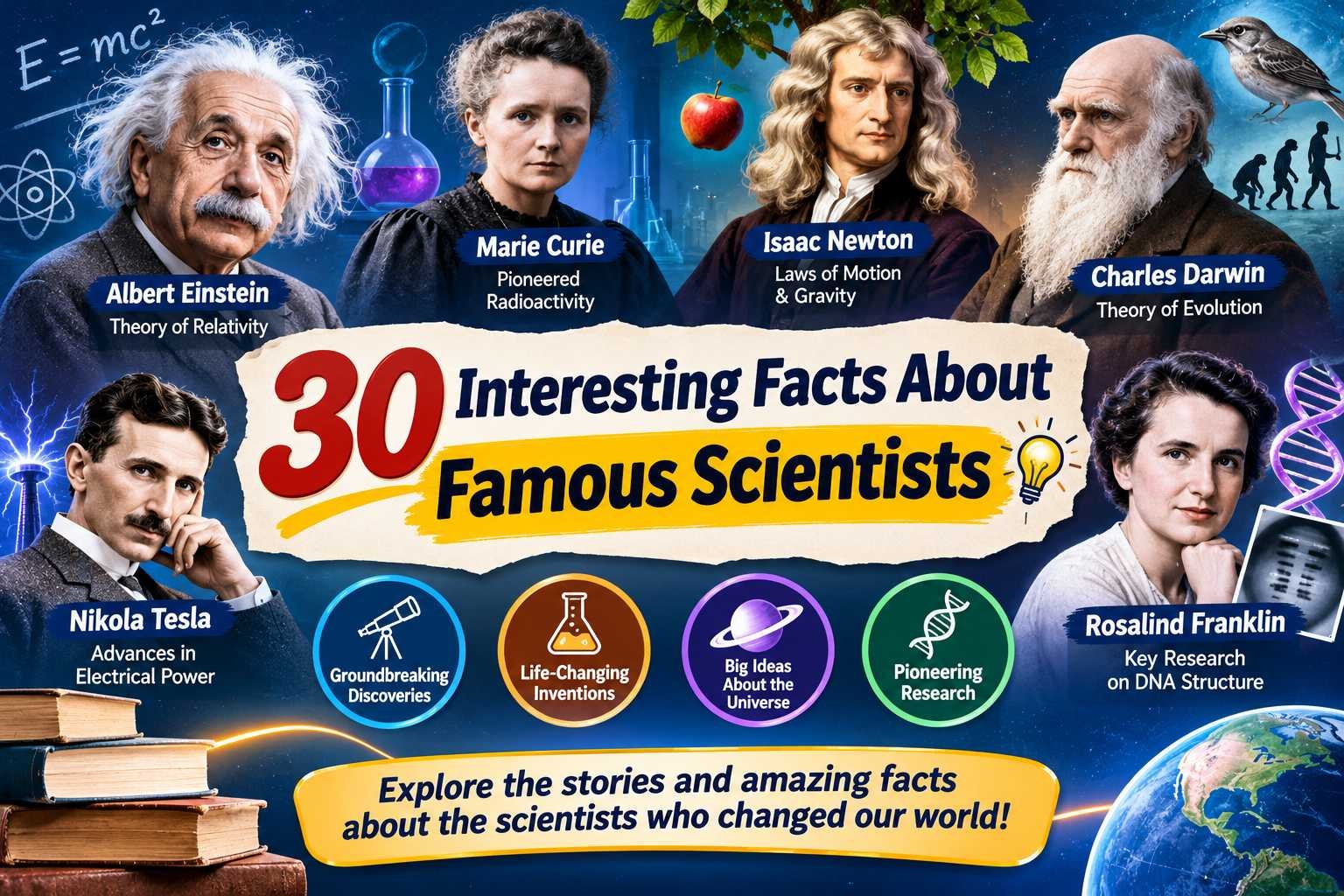
Science is full of people who looked at the world and asked, “Why?” Their curiosity helped us understand everything from tiny cells to distant galaxies. Some scientists changed how we see the universe, while others developed discoveries that still shape everyday life.
Here are 30 interesting facts about famous scientists and the ideas that made them unforgettable.
1. Albert Einstein’s Nobel Prize Was for More Than Relativity
Albert Einstein is best known for the theory of relativity, but he received the 1921 Nobel Prize in Physics for explaining the photoelectric effect. His work helped scientists understand how light can behave as packets of energy.
2. Marie Curie Was the First Woman to Win a Nobel Prize
Marie Curie won the Nobel Prize in Physics in 1903, sharing it with Pierre Curie and Henri Becquerel. In 1911, she won a second Nobel Prize, this time in Chemistry, for her work on radium and polonium.
3. Isaac Newton Helped Explain Gravity
Isaac Newton developed the law of universal gravitation, describing how objects attract one another. The familiar story of an apple falling from a tree is often associated with his thinking about gravity, though the popular version is simplified.
4. Galileo Galilei Improved the Telescope
Galileo did not invent the telescope, but he improved it and used it to observe the sky. His observations included Jupiter’s four largest moons, showing that not everything in the heavens revolved around Earth.
5. Charles Darwin Studied Nature on a Long Voyage
Charles Darwin gathered observations during a voyage aboard the HMS Beagle. His studies of plants, animals, and fossils helped him develop the theory of evolution by natural selection.
6. Rosalind Franklin’s Images Helped Reveal DNA’s Structure
Rosalind Franklin used X-ray diffraction to study DNA. Her research produced important evidence about its structure and contributed to the discovery of DNA’s double-helix form.
7. Nikola Tesla Worked on Alternating Current
Nikola Tesla made major contributions to alternating-current electrical systems. This approach made it practical to transmit electricity over long distances and helped shape modern power networks.
8. Alexander Fleming Discovered Penicillin by Accident
In 1928, Alexander Fleming noticed that mold had stopped bacteria from growing in a laboratory dish. The observation led to the discovery of penicillin, which became one of the world’s most important antibiotics.
9. Katherine Johnson Helped Calculate Spaceflight Paths
Mathematician Katherine Johnson worked for NASA and its predecessor, helping calculate the paths of early human spaceflights. Her careful calculations supported missions that carried astronauts into orbit and toward the Moon.
10. Stephen Hawking Studied Black Holes
Stephen Hawking made influential contributions to the study of black holes and the early universe. He proposed that black holes could emit radiation, now known as Hawking radiation.
11. Jane Goodall Changed How We Understand Chimpanzees
Jane Goodall observed chimpanzees in the wild and documented their complex social lives. Her research showed that chimpanzees make and use tools, challenging ideas about what makes humans unique.
12. Louis Pasteur Helped Make Food Safer
Louis Pasteur showed that microorganisms cause fermentation and that heating certain liquids can reduce harmful microbes. The process became known as pasteurization and is still used to make foods and drinks safer.
13. Dmitri Mendeleev Organized the Elements
Dmitri Mendeleev arranged known chemical elements into a periodic table. He left gaps for elements that had not yet been discovered and predicted some of their properties.
14. Archimedes Made Discoveries About Floating Objects
Archimedes studied how objects behave in liquids. The principle associated with his name explains why an object experiences an upward force when it is placed in a fluid.
15. Ada Lovelace Imagined What Computers Could Do
Ada Lovelace wrote notes describing how Charles Babbage’s proposed Analytical Engine could process more than numbers. Her work is often remembered as an early vision of computer programming.
16. Michael Faraday Helped Build the Foundations of Electric Motors
Michael Faraday discovered electromagnetic induction, showing how changing magnetic fields can produce electric current. His experiments helped lay the groundwork for electric generators and motors.
17. Ibn al-Haytham Emphasized Testing Ideas
Ibn al-Haytham, also known as Alhazen, made important contributions to optics. He argued that understanding nature requires observation, experiments, and careful reasoning.
18. Srinivasa Ramanujan Made Remarkable Mathematical Discoveries
Srinivasa Ramanujan developed powerful mathematical ideas despite having little formal training in advanced mathematics. His work on numbers and infinite series continues to influence mathematicians.
19. Niels Bohr Helped Explain the Atom
Niels Bohr proposed a model of the atom in which electrons occupy specific energy levels. Later discoveries refined the model, but his work was a major step in the development of quantum physics.
20. Chien-Shiung Wu Tested a Key Physics Idea
Physicist Chien-Shiung Wu led an experiment that showed parity is not conserved in certain weak nuclear interactions. The result challenged a long-held assumption in physics.
21. George Washington Carver Found Many Uses for Crops
George Washington Carver promoted crop rotation and soil improvement, especially for farmers growing cotton. He also researched many uses for peanuts and other crops, helping encourage agricultural diversity.
22. Hedy Lamarr Helped Inspire Wireless Technology
Hedy Lamarr, known as an actor as well as an inventor, co-developed a frequency-hopping communication system during World War II. The idea later became part of the broader history of wireless communications.
23. Subrahmanyan Chandrasekhar Studied the Life of Stars
Subrahmanyan Chandrasekhar calculated a limit related to how massive a white dwarf star can be. His work helped scientists understand how stars evolve and what can happen when they run out of fuel.
24. Barbara McClintock Discovered “Jumping Genes”
Barbara McClintock discovered that some genetic elements can move within a genome. These “jumping genes,” or transposable elements, changed how scientists understand genes and heredity.
25. Tu Youyou Helped Develop a Malaria Treatment
Chinese scientist Tu Youyou helped discover artemisinin, a medicine that became a crucial treatment for malaria. Her work drew on both modern research and the study of traditional medical texts.
26. Edwin Hubble Found Evidence That the Universe Is Expanding
Edwin Hubble’s observations showed that distant galaxies generally move away from us, with more distant galaxies receding faster. This became key evidence that the universe is expanding.
27. Antoine Lavoisier Helped Transform Chemistry
Antoine Lavoisier helped establish modern chemistry through careful measurement and clear explanations of chemical reactions. He also helped name oxygen and hydrogen and described the conservation of mass in chemical change.
28. Rachel Carson Raised Awareness About Pesticides
Biologist and writer Rachel Carson’s book Silent Spring examined the environmental effects of pesticides. It helped bring public attention to pollution and the importance of protecting ecosystems.
29. Alan Turing Helped Shape Computer Science
Alan Turing developed foundational ideas about computation and helped crack German codes during World War II. His work influenced both theoretical computer science and the history of computing.
30. Mae Jemison Became the First Black Woman in Space
Mae Jemison traveled into space aboard the Space Shuttle Endeavour in 1992. A physician and engineer, she later worked to encourage science education and exploration.
Conclusion
Famous scientists have changed the way we understand the world, often by asking questions that others had not thought to ask. Their stories show that discovery can begin with a simple observation, a careful experiment, or a bold new idea. Science continues to grow as each generation builds on the work that came before.
Frequently Asked Questions
Who is considered the most famous scientist?
There is no single answer. Albert Einstein, Isaac Newton, Marie Curie, and Charles Darwin are among the scientists whose work has had a lasting influence.
Who was the first woman to win a Nobel Prize?
Marie Curie became the first woman to win a Nobel Prize when she received the 1903 Nobel Prize in Physics.
Which scientist discovered penicillin?
Alexander Fleming discovered penicillin in 1928 after noticing that mold inhibited bacterial growth in a laboratory dish.
What did Rosalind Franklin contribute to the discovery of DNA’s structure?
Her X-ray diffraction research provided important evidence about DNA’s structure and contributed to the discovery of the double helix.
Why are famous scientists important?
Their discoveries and ideas help explain natural phenomena, improve technology and medicine, and inspire new generations to explore unanswered questions.