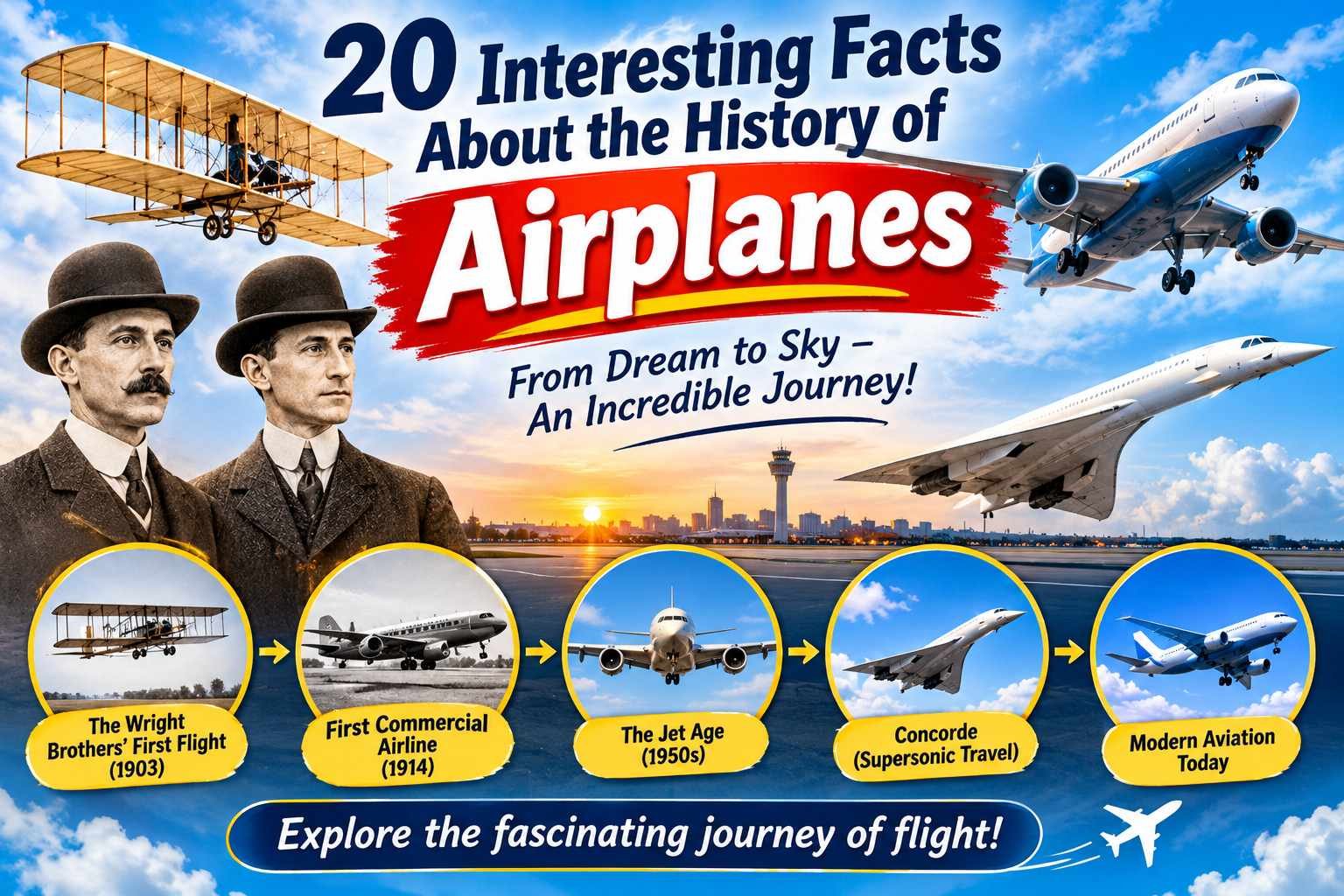
From the first fragile flying machines to today’s passenger jets, the history of airplanes is a story of bold ideas, repeated experiments, and remarkable engineering. For centuries, people dreamed of flying like birds. Turning that dream into a practical way to travel took patience—and a lot of trial and error.
The airplane changed how people travel, trade, communicate, and experience the world. It also transformed warfare, scientific research, and emergency response. Here are 20 interesting facts about how airplanes developed and changed our lives.
1. The Dream of Flight Is Centuries Old
Long before airplanes existed, people imagined machines that could carry them through the sky. Inventors, artists, and scientists studied birds and experimented with designs for wings and flying devices.
One famous example is Leonardo da Vinci, who sketched several flying-machine concepts in the late 15th century. His designs were never built into working airplanes, but they show how long humans had been thinking about flight.
Also Read-30 Fascinating Facts About the World’s Tallest Buildings
2. The Wright Brothers Made the First Controlled, Powered Flight
On December 17, 1903, Orville and Wilbur Wright achieved a major milestone near Kitty Hawk, North Carolina. Their aircraft, the Wright Flyer, made a powered flight that was controlled and sustained.
Orville piloted the first flight, which lasted 12 seconds and covered about 120 feet (36.5 metres). The brothers made three more flights that day, with Wilbur’s final flight lasting 59 seconds.
3. The Wright Brothers Were Bicycle Makers
Before they became famous for aviation, the Wright brothers ran a bicycle business in Dayton, Ohio. Their experience with bicycles helped them understand balance, steering, and mechanical design.
They applied that knowledge to their flying experiments. Instead of simply trying to make an aircraft rise, they focused on how a pilot could control it in the air.
4. Their First Successful Airplane Was Built From Lightweight Materials
The Wright Flyer was made mainly from spruce wood, with fabric covering its wings. It was powered by a small gasoline engine that the brothers helped develop with their mechanic, Charlie Taylor.
The aircraft was fragile by modern standards, but its design demonstrated that a powered machine could be controlled in flight. Its success helped launch the development of practical airplanes.
5. Early Pilots Had to Learn How to Fly From Scratch
When powered airplanes first appeared, there were no established flight schools, detailed manuals, or standardized training programs.
Early pilots learned through experimentation. They had to understand how to steer, balance, take off, and land aircraft that were often difficult to control.
As aviation grew, flight instruction became more organized, helping make flying safer and more reliable.
6. Airplanes Developed Quickly in the Early 1900s
The Wright brothers’ flight did not immediately lead to widespread air travel. Early airplanes were limited by their engines, materials, and control systems.
But inventors continued improving them. Aircraft gradually became faster, more stable, and capable of flying longer distances.
Within a few decades, airplanes had moved from experimental machines to useful tools for transportation, exploration, and military operations.
7. The First Commercial Airline Service Began in 1914
On January 1, 1914, a scheduled passenger service began between St. Petersburg and Tampa, Florida.
The flight was operated by the St. Petersburg–Tampa Airboat Line. Its aircraft carried one passenger at a time across Tampa Bay, making the trip much faster than many surface routes.
The service lasted only a few months, but it became an important early step in commercial passenger aviation.
8. World War I Accelerated Airplane Development
During World War I, airplanes were used for reconnaissance, communication, and combat. Military needs encouraged rapid improvements in aircraft design and performance.
Engineers developed stronger airframes, more powerful engines, and specialized aircraft for different missions.
The war also produced many experienced pilots and mechanics, some of whom later helped shape civilian aviation.
9. Charles Lindbergh Made a Historic Solo Atlantic Flight
In May 1927, American aviator Charles Lindbergh flew solo across the Atlantic Ocean in his airplane, Spirit of St. Louis.
He departed from New York and landed near Paris after a flight of about 33.5 hours. The journey drew worldwide attention and showed what long-distance aviation could achieve.
Lindbergh’s flight became one of the best-known events in aviation history, though other pilots had crossed the Atlantic before him as part of crews or in different circumstances.
10. Amelia Earhart Became a Trailblazing Aviator
Amelia Earhart was one of the most famous pilots of the early 20th century. In 1932, she became the first woman to fly solo nonstop across the Atlantic.
She also set other aviation records and encouraged more women to pursue flying. Earhart disappeared in 1937 while attempting to fly around the world, and her fate remains a subject of historical investigation.
11. Airplanes Helped Make Mail Delivery Faster
In the early days of aviation, carrying mail was one of the most practical uses for airplanes. Aircraft could move letters and documents between cities more quickly than many ground-based routes.
Air mail services helped demonstrate the value of scheduled flights and encouraged the growth of aviation infrastructure, including airports and navigation systems.
Over time, air transport became important for moving not only letters but also urgent packages and other time-sensitive goods.
12. The Jet Age Changed Air Travel
Early airplanes generally relied on propellers, but jet engines brought a major change in speed and performance.
The first jet-powered aircraft flew in the 1930s, and jet technology advanced rapidly during World War II. After the war, jet engines became increasingly important in commercial aviation.
By the mid-20th century, jet airliners were helping people travel long distances in much less time than earlier propeller-driven aircraft.
13. The Boeing 707 Helped Popularize Jet Airliners
The Boeing 707 entered commercial service in 1958 and became one of the aircraft that helped establish the jet age in passenger travel.
Its speed and range made long-distance flights more practical, while its design influenced later generations of jet airliners.
The 707 was not the first jet airliner, but it became one of the most influential and commercially successful early models.
14. The Concorde Made Supersonic Passenger Travel Possible
The Concorde was a supersonic passenger aircraft developed through a British-French partnership. It entered commercial service in 1976.
Concorde could cruise at more than twice the speed of sound, allowing it to cross the Atlantic much faster than conventional airliners.
It was retired in 2003. High operating costs, limited passenger capacity, and other challenges meant that supersonic passenger travel did not become a routine option for most travellers.
15. Airplanes Have Played a Major Role in Humanitarian Aid
Airplanes can reach places that are difficult to access by road or sea. This makes them valuable during emergencies, including earthquakes, floods, and other disasters.
Aircraft are used to deliver food, medicine, and equipment, as well as to evacuate people and transport medical teams.
Their ability to travel quickly over long distances has made aviation an important part of humanitarian response.
16. The First Flight Around the World Took Place in 1924
In 1924, a team of United States Army Air Service pilots completed the first successful flight around the world.
They used four Douglas World Cruiser aircraft, although only two completed the entire journey. The expedition took about 175 days, including stops and repairs.
The flight demonstrated how far aviation had progressed and highlighted the challenges of navigating, maintaining, and refuelling aircraft across different regions.
17. Airplanes Helped Scientists Explore the World
Aircraft transformed scientific research by allowing researchers to observe landscapes and environments from above.
Scientists use airplanes to study weather, map terrain, monitor wildlife, and collect data about the atmosphere. Specially equipped aircraft can carry instruments into places that are difficult to reach from the ground.
Aviation has also helped researchers observe changes in glaciers, forests, oceans, and other parts of the planet.
18. Modern Airplanes Use Advanced Navigation Systems
Early pilots relied heavily on visual landmarks, maps, and basic instruments. Modern aircraft use a combination of satellite navigation, onboard computers, radar, and ground-based systems.
These tools help pilots determine their position, follow planned routes, and navigate in conditions where landmarks may not be visible.
Air traffic control systems also help coordinate aircraft movements, especially around busy airports and along major flight routes.
19. Airplane Design Has Become More Fuel-Efficient
Modern aircraft are designed to use fuel more efficiently than many earlier models. Engineers improve aerodynamics, develop lighter materials, and refine engines to reduce fuel use.
Winglets, carefully shaped wings, and advanced engine designs can help reduce drag or improve performance.
Aircraft still produce emissions, but ongoing research aims to reduce aviation’s environmental impact through better technology, operational changes, and alternative fuels.
20. The History of Airplanes Is Still Being Written
Airplane development did not stop with the arrival of jet airliners. Engineers continue exploring new designs, materials, engines, and ways to make flying safer and more efficient.
Research includes electric and hybrid-electric aircraft, improved sustainable aviation fuels, and designs intended to reduce noise and emissions.
The future of aviation may look different from today’s air travel, but it continues the same tradition that began with early inventors: finding new ways to move through the sky.
Conclusion
The history of airplanes is a remarkable journey from early experiments to a global transportation system. The Wright brothers’ achievement in 1903 helped make powered, controlled flight possible, and generations of pilots, engineers, and designers built on that breakthrough.
Airplanes have changed how people travel, deliver goods, respond to emergencies, and study the planet. They have also shown how much can be achieved through curiosity, persistence, and careful engineering.
As aviation continues to evolve, its next chapter will be shaped by the same spirit of discovery that first carried humans into the air.
Frequently Asked Questions (FAQs)
1. Who invented the airplane?
Orville and Wilbur Wright are widely credited with achieving the first successful controlled, sustained flight in a powered airplane on December 17, 1903.
2. When did commercial passenger flights begin?
One of the earliest scheduled commercial passenger services began on January 1, 1914, between St. Petersburg and Tampa, Florida.
3. Who was the first person to fly solo nonstop across the Atlantic?
Charles Lindbergh completed the first solo nonstop transatlantic flight in May 1927, flying from New York to the Paris area in the Spirit of St. Louis.
4. What was the first widely used jet airliner?
The Boeing 707, which entered commercial service in 1958, was one of the early jet airliners that helped make jet-powered passenger travel widespread.
5. How have airplanes changed over time?
Airplanes have become faster, more reliable, and more efficient. Modern aircraft use advanced engines, navigation systems, materials, and safety technology that were unavailable to early pilots.