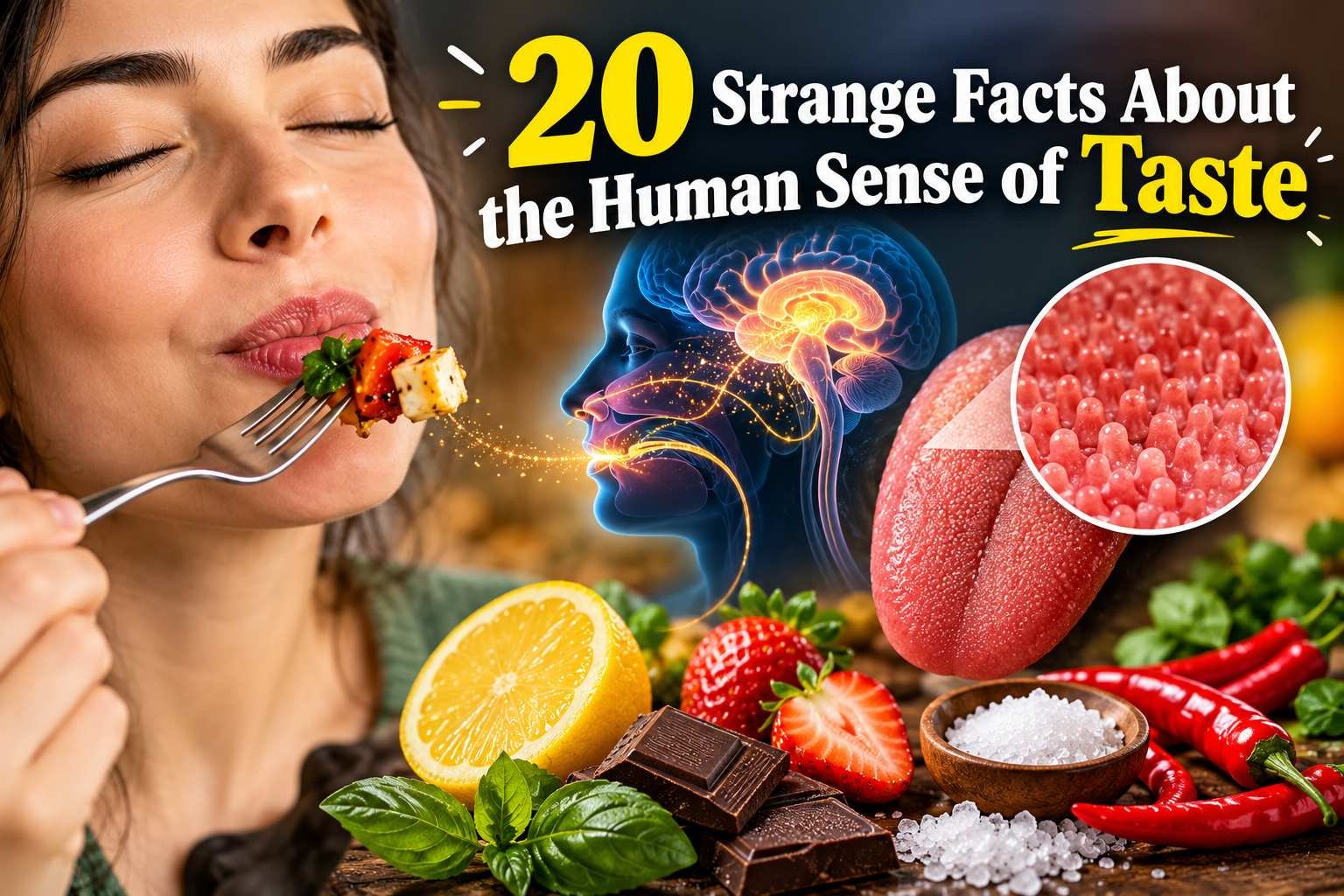
Your sense of taste does much more than help you enjoy your favourite foods. It helps you recognize different flavours, influences what you like to eat, and works closely with your sense of smell to shape your experience of food.
But here’s the surprising part: the taste you experience is not determined by your tongue alone. Your brain, genetics, age, memories, and even the temperature of your food can influence how something tastes. From people who experience flavours more intensely to the strange reason orange juice can taste unpleasant after brushing your teeth, the science of taste is full of unexpected discoveries.
If you have ever wondered why spicy food feels hot or why your favourite meal tastes bland when you have a blocked nose, these 20 strange facts about the human sense of taste will help explain what is happening inside your mouth.
1. Those Tiny Bumps on Your Tongue Are Not Taste Buds
Have you ever looked closely at your tongue and noticed hundreds of tiny bumps? You might think those bumps are your taste buds, but that is not entirely correct. Most of them are structures called papillae, which contain taste buds or help support the tongue’s surface.
Taste buds contain specialized receptor cells that respond to chemicals in food. These cells send signals to your brain, helping you recognize whether something tastes sweet, salty, sour, bitter, or savoury.
So, the next time you look at your tongue in the mirror, remember that the tiny bumps you see are only part of a much more complex tasting system.
2. Your Tongue Is Not the Only Place That Detects Taste
Many people assume that taste buds exist only on the tongue. In reality, taste receptor cells are also found in other areas of the mouth and throat, including the roof of the mouth and parts of the throat.
When you eat something delicious, several parts of your mouth help detect the chemicals responsible for its taste. These signals travel through nerves to the brain, which interprets them.
This is one reason eating is more complicated than simply touching food with your tongue. Your body uses a network of sensory cells to help you experience different tastes.
Also Read-20 Strange Facts About the Human Senses
3. The Famous Tongue Map Is a Myth
Do you remember learning that the tip of your tongue tastes sweetness, the sides detect sourness, and the back senses bitterness? This familiar tongue map gives a misleading picture of how taste works.
In reality, most regions of your tongue can detect all five commonly recognized basic tastes: sweet, sour, salty, bitter, and umami. Some areas may be more sensitive to particular tastes, but there are no separate zones exclusively responsible for each one.
This discovery shows how easily a simplified classroom diagram can become a popular misconception. Your tongue works as a coordinated sensory surface rather than a collection of isolated taste zones.
4. Scientists Recognize Five Basic Tastes
Sweet, sour, salty, bitter, and umami are the five basic tastes commonly recognized by scientists.
Sweetness is often associated with sugars, while sourness comes from acids. Saltiness is commonly triggered by sodium-containing salts, and bitterness can be produced by many different chemical compounds.
The fifth taste, umami, is often described as savoury or meaty. It is associated with substances such as glutamate, which occurs naturally in foods including tomatoes, mushrooms, aged cheese, and certain broths.
Scientists continue to investigate whether other sensations, such as metallic or alkaline tastes, should be classified as distinct basic tastes. For now, these five provide a useful foundation for understanding human taste.
5. Umami Was Recognized as a Separate Taste Relatively Recently
For centuries, people enjoyed savoury foods without having a clear scientific explanation for this particular taste. That changed in 1908, when Japanese chemist Kikunae Ikeda studied the flavour of kombu seaweed.
Ikeda identified glutamic acid as a key contributor to its savoury taste and helped establish the concept of umami. The word comes from Japanese and is often translated as “pleasant savoury taste.”
Today, umami is recognized as one of the five basic tastes. You can experience it in foods such as ripe tomatoes, mushrooms, soy sauce, aged cheese, and meat broth.
The discovery is a reminder that familiar experiences can contain scientific mysteries waiting to be explained.
6. Some People Are Supertasters
Imagine taking a bite of dark chocolate and finding it pleasantly rich, while another person finds the same chocolate intensely bitter. One possible explanation is a difference in taste sensitivity.
Some people are known as supertasters. They experience certain tastes, particularly bitterness, more intensely than many other people. Genetic differences can contribute to this variation, along with other factors affecting taste perception.
Being a supertaster is not necessarily an advantage. Stronger taste sensations can make some vegetables, coffee, or other bitter foods unpleasant, while milder flavours may seem overwhelming.
However, taste sensitivity exists on a spectrum, and no single food preference can prove that someone is a supertaster.
7. Taste Buds Are Replaced Regularly
Your taste buds are not permanent structures that remain unchanged throughout your life. The cells involved in taste are continually renewed, with many taste receptor cells lasting roughly one to two weeks.
This renewal helps maintain your ability to detect different tastes. If you temporarily damage the surface of your tongue by eating something too hot, your taste sensation may recover as the affected tissue heals.
The exact recovery time depends on the injury, so a serious burn should not be ignored. Still, the ongoing replacement of taste cells is one fascinating example of how the human body maintains its sensory systems.
8. Your Sense of Taste Can Change as You Age
Have you ever noticed that a food you disliked as a child becomes enjoyable when you are older? Taste preferences can change throughout life, and age is one factor that may contribute.
Sensitivity to some tastes can decline with age, while changes in smell, oral health, medications, and general health can also affect the flavour of food. This may help explain why some older adults find familiar meals less enjoyable than before.
However, there is no single pattern that applies to everyone. People differ in their genetics, experiences, and health, so one person’s taste preferences may change very differently from another’s.
9. Spicy Is Not One of the Five Basic Tastes
Chilli peppers can make your mouth feel as if it is on fire, but spiciness is not considered one of the five basic tastes.
The burning sensation mainly comes from a chemical called capsaicin, found in many hot peppers. Capsaicin activates sensory receptors involved in detecting heat and irritation, sending signals that the brain interprets as a burning sensation.
That is why drinking water may not provide much relief from some chilli-induced burning. Capsaicin does not behave like an ordinary taste chemical, and the sensation involves the nervous system’s response to irritation.
Interestingly, the flavour of a chilli pepper comes from other compounds in the pepper, while the fiery feeling comes largely from capsaicin.
10. Your Nose Does a Lot of the Work When You Taste Food
Taste and smell work together so closely that it can be difficult to separate them during a meal. Your tongue detects basic tastes, while your nose identifies many of the aromas that make foods distinctive.
For example, strawberries and raspberries can both taste sweet and slightly sour, yet their characteristic aromas make them easy to tell apart. Much of what you describe as a food’s flavour comes from this combined sensory experience.
When you have a blocked nose because of a cold, food may seem bland even though your taste receptors are still working. The problem is often that fewer aroma molecules reach the smell receptors in your nose.
This is why the smell of freshly baked bread or a favourite curry can make a meal feel so inviting even before you take a bite.
11. Toothpaste Can Make Orange Juice Taste Terrible
Have you ever brushed your teeth and then taken a sip of orange juice, only to wonder why it tastes so unpleasant? There is a scientific explanation for this familiar experience.
Many toothpastes contain foaming ingredients, including certain surfactants, that can temporarily affect how you perceive flavours. These ingredients can reduce the perceived sweetness of foods and drinks, while the sour and bitter notes of orange juice remain noticeable.
As a result, the juice may taste much more acidic and bitter than usual. The effect is generally temporary, and the normal flavour usually returns after the toothpaste’s influence fades.
So, if you want to enjoy your morning orange juice, drinking it before brushing may help you avoid this strange flavour surprise.
12. The Temperature of Food Can Change Its Flavour
The temperature of food does more than determine whether it feels hot or cold in your mouth. It can also influence how you perceive its flavour.
Temperature affects the release of aroma compounds, which contribute significantly to the overall eating experience. A warm dish may release more noticeable aromas than the same dish served cold.
Think about the difference between freshly baked bread and a cold slice taken straight from the refrigerator. The ingredients may be similar, but the aroma and texture can make the experiences feel different.
Temperature can also influence the intensity of some taste sensations. This is one reason food scientists consider serving temperature when developing recipes and testing flavours.
13. Your Genes Can Influence Which Foods You Enjoy
Why does one person love bitter coffee while another needs plenty of milk and sugar? Differences in taste perception can partly come from genetics.
Some people inherit variations in taste receptors that make certain bitter compounds much easier to detect. As a result, foods such as broccoli, dark chocolate, or unsweetened coffee may taste stronger to them.
Genetics is only one part of the picture, however. Childhood experiences, culture, repeated exposure, and personal memories can all influence food preferences.
You cannot predict every food someone will like simply by looking at their genes. Instead, taste preferences develop through a combination of biology and experience.
14. Babies Experience Taste Before They Are Born
The development of taste begins before birth. During pregnancy, a developing baby can be exposed to flavour-related compounds in the amniotic fluid.
After birth, breast milk can also carry flavour compounds influenced by a mother’s diet. These early experiences may help introduce babies to certain flavours before they begin eating solid foods.
This does not mean that a baby will automatically love every food their mother eats. Later preferences are influenced by many other factors, including repeated exposure, family meals, and cultural traditions.
Still, early flavour experiences are an intriguing example of how our relationship with food can begin before we ever sit down for our first meal.
15. The Food You Grow Up Eating Can Shape Your Taste
A person’s favourite flavours are often connected to their upbringing and cultural background. Someone who grows up eating spicy curries may become comfortable with flavours that seem intense to someone raised on milder food.
The same can be true of fermented foods, sour fruits, strong cheeses, bitter vegetables, and unfamiliar spices. Repeated exposure can make a flavour more familiar and sometimes more enjoyable.
This helps explain why there is no universal list of foods that everyone finds delicious. Preferences are shaped by family traditions, regional ingredients, cooking methods, and personal experiences.
Taste is biological, but the foods we learn to love are also part of our cultural identity.
16. Your Brain Helps Create the Experience of Flavour
Taste does not happen entirely inside your mouth. Taste receptor cells detect chemical compounds and send signals through nerves to your brain, where those signals are processed alongside information from smell and other senses.
Your brain combines these signals with memories, expectations, and previous experiences. This helps explain why the same food can seem more appealing when you are hungry or less enjoyable when you are already full.
Presentation and expectations can also influence how you experience a meal. A familiar dish may feel comforting because your brain connects its smell and flavour with positive memories.
In other words, tasting food is not simply a chemical reaction. It is a sensory experience that your brain actively interprets.
17. Smell Can Change How Salty a Food Seems
Taste perception is more flexible than many people realize. The aroma of a food can influence how people judge its flavour, including how salty or savoury it seems.
Food researchers study combinations of aroma, taste, and texture to understand how flavours are perceived. Certain aromas may enhance the impression of savouriness or saltiness, even when the amount of salt itself has not changed.
However, this effect depends on the food and the individual. An aroma will not automatically make every dish taste saltier, but it shows how closely the senses interact during eating.
This research may also help food developers create enjoyable foods while adjusting ingredients to meet different nutritional needs.
18. Your Taste Buds Need Saliva to Work Properly
Saliva is essential for eating, swallowing, and tasting. When food enters your mouth, saliva helps dissolve many of its chemical compounds so they can reach the taste receptor cells.
This is one reason a dry mouth can make food taste different or less intense. Saliva also helps lubricate food, making chewing and swallowing easier.
Dry mouth can occur for several reasons, including dehydration, certain medications, and some medical conditions. Drinking enough water may help when dehydration is the cause, but persistent dry mouth deserves medical or dental advice.
Your mouth’s moisture may seem like a small detail, but it plays an important role in helping you enjoy food and detect its flavours.
19. Bitterness May Help You Avoid Harmful Substances
Bitterness is often associated with coffee, dark chocolate, and some vegetables, but it can also serve as a warning signal.
Many potentially harmful plant compounds taste bitter, so sensitivity to bitterness may have helped our ancestors avoid eating certain dangerous substances. This is one reason bitterness is often discussed in relation to the protective role of taste.
However, bitter does not automatically mean poisonous. Many perfectly safe and nutritious foods have bitter flavours, including some leafy greens and unsweetened cocoa.
Taste can provide useful clues, but it cannot reliably determine whether a food is safe. Food safety also depends on factors such as contamination, spoilage, preparation, and storage.
20. Losing Your Sense of Taste Is Different From Losing Flavour
People often say they have lost their sense of taste when food suddenly seems bland. But the problem may actually involve their sense of smell, which contributes greatly to flavour.
A condition that affects smell can make foods seem less distinctive even when the tongue can still detect sweetness, sourness, saltiness, bitterness, and umami. Some illnesses, injuries, medicines, and dental problems can also affect taste directly.
The medical terms for taste disturbances include hypogeusia, a reduced ability to taste, and ageusia, the loss of taste. Changes in taste can have different causes, so persistent or sudden changes should be discussed with a healthcare professional.
Understanding the difference between taste and flavour helps explain why a blocked nose can make a favourite meal seem strangely unfamiliar.
Conclusion
The human sense of taste is far more complex than it first appears. It depends on taste receptor cells, saliva, smell, the brain, genetics, and experiences that shape our food preferences over time.
From the surprising effect of toothpaste on orange juice to the way chilli peppers trigger a burning sensation, these strange facts show that eating is a fascinating sensory process. Even familiar foods can reveal something unexpected about how our bodies work.
The next time you enjoy your favourite meal, take a moment to notice its aroma, texture, temperature, and flavour. You might discover that tasting food is much more interesting than you ever imagined.
Frequently Asked Questions (FAQs)
1. What are the five basic tastes?
The five basic tastes commonly recognized by scientists are sweet, sour, salty, bitter, and umami. Umami is often described as a savoury or meaty taste.
2. Why does food taste bland when you have a blocked nose?
Your sense of smell contributes significantly to flavour. When a blocked nose prevents aroma molecules from reaching your smell receptors, food may seem bland even if your tongue can still detect basic tastes.
3. What is a supertaster?
A supertaster is someone who experiences certain tastes, especially bitterness, more intensely than many other people. Genetic differences can contribute to this sensitivity, but taste perception varies from person to person.
4. Why does orange juice taste bad after brushing your teeth?
Some toothpaste ingredients can temporarily reduce the perceived sweetness of foods and drinks. This makes the sour and bitter flavours in orange juice more noticeable.
5. Can your sense of taste change as you get older?
Yes. Taste perception may change with age, but the effect varies between individuals. Changes in smell, oral health, medications, and general health can also influence how food tastes.
1 thought on “20 Strange Facts About the Human Sense of Taste”