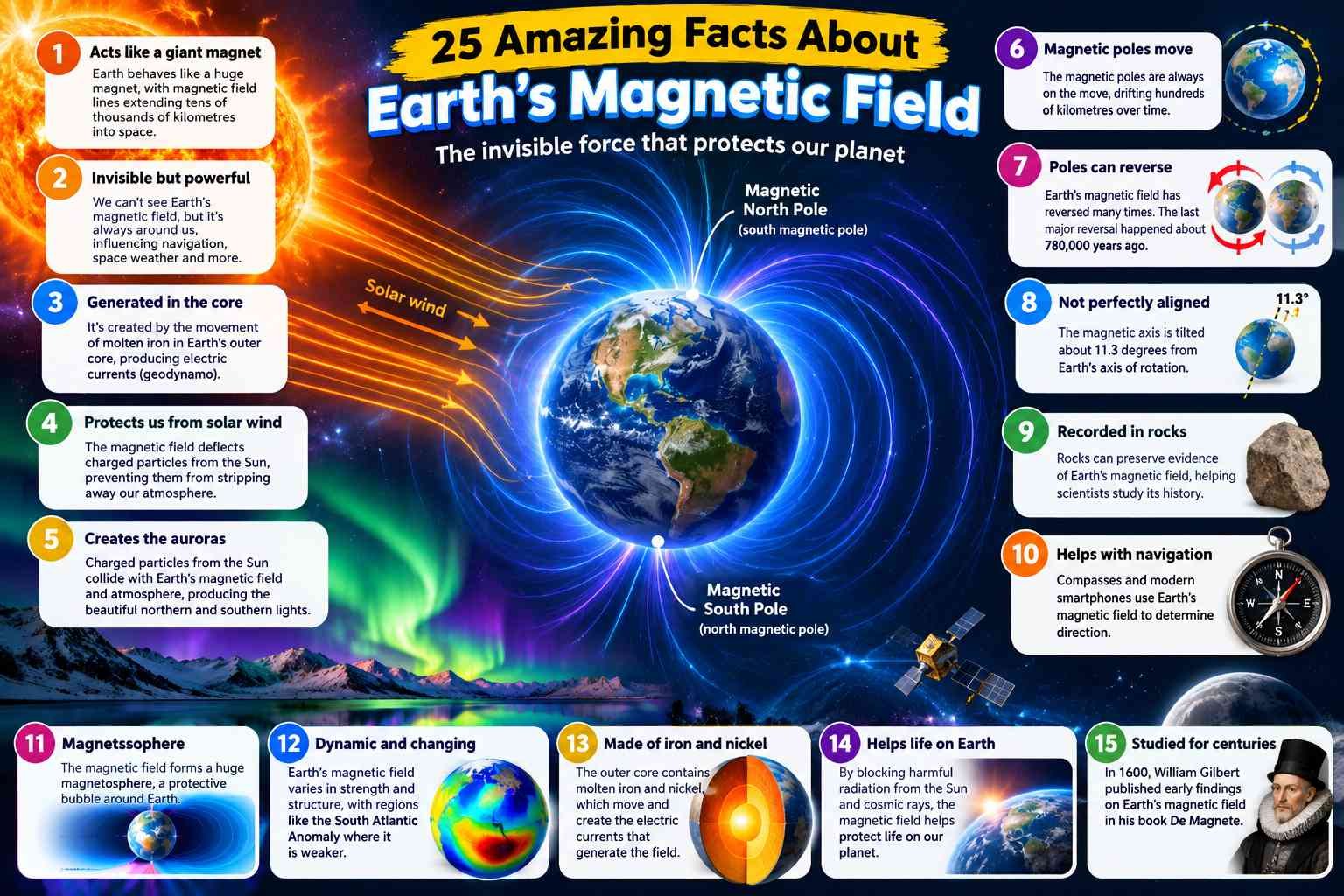
Earth may look like a quiet blue planet from space, but surrounding it is an invisible and constantly changing magnetic environment. We cannot see this field with our eyes, yet it plays an important role in navigation, space weather, atmospheric protection, and even the beautiful auroras seen near the polar regions.
Earth’s magnetic field, also called the geomagnetic field, is generated deep inside the planet and stretches far out into space. It behaves in many ways like the field around a giant magnet, although its origin is much more complicated.
From wandering magnetic poles to dramatic pole reversals and glowing northern lights, here are 25 amazing facts about Earth’s magnetic field that reveal just how fascinating our planet really is.
1. Earth Acts Like a Giant Magnet
One of the simplest ways to understand Earth’s magnetic field is to imagine Earth behaving somewhat like a gigantic magnet. Its magnetic poles are located near, but not exactly at, the geographic poles. Magnetic field lines extend thousands of kilometres into space around the planet.
This enormous magnetic environment is known as the magnetosphere.
2. Earth’s Magnetic Field Is Invisible
You cannot see Earth’s magnetic field with your eyes. Unlike a physical object, it doesn’t have a visible surface or boundary.
Scientists detect and measure it using instruments such as magnetometers, while a simple compass provides a familiar way to observe its directional effects.
Also Read-30 Fascinating Facts About Planet Earth
3. The Magnetic Field Is Generated Deep Inside Earth
The source of Earth’s magnetic field lies deep beneath our feet. Scientists believe it is generated by electrical currents associated with moving molten metal in the planet’s outer core.
The movement of this liquid material is a key part of the process that creates the geomagnetic field.
4. The Outer Core Contains Mostly Iron and Nickel
The outer core is described in the supplied source as a thick layer of molten material consisting primarily of iron and nickel.
Because this material is liquid and can move, differences in temperature and pressure allow convection currents to develop inside it.
5. Earth’s Rotation Helps Drive the Magnetic Dynamo
Earth’s rotation also plays a role in the movement of electrically conducting material inside the core. As liquid iron moves and generates electrical currents, those currents produce a magnetic field.
This self-sustaining process is known as the geodynamo.
6. The Magnetic Poles Are Different From the Geographic Poles
The geographic North and South Poles are defined by Earth’s rotation axis. Magnetic poles, on the other hand, are associated with the direction of Earth’s magnetic field.
Because these are different systems, the geographic and magnetic poles do not exactly line up.
7. The Magnetic North Pole Moves
Earth’s magnetic poles aren’t fixed in one place. They continually move across the planet’s surface.
The supplied ESA material notes that Earth’s magnetic north pole has been drifting and that its movement accelerated considerably from the 1990s onward.
8. The Magnetic North Pole Has Been Moving Toward Siberia
According to the ESA source, the magnetic north pole has been moving toward Siberia. The source connects this movement with changes in the circulation of magnetic material deep beneath Earth’s surface.
It’s a remarkable reminder that even Earth’s magnetic geography is constantly changing.
9. The Magnetic Pole Can Move Much Faster Than You Might Expect
The ESA article reports that the magnetic north pole’s present movement was around 50–60 kilometres per year at the time of that article.
That is dramatically faster than the slower movement observed in earlier periods.
10. A Compass Responds to Earth’s Magnetic Field
A traditional compass is one of the easiest ways to experience Earth’s magnetic field.
The compass needle aligns with the planet’s magnetic environment, giving people a practical way to determine direction. This simple principle has been important for navigation for centuries.
11. A Compass Doesn’t Simply Point to the Geographic North Pole
It is a common misconception that a compass needle points directly toward the geographic North Pole.
Instead, it responds to Earth’s magnetic field. The relationship between geographic and magnetic north is why navigation systems need to account for magnetic differences.
12. Earth’s Magnetic Axis Is Tilted
The magnetic axis isn’t perfectly aligned with Earth’s rotational axis.
One of the supplied sources gives the tilt of the magnetic axis as approximately 11.3 degrees relative to Earth’s axis of rotation.
That tilt is one reason Earth’s magnetic field isn’t arranged like a perfectly symmetrical bar magnet.
13. Earth’s Magnetic Field Extends Far Into Space
Earth’s magnetic field isn’t limited to the atmosphere immediately surrounding the planet.
Magnetic field lines stretch tens of thousands of kilometres into space, forming the magnetosphere.
This enormous region is where Earth’s magnetic environment interacts with particles coming from the Sun.
14. The Magnetosphere Helps Shield Earth From Solar Wind
The Sun constantly sends streams of charged particles into space. This flow is called the solar wind.
Earth’s magnetosphere interacts with these particles and helps deflect much of the solar wind around the planet rather than allowing it to directly impact the atmosphere.
15. Earth’s Magnetic Field Also Interacts With Solar Storms
The Sun occasionally releases enormous bursts of energy and material known as coronal mass ejections (CMEs).
These events can send large amounts of charged material into space. Earth’s magnetic field plays an important role in how these particles interact with our planet.
16. The Magnetic Field Helps Produce the Northern Lights
One of the most beautiful effects associated with Earth’s magnetic environment is the Aurora Borealis, commonly called the northern lights.
Energetic particles from the Sun interact with Earth’s magnetic environment and atmosphere, causing gases to emit colorful light.
17. There Are Southern Lights Too
Auroras aren’t limited to the Northern Hemisphere.
Similar displays occur around the southern polar region and are known as the Aurora Australis, or southern lights. The supplied source explains that auroras occur when energetic solar particles interact with atoms and molecules in Earth’s atmosphere.
18. Earth’s Magnetic Field Has Reversed Many Times
Earth’s magnetic field hasn’t always had the same orientation.
Throughout geological history, the magnetic north and south poles have reversed positions. In other words, the direction of the planet’s magnetic field has flipped.
19. The Last Major Magnetic Reversal Happened About 780,000 Years Ago
The supplied sources place the most recent major magnetic reversal at approximately 780,000 years ago.
During such a reversal, the magnetic north and south poles exchange their positions.
20. Magnetic Reversals Don’t Happen on a Simple Schedule
Although one supplied source describes reversals as occurring roughly every 250,000 years on average, it also notes that scientists do not have a clear theory explaining exactly why they happen.
The geological record shows that the intervals between reversals have varied, so they shouldn’t be thought of as a precise clock.
21. Rocks Can Preserve Evidence of Earth’s Magnetic Field
Earth’s magnetic field can leave a record in rocks.
When molten rock cools and solidifies, tiny magnetic particles within it can align with the magnetic field present at that time. Scientists can study these records to investigate how Earth’s magnetic field has changed throughout geological history.
22. Earth’s Magnetic Field Isn’t Perfectly Symmetrical
The magnetic field doesn’t form a perfectly even pattern around Earth.
The supplied source explains that the magnetic poles are slightly offset and that the field is stronger near the poles and weaker around the equator.
23. The Magnetic Field Is Changing Today
Earth’s magnetic field is not static. Measurements show that its strength and structure change over time.
One example is the South Atlantic Anomaly, an area where the magnetic field is weaker than in surrounding regions. The reason for this regional weakening is not fully understood.
24. Smartphones Can Detect Earth’s Magnetic Field
You don’t necessarily need a traditional compass to interact with Earth’s magnetic field.
Many smartphones contain magnetometers, along with other sensors, which help determine direction and support navigation features in apps.
So, the tiny device in your pocket can actually sense Earth’s invisible magnetic environment.
25. Earth’s Magnetic Field Has Been Studied for Centuries
People have been investigating Earth’s magnetism for a very long time. In 1600, William Gilbert published his work on Earth’s magnetic field and proposed ideas about its origin in his book De Magnete.
Since then, scientists have developed increasingly sophisticated instruments and satellites to understand how Earth’s magnetic field behaves.
Conclusion
Earth’s magnetic field is one of those natural features we rarely notice, yet it is constantly working around us. It begins deep inside the planet, extends far into space, influences compass navigation, interacts with solar particles, and helps create spectacular auroras.
Perhaps the most fascinating part is that Earth’s magnetic field is constantly changing. The poles wander, the field varies in strength, and over geological timescales the magnetic poles can even reverse. The movement of Earth’s magnetic north pole toward Siberia is a particularly striking example of how dynamic our planet really is.
The next time you use a compass, see the northern lights in a photograph, or simply look up at the night sky, remember that an invisible magnetic system is surrounding Earth—and it has a much bigger story to tell than we can see with our eyes.
1 thought on “25 Amazing Facts About Earth’s Magnetic Field”