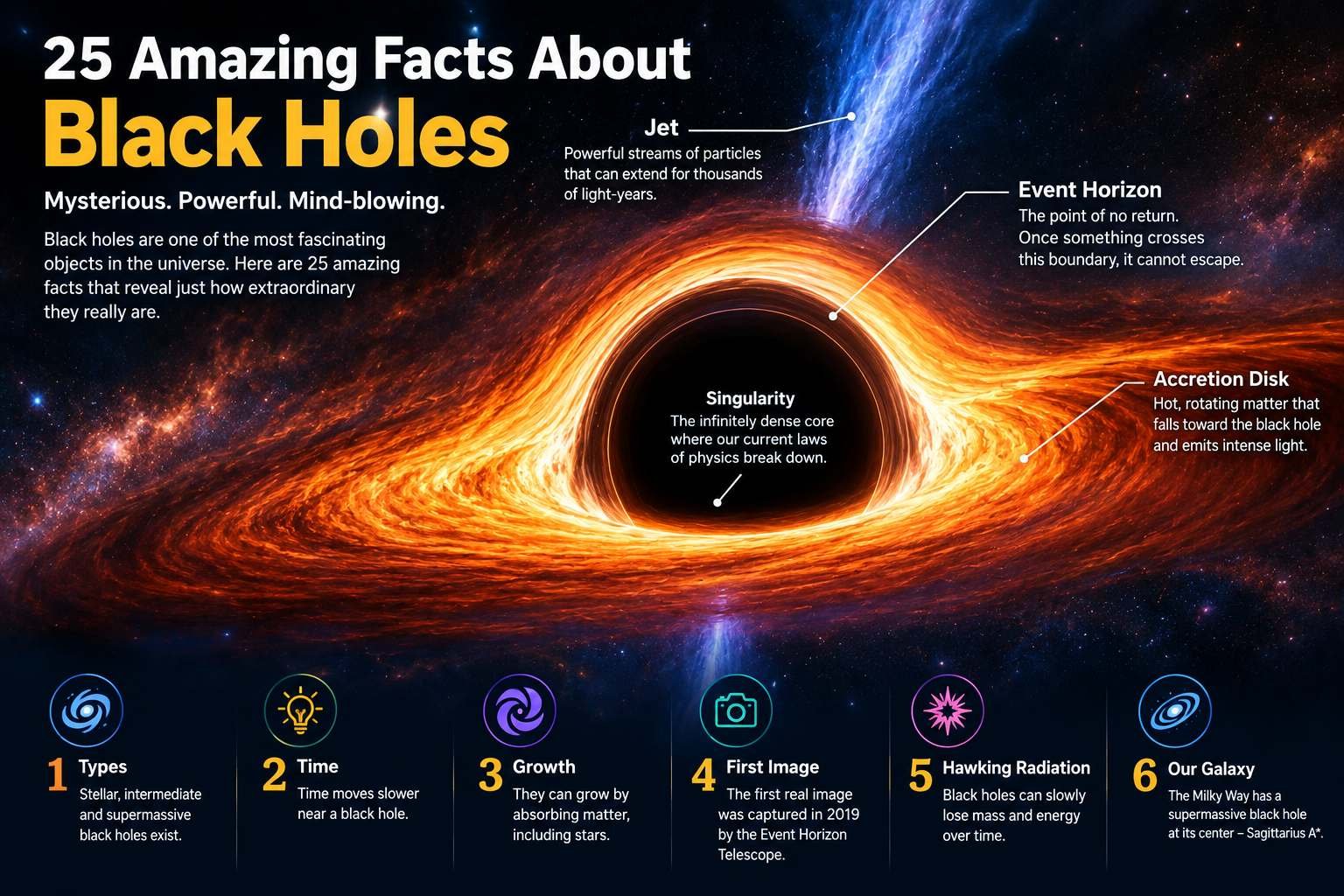
Black holes are some of the strangest and most fascinating objects in the universe. They are places where gravity becomes so powerful that even light cannot escape. But there is much more to black holes than simply being “dark” objects in space.
From time slowing down to stars being torn apart, black holes challenge the way we think about space, time, and gravity. Here are 25 amazing facts that make these mysterious cosmic objects even more fascinating.
1 Black Holes Have Extremely Powerful Gravity
A black hole is a region of space where gravity is so strong that nothing, not even light, can escape once it gets too close. This incredible gravity is what makes black holes so difficult to observe directly.
Also Read-30 Fascinating Facts About the Human Brain
2 Some Black Holes Form From Massive Stars
One of the ways black holes can form is through the death and gravitational collapse of massive stars. When such a star runs out of nuclear fuel, it can no longer resist its own gravity and may eventually collapse into a black hole.
3 Black Holes Come in Different Sizes
Not every black hole is the same size. Stellar-mass black holes are typically several times the mass of our Sun, while supermassive black holes can contain hundreds of thousands to billions of solar masses.
4 There May Also Be Intermediate-Mass Black Holes
Between stellar-mass and supermassive black holes lies another proposed category: intermediate-mass black holes. Scientists are still investigating how these objects form and how common they are.
5 The Event Horizon Is the Point of No Return
Every black hole has a boundary called the event horizon. Once an object crosses this boundary, it cannot escape the black hole’s gravitational pull. Think of it as a cosmic point of no return.
6 A Black Hole Has a Mysterious Singularity
At the center of a black hole lies what is known as the singularity. According to the source, this is an extremely dense region where our current understanding of physics breaks down, making it one of the biggest mysteries in modern science.
7 Black Holes Can Spin
Black holes are not necessarily motionless objects. Some rotate rapidly, carrying angular momentum left over from the material and stars from which they formed. Rotating black holes are described by the Kerr model.
8 Scientists Captured the First Image of a Black Hole
In April 2019, the Event Horizon Telescope revealed the first-ever image of a black hole. The famous image showed the supermassive black hole at the center of the galaxy M87, marking a historic moment in astronomy.
9 Black Holes Can Bend Light
Black holes don’t just affect objects—they can also dramatically affect light. Their immense gravity bends the path of light passing nearby, a phenomenon known as gravitational lensing.
10 Black Holes Can Stretch Objects Like Spaghetti
Getting too close to a black hole would be a very bad idea. The extreme difference in gravitational force across an object can stretch it into a long, thin shape. Scientists call this dramatic effect spaghettification.
11 Time Behaves Differently Near a Black Hole
One of the strangest consequences of extreme gravity is time dilation. Time passes more slowly near a black hole, particularly close to the event horizon, when compared with a distant observer.
12 Cygnus X-1 Was an Early Black Hole Discovery
Cygnus X-1 is a famous stellar-mass black hole candidate discovered in 1964. It exists in a binary system with a blue supergiant star and became an important object in the history of black-hole research.
13 Black Holes Can’t Be Seen Directly
Despite their name, black holes are not simply objects that astronomers can photograph like a planet or star. Scientists study them by observing their effects on nearby objects and the radiation produced by matter falling toward them.
14 Two Black Holes Can Orbit Each Other
Black holes can exist in binary systems, meaning two black holes can orbit around one another. When they eventually merge, they can release enormous amounts of energy in the form of gravitational waves.
15 Black Holes Can Grow
Supermassive black holes can increase their mass by gathering material from their surroundings. Gas, stars, and other matter can contribute to their growth over enormous periods of time.
16 Black Holes Don’t Act Like Cosmic Vacuum Cleaners
A common misconception is that black holes automatically suck up everything around them. They don’t. Objects have to come sufficiently close to a black hole to be captured by its gravity.
17 Stephen Hawking Predicted Black Hole Radiation
Stephen Hawking proposed that black holes can emit radiation because of quantum effects near their event horizons. This phenomenon is now known as Hawking radiation.
18 Black Holes May Eventually Evaporate
Hawking radiation suggests that black holes can gradually lose energy and mass. For extremely small black holes, this evaporation could happen much more quickly than it would for massive ones.
19 Quasars Can Be Powered by Black Holes
Some of the brightest objects seen across the universe are quasars. They are associated with supermassive black holes that consume surrounding matter, producing enormous amounts of radiation that can be detected from vast distances.
20 A Star Can Be Torn Apart by a Black Hole
If a star ventures too close to a black hole, the black hole’s tidal forces can rip it apart. This spectacular event is called a tidal disruption event, and it can produce an enormous burst of energy and radiation.
21 Our Milky Way Has a Supermassive Black Hole
At the heart of our own Milky Way galaxy sits a supermassive black hole known as Sagittarius A*. It is about 26,000 light-years from Earth and has a major influence on the motion of nearby stars.
22 Black Holes Can Produce Powerful Jets
Some black holes can generate enormous jets of particles and radiation. These jets can extend for thousands of light-years into space, making black holes capable of influencing their surroundings on truly gigantic scales.
23 Some Black Holes Are Surrounded by Accretion Disks
Matter falling toward a black hole can form a flattened, rapidly rotating structure called an accretion disk. As gas and dust spiral inward, friction and extreme conditions can heat the material and produce intense radiation.
24 White Holes Are a Hypothetical Opposite
Scientists have proposed the theoretical idea of white holes, which would behave almost like the opposite of black holes by expelling matter and energy rather than trapping them. However, there is currently no experimental evidence confirming that white holes exist.
25 Black Holes Are Still Full of Mysteries
Even after decades of research, black holes continue to raise enormous questions. Scientists are still studying their formation, growth, mergers, information paradox, and connection to the fundamental laws of physics. Future observatories and experiments could reveal even more about these mysterious objects.
Conclusion
Black holes may be dark, but they have opened a bright new window into our understanding of the universe. They challenge our ideas about gravity, time, matter, and even the limits of physics.
From the event horizon and Hawking radiation to star-shredding tidal forces and the supermassive black hole at the center of the Milky Way, every discovery seems to make black holes even more fascinating. And perhaps the most amazing fact of all is that we are still only beginning to understand them.
1 thought on “25 Amazing Facts About Black Holes”