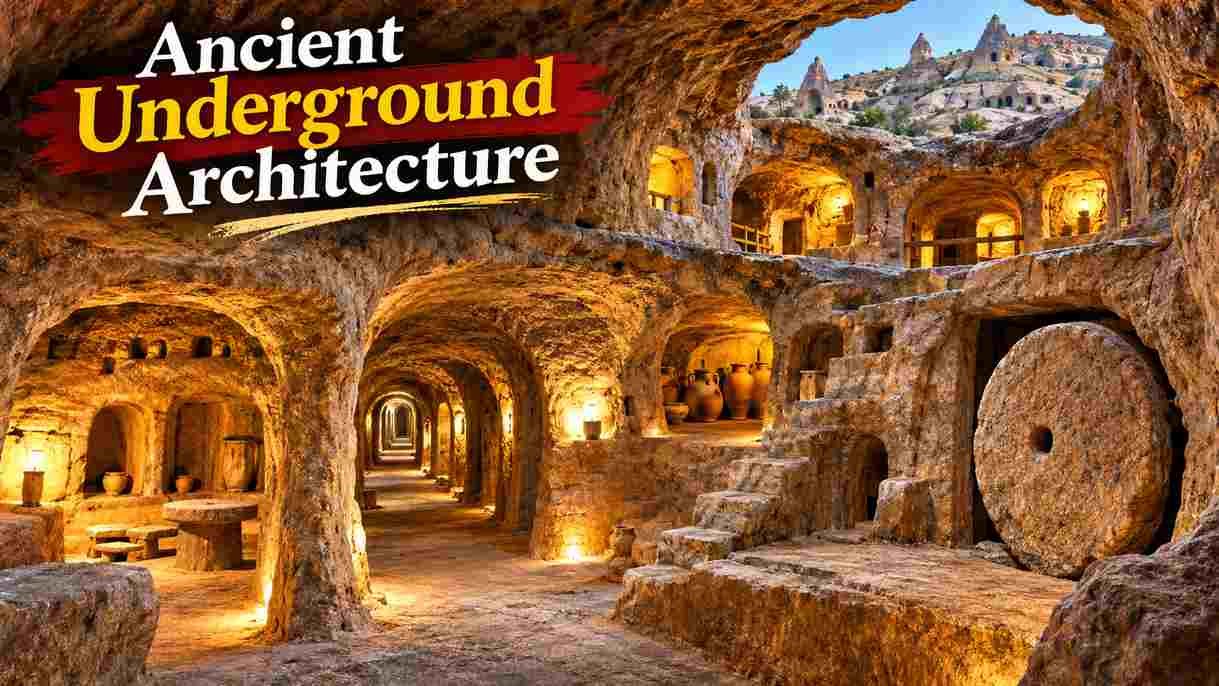
Imagine walking across an ordinary landscape without realizing that an entire world exists beneath your feet. Hidden below mountains, deserts, and ancient cities are underground rooms, tunnels, temples, homes, and even complete settlements built by people thousands of years ago.
Ancient underground architecture is one of the most fascinating achievements in human history. Long before modern construction equipment existed, people carved enormous spaces into solid rock, created underground water systems, and designed buildings that could protect them from extreme weather and outside threats.
Some underground structures were built as homes, while others served as religious centres, burial places, storage facilities, and defensive shelters. Many of these remarkable constructions still exist today, giving historians and archaeologists valuable clues about ancient civilizations.
Let’s explore 20 amazing examples and facts about ancient underground architecture that reveal how creative and skilled early builders really were.
1. Ancient Underground Cities Could House Thousands of People
Ancient underground cities are among the most impressive achievements of early civilizations. These settlements were carefully designed beneath the Earth’s surface and included living rooms, kitchens, food storage areas, wells, and ventilation systems. Cappadocia in Turkey is particularly famous for its underground cities, where communities created extensive networks of tunnels and chambers inside volcanic rock. Some settlements were large enough to accommodate thousands of people during emergencies. These underground spaces provided protection from harsh weather and potential attacks. Their complex layouts demonstrate how ancient people developed practical architectural solutions using limited tools and locally available materials.
2. Derinkuyu Is One of the Deepest Underground Cities
Derinkuyu Underground City in Cappadocia, Turkey, is a remarkable example of ancient underground engineering. It extends approximately 85 metres below the ground and contains multiple levels connected by narrow corridors and stairways. The settlement included kitchens, storage rooms, wells, living spaces, and ventilation shafts. Large circular stone doors were designed to close certain passageways and restrict access during dangerous situations. Researchers believe different communities used the underground complex during periods of conflict and uncertainty. Its impressive construction shows how ancient builders understood the importance of ventilation, security, and space planning when creating large underground settlements.
3. Kaymakli Was Designed With Multiple Underground Levels
Kaymakli Underground City is another fascinating historical site in Cappadocia, Turkey. It was created by carving interconnected rooms and passages into soft volcanic rock. The underground settlement contained areas for cooking, food storage, living, and keeping animals. Its narrow corridors and heavy stone doors helped residents control movement between different sections. The arrangement of rooms suggests that underground spaces supported everyday activities rather than serving only as temporary shelters. Kaymakli also demonstrates how ancient communities used natural geological conditions to create protected living environments. Today, it remains an important archaeological attraction that reveals the architectural skills of early inhabitants.
4. The Ancient Romans Built Extensive Catacombs
Ancient Rome developed an extensive network of underground burial places known as catacombs. These underground cemeteries were particularly important to early Christian communities, which used them to bury their dead and remember loved ones. The passageways contained burial niches, small chambers, inscriptions, and decorative paintings. The Catacombs of San Callisto and San Sebastiano are among the best-known examples in Rome. Their design reflects ancient burial customs and religious traditions. Archaeologists continue to study these places to understand how early Christian communities lived and practised their beliefs. The catacombs remain valuable historical records of Rome’s religious and cultural development.
5. The Hypogeum of Hal-Saflieni Was Carved Into Limestone
The Ħal Saflieni Hypogeum in Paola, Malta, is a prehistoric underground complex carved directly into limestone. Dating back thousands of years, it contains interconnected chambers arranged across multiple levels. Archaeological evidence suggests that the structure served as a burial and ritual site. Some chambers feature carefully shaped walls and ceilings, showing the advanced stone-working abilities of prehistoric communities. One particularly interesting feature is the unusual acoustic behaviour found in certain rooms. Researchers continue to investigate how the structure was designed and used. The Hypogeum provides important evidence of prehistoric architecture, burial practices, and the cultural traditions of ancient Malta.
6. Petra Contains Remarkable Rock-Cut Architecture
Petra in Jordan is one of the world’s most famous examples of ancient rock-cut architecture. The Nabataeans transformed natural sandstone cliffs into impressive buildings by carefully removing sections of rock. The city contains elaborate tombs, temples, facades, and monuments. Its most recognizable structure is the Treasury, also known as Al-Khazneh, which features detailed architectural decorations carved into a sandstone cliff. Petra also demonstrates how ancient communities adapted their settlements to the surrounding landscape. Although it is not entirely underground, its rock-cut buildings reveal extraordinary craftsmanship and engineering knowledge. Today, Petra attracts visitors and researchers interested in ancient architecture and Nabataean history.
7. Ancient People Built Underground Homes to Escape Extreme Weather
Underground homes provided practical protection against extreme temperatures in many ancient communities. Soil and rock naturally reduce temperature changes, helping indoor spaces remain cooler during hot weather and warmer during colder periods. In northern China, traditional cave dwellings called yaodong were built into hillsides or excavated into loess soil. These homes commonly included living rooms, kitchens, and storage spaces. Their construction made effective use of natural materials and the surrounding landscape. Some communities continue to live in traditional yaodong homes today. Their long history demonstrates how architectural designs can respond to local climate conditions while using relatively simple construction methods.
8. Underground Water Channels Supplied Ancient Communities
Ancient civilizations developed underground water channels to transport fresh water from distant sources to settlements and agricultural areas. One important example is the Persian qanat system. These channels used gently sloping tunnels to carry groundwater from higher elevations towards villages and farms. Vertical shafts were constructed at intervals to help workers build, inspect, and maintain the tunnels. Transporting water underground also reduced evaporation, which was particularly useful in dry environments. Such systems supported drinking water supplies, agriculture, and everyday activities. Their construction required knowledge of underground geology, gravity, and water movement, making them impressive examples of ancient engineering.
9. The Qanat System Helped Agriculture Survive in Desert Regions
Water management was essential for ancient communities living in dry regions. Persian qanats provided a practical solution by transporting groundwater through underground tunnels to agricultural fields and settlements. The system relied on gravity rather than mechanical pumps, allowing water to travel across considerable distances. Because the channels remained underground, less water was lost through evaporation. Qanats supported irrigation, drinking water supplies, and the growth of settlements in areas where surface water was limited. This traditional technology spread across parts of the Middle East and Central Asia. It remains an important example of how ancient engineering helped people adapt to challenging environmental conditions.
10. Ancient Egyptians Built Rock-Cut Tombs
Ancient Egypt is famous for its pyramids, but many important burial structures were also created beneath the ground. The Valley of the Kings contains numerous tombs carved into rocky hillsides for pharaohs and powerful officials. These underground chambers were decorated with colourful paintings, religious symbols, and inscriptions. Their designs reflected Egyptian beliefs about death and the afterlife. The tombs were intended to protect royal burials and provide a setting for religious traditions connected with the next world. Archaeologists study their artwork and architecture to understand ancient Egyptian society, burial practices, and religious beliefs. They remain some of the most important historical sites in Egypt.
11. The Tomb of Seti I Has Beautiful Underground Decorations
The tomb of Pharaoh Seti I in the Valley of the Kings is one of the most impressive examples of ancient Egyptian tomb architecture. Its underground corridors and chambers contain detailed paintings, religious inscriptions, and symbolic decorations. Many of these artworks describe ancient Egyptian beliefs about the afterlife and the journey of the sun god. The tomb’s carefully designed interior demonstrates the artistic abilities of ancient craftsmen and the importance of religion in royal burial traditions. Its decoration also provides researchers with valuable information about Egyptian mythology and funerary practices. The tomb remains an outstanding example of ancient architectural and artistic achievement.
12. Lalibela Has Churches Carved Directly From Solid Rock
Lalibela in Ethiopia is internationally famous for its extraordinary rock-hewn churches. Instead of building with separate stones, ancient craftsmen carved many of these structures directly into solid volcanic rock. They removed the surrounding material to reveal complete buildings with doors, windows, columns, and decorative details. The Church of Saint George is particularly well known for its distinctive cross-shaped design. These churches were created as important places of Christian worship and remain active religious sites. Their construction required careful planning and impressive stone-carving skills. Lalibela demonstrates how ancient communities combined engineering, religious devotion, and artistic creativity to create remarkable architectural monuments.
13. Ajanta Caves Were Created for Buddhist Monks
The Ajanta Caves in Maharashtra, India, are among the finest examples of ancient Buddhist rock-cut architecture. Developed over several centuries, the complex includes monasteries, prayer halls, sculptures, and beautiful wall paintings. Buddhist monks used these caves for meditation, worship, teaching, and everyday living. Many paintings depict religious stories, historical figures, and scenes from ancient Indian society. The caves reveal the artistic and architectural skills of craftsmen who worked with natural rock to create detailed interiors. Today, Ajanta is recognized as an important cultural heritage site. Its paintings and sculptures continue to help historians understand the development of Buddhist traditions and ancient Indian art.
14. Ellora Shows How Different Religions Shared One Landscape
The Ellora Caves in Maharashtra, India, represent an extraordinary achievement in rock-cut architecture. The complex includes Buddhist, Hindu, and Jain monuments created between approximately the sixth and tenth centuries CE. One of its most remarkable structures is the Kailasa Temple, which was carved from a single massive rock formation. Workers removed enormous quantities of stone to create courtyards, pillars, sculptures, and detailed architectural features. The site demonstrates the technical abilities of ancient Indian craftsmen and the presence of different religious traditions within one historical landscape. Ellora remains an important destination for people interested in Indian history, architecture, sculpture, and cultural heritage.
15. Underground Architecture Was Also Used for Food Storage
Before refrigerators existed, ancient communities needed effective ways to preserve food for longer periods. Underground cellars and storage chambers offered relatively cool and stable temperatures compared with exposed spaces. People used these rooms to store grains, vegetables, wine, and other essential supplies. Underground storage also helped protect food from direct sunlight, certain animals, and changing weather conditions. These spaces were particularly useful in regions where seasonal food shortages could affect community survival. Their design was often simple but practical, making use of the natural insulating properties of soil and rock. Such storage systems reveal how ancient people developed solutions to everyday challenges.
16. Ancient Underground Structures Included Ventilation Systems
Ventilation was one of the most important requirements when constructing underground buildings. Without fresh air, enclosed rooms and tunnels could become uncomfortable and unsafe for people and animals. Ancient builders addressed this challenge by creating ventilation shafts, openings, and connecting passages that allowed air to circulate. The underground cities of Cappadocia are especially notable for their ventilation arrangements. These systems helped make large underground settlements more suitable for extended use. Designing them required an understanding of airflow and the layout of enclosed spaces. Their presence demonstrates that ancient builders considered not only protection and storage but also the practical needs of people living underground.
17. Some Underground Buildings Were Designed for Religious Activities
Many ancient underground structures were created for spiritual and religious purposes rather than ordinary living. Communities carved caves, chambers, and rock-cut sanctuaries for worship, meditation, ceremonies, and burial rituals. These spaces often held special cultural importance because of their connection with sacred landscapes, ancestors, and beliefs about life and death. Natural rock formations provided quiet surroundings and allowed builders to create distinctive religious environments. Examples can be found in different parts of the world, including India, Malta, Egypt, and Ethiopia. Studying these structures helps historians understand how ancient communities expressed their beliefs through architecture and transformed natural spaces into places of worship.
18. Ancient Underground Architecture Required Impressive Engineering Skills
Creating underground buildings was a challenging task for ancient workers. They had to identify suitable locations, understand the properties of rock and soil, and remove material carefully to avoid structural collapse. Builders also needed to plan entrances, stairways, drainage channels, ventilation shafts, and lighting arrangements. Without modern power tools or heavy machinery, most construction work depended on hand tools, experience, teamwork, and careful planning. Large underground settlements required even more coordination because different rooms and passageways had to connect properly. The survival of many ancient structures shows how effectively early builders combined practical knowledge with creativity and engineering skills.
19. Many Ancient Underground Structures Are Still Standing Today
One remarkable feature of ancient underground architecture is how many structures have survived for hundreds or even thousands of years. Rock-cut monuments, tunnels, burial chambers, and underground settlements continue to provide evidence of ancient construction methods. Their durability depends on factors such as the type of rock, construction quality, climate, groundwater, and maintenance. However, these structures are not completely protected from damage. Erosion, water infiltration, pollution, increasing tourism, and environmental changes can threaten their condition. Conservation programmes are important for preserving these historical places. Protecting them ensures that future generations can continue learning about the achievements of ancient civilizations.
20. Modern Archaeology Continues to Discover Hidden Underground Spaces
Modern technology is changing the way archaeologists investigate ancient underground structures. Tools such as ground-penetrating radar, laser scanning, satellite imagery, and 3D mapping help researchers identify buried walls, tunnels, chambers, and other hidden features. These methods can provide information about underground spaces without immediately digging or disturbing the site. Researchers can also create detailed digital models to study the structure and condition of historic monuments. As these technologies improve, archaeologists may discover previously unknown parts of ancient settlements. Modern investigations are helping reveal how people built, used, and maintained underground environments throughout history.
Conclusion
Ancient underground architecture is a remarkable reminder of human creativity and engineering ability. From the multi-level cities of Cappadocia to the rock-cut temples of India and the tombs of Egypt, these structures reveal how people adapted to their environments and found innovative ways to build.
Some underground spaces protected communities from danger, while others served religious, cultural, and practical purposes. Many have survived for centuries and continue to attract researchers and visitors from around the world.
The next time you walk through an ancient landscape, remember that its most fascinating secrets may not be visible above the ground. Sometimes, an entire chapter of history is waiting just beneath your feet.
Frequently Asked Questions About Ancient Underground Architecture
1. What is ancient underground architecture?
Ancient underground architecture refers to buildings, tunnels, chambers, homes, temples, and other structures created beneath the Earth’s surface or carved directly into natural rock.
2. Which is one of the most famous underground cities in the world?
Derinkuyu in Cappadocia, Turkey, is one of the best-known underground cities. It contains multiple levels of rooms, passageways, storage spaces, and ventilation shafts.
3. Why did ancient civilizations build underground structures?
Ancient people built underground structures for several reasons, including protection from extreme weather, defence, food storage, religious activities, water transportation, and burial practices.
4. Which country has famous ancient rock-cut architecture?
Several countries have important examples. Turkey, Egypt, India, Malta, Jordan, and Ethiopia are especially well known for their underground and rock-cut historical structures.
5. Are ancient underground structures still used today?
Some are preserved as historical monuments, religious sites, or tourist attractions. Traditional underground homes and water systems are also still used in certain regions.

I write engaging, informative, and SEO-friendly biographies, science articles, and interesting facts about famous personalities, scientists, scientific discoveries, technology, and innovations. My content is well-researched, easy to understand, and written in a simple, reader-friendly style.