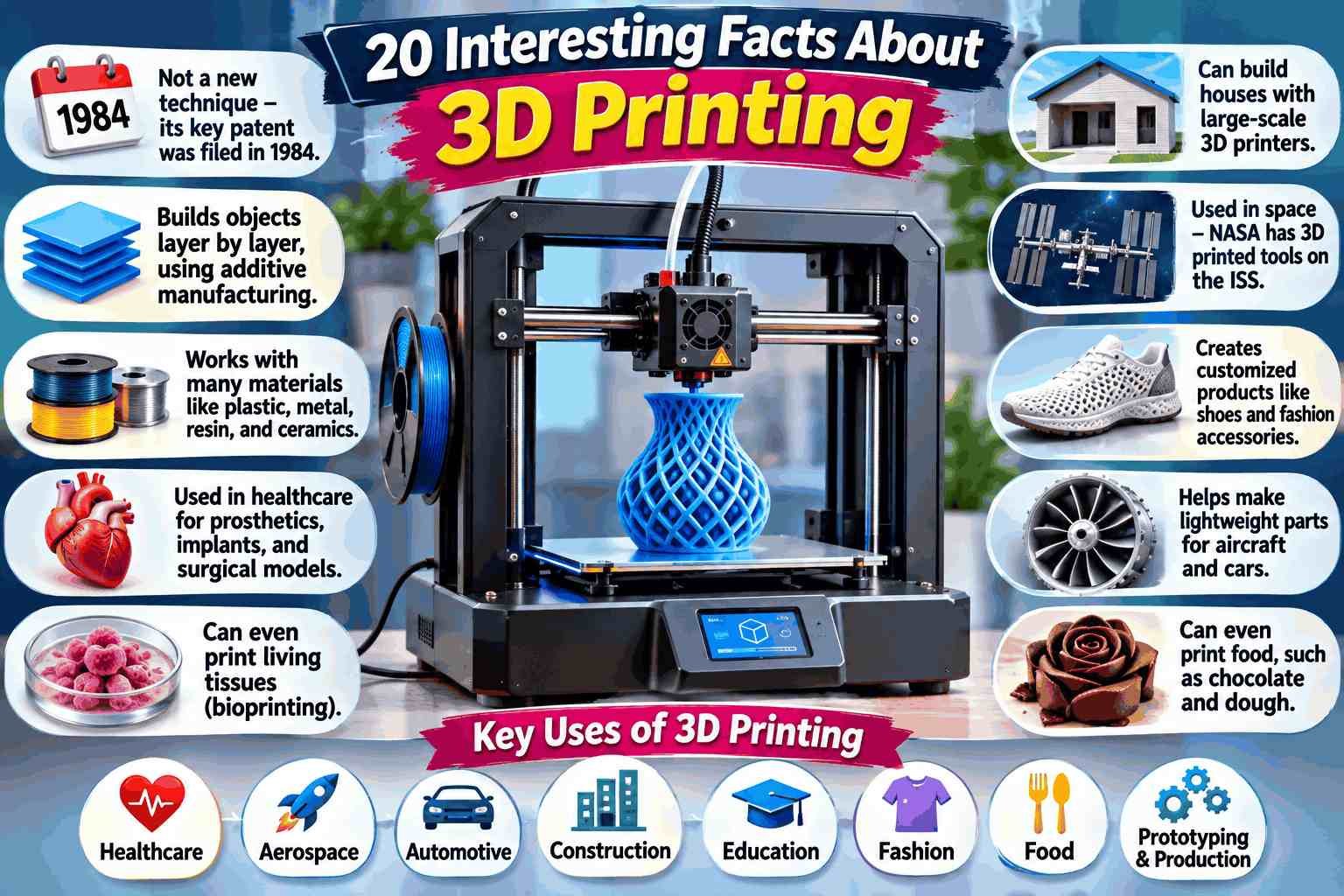
1. 3D Printing Is Older Than You Think
Many people believe 3D printing is a recent invention, but its history goes back more than four decades. Early working systems appeared in the 1980s. Japanese researcher Hideo Kodama demonstrated a rapid-prototyping system in 1981, while Chuck Hull developed stereolithography and filed a major patent in 1984.
2. 3D Printers Build Objects Layer by Layer
Unlike traditional printers that put ink on paper, 3D printers create physical objects. They do this by adding material in thin layers, one after another, until the complete object takes shape. This process is known as additive manufacturing.
3. 3D Printing Starts With a Digital Design
Before printing begins, an object is usually designed using computer-aided design (CAD) software. The digital model is then prepared using slicing software, which divides it into layers and creates instructions for the printer.
4. There Are Different Types of 3D Printing Technologies
Not all 3D printers work in the same way. Some melt plastic filament and deposit it through a nozzle, while others use light to harden liquid resin or lasers to fuse powder. Popular technologies include FDM, SLA, SLS, MJF, and metal powder-bed fusion.
5. 3D Printing Uses More Than Just Plastic
Plastic filament is common, especially in home printers, but the technology can work with many other materials. Depending on the printing method, materials include titanium, aluminium, stainless steel, nylon, resin, ceramics, and flexible polymers.
6. 3D Printing Can Help Save Lives
Healthcare is one of the most exciting areas for 3D printing. Doctors can use patient-specific models to understand complicated medical conditions and prepare for surgery. The technology also helps produce customized prosthetics, implants, surgical guides, and medical equipment.
7. Scientists Can 3D Print Living Tissues
Bioprinting is a specialized area of 3D printing that uses bio-inks containing living cells. Researchers are investigating ways to create structures such as skin tissue, cartilage, and blood-vessel-like networks. Although this research is promising, fully functional transplantable organs are not yet routinely available.
8. NASA Uses 3D Printing in Space
3D printing can be especially useful for astronauts because sending replacement equipment into space is expensive and takes time. NASA installed a 3D printer aboard the International Space Station in 2014. Astronauts used it to produce tools, including a ratchet wrench, while in orbit.
9. 3D Printing Could Help Build Homes
The construction industry is exploring large-scale 3D printing to create walls and other building components. Special printers deposit construction materials in layers to form structures. This approach may help reduce construction time and material waste in suitable projects.
10. You Can Wear 3D-Printed Fashion
3D printing has found its way into the fashion world. Designers use it to create shoes, jewellery, glasses, clothing accessories, and experimental garments. Because digital designs can be customized, manufacturers can create products with unusual shapes and personalized fits.
11. 3D Printing Is Used in the Automotive Industry
Car manufacturers use 3D printing to develop prototypes and test new designs before producing them on a larger scale. It can also create lightweight brackets, custom tools, and replacement parts. This helps engineers experiment with designs without making expensive production molds.
12. Aircraft Engines Can Contain 3D-Printed Parts
The aerospace industry uses 3D printing to manufacture selected components that need complex shapes and low weight. For example, General Electric’s LEAP jet engines use 3D-printed fuel nozzles. These components combine several parts into a single printed piece, reducing the need for multiple welded sections.
13. 3D Printing Can Produce Food Designs
Yes, food can be 3D printed! Specialized food printers use ingredients such as chocolate, sugar, and dough to create detailed shapes and decorations. This technology offers interesting possibilities for pastry chefs, food designers, and the food industry.
14. The Film Industry Uses 3D Printing
Creating props and detailed models for movies can take considerable time. 3D printing gives film production teams another way to make customized objects, costumes, miniature models, and visual effects components. It can also make it easier to reproduce a design when several identical pieces are needed.
15. 3D Printing Is Becoming a Useful Educational Tool
Schools and colleges are using 3D printers to help students understand science, engineering, mathematics, and design. Instead of only looking at pictures in a textbook, students can create and examine physical models. This makes complex ideas easier to explore through practical learning.
16. 3D Printing Can Reduce Material Waste
Traditional manufacturing often involves cutting material away from a larger block. 3D printing works differently because it adds material where the design requires it. This can reduce waste, especially when producing complex parts, although support structures and failed prints can still create leftover material.
17. It Can Make Highly Customized Products
One of the biggest advantages of 3D printing is customization. A digital design can be adjusted to suit a person’s measurements or requirements before printing. This is useful for customized prosthetics, dental products, medical implants, eyewear, and many other applications.
18. 3D Printing Can Help Restore Animal Mobility
The technology has also been used in animal care and conservation projects. Customized prosthetic devices and printed supports can help injured animals. Examples include specially designed beaks for birds and protective patches for damaged turtle shells.
19. 3D Printing Is More Than a Prototyping Tool
In its early years, 3D printing was mainly associated with making prototypes and testing designs. Today, it is also used to manufacture selected finished products and industrial components. However, traditional manufacturing methods can still be more economical for many high-volume production jobs.
20. 3D Printing Has an Exciting Future
Researchers and engineers continue to explore new applications for additive manufacturing. Developments in metal printing, bioprinting, construction, and space technology could open up even more possibilities. The technology is not a solution for every manufacturing challenge, but it is giving people new ways to turn digital ideas into physical objects.
Final Thoughts
3D printing has grown from an experimental manufacturing idea into a technology used across many industries. It can help doctors prepare for operations, engineers develop aircraft components, designers create customized fashion, and researchers explore new materials.
What makes it especially interesting is the freedom to create complex objects directly from digital designs. As printers and materials continue to improve, 3D printing may become an even more important part of how we design, manufacture, and build things.
Frequently Asked Questions
What is 3D printing in simple words?
3D printing is a manufacturing process that creates physical objects from digital designs by adding material in thin layers.
Who invented 3D printing?
Several researchers contributed to the early development of 3D printing. Hideo Kodama demonstrated an early working rapid-prototyping system in 1981, and Chuck Hull filed a major stereolithography patent in 1984.
What materials are used in 3D printing?
Common materials include PLA, ABS, PETG, nylon, resin, and TPU. Industrial printers can also work with metals such as titanium and aluminium, as well as ceramics and other specialized materials.
Can 3D printers print human organs?
Researchers are developing bioprinting techniques to create living tissues and organ-like structures. However, printing fully functional human organs for routine transplantation remains a major scientific challenge.