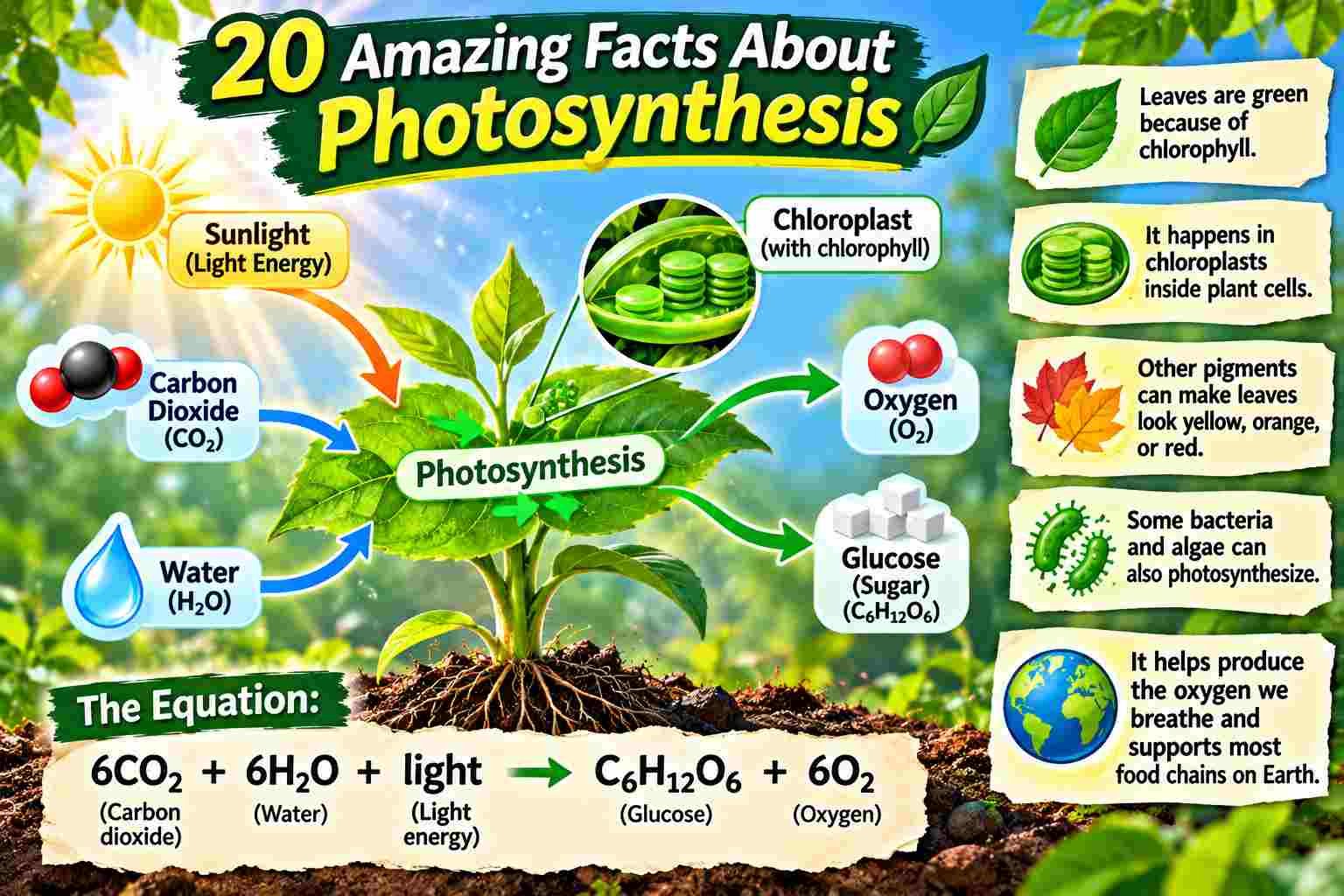
Photosynthesis is how plants turn sunlight into the energy they need to grow. It also helps provide the oxygen we breathe and supports much of life on Earth. But this familiar process has some surprising details—from colorful leaf pigments to tiny organisms that helped change the planet’s atmosphere.
1. Plants Make Their Own Food Using Sunlight
Plants use light energy to turn water and carbon dioxide into sugar. That sugar provides energy and raw materials for growth. Plants are called producers because they make their own food instead of eating other organisms.
2. Photosynthesis Releases Oxygen
During photosynthesis, plants release oxygen into the air. The oxygen comes from water molecules that are split during the light-dependent reactions—not directly from carbon dioxide.
3. Leaves Look Green Because of Chlorophyll
Chlorophyll is a pigment that absorbs light, especially red and blue wavelengths. It reflects more green light, which is why many leaves appear green to our eyes.
4. Chlorophyll Isn’t the Only Photosynthetic Pigment
Plants and algae contain other pigments, too. These pigments absorb different wavelengths of light and help capture energy. In autumn, as chlorophyll breaks down, yellow and orange pigments can become more visible in leaves.
5. Photosynthesis Happens in Tiny Cell Structures
In plants and algae, photosynthesis takes place in structures called chloroplasts. Inside them, flattened membrane sacs called thylakoids contain chlorophyll and other components that capture light.
6. Plants Need More Than Sunlight
Sunlight is essential, but it isn’t the only ingredient. Photosynthesis also requires water and carbon dioxide. If one of these inputs is in short supply, the process can slow down—even when the other inputs are plentiful.
7. The Sugar Plants Make Has Many Uses
Plants use the sugar produced through photosynthesis for energy and growth. They can also convert it into starch for storage or cellulose, which helps build sturdy cell walls.
8. Photosynthesis Has Two Main Stages
The process includes light-dependent reactions and the Calvin cycle. The first stage captures light energy and produces energy-carrying molecules. The Calvin cycle uses that stored energy to help build sugar from carbon dioxide.
9. Plants Photosynthesize and Respire
Plants carry out photosynthesis when light is available, but they also perform cellular respiration. Respiration releases usable energy from sugars and happens during both the day and night.
10. Photosynthesis Helps Support Food Chains
Plants, algae, and other photosynthetic organisms form the base of many food webs. Animals get energy by eating plants or by eating other organisms that depend on plants.
11. Some Bacteria Photosynthesize, Too
Plants aren’t the only organisms that use sunlight to make food. Certain bacteria, including cyanobacteria, can photosynthesize. Cyanobacteria were especially important in Earth’s history because they helped add oxygen to the atmosphere.
12. Photosynthesis Changed Earth’s Atmosphere
Early Earth had very little oxygen in its atmosphere. Over time, oxygen-producing photosynthesis—carried out by ancient microbes—helped oxygen build up. This major environmental shift made many forms of complex life possible.
13. Not All Photosynthesis Produces Oxygen
Some bacteria use forms of photosynthesis that do not release oxygen. Instead of splitting water, they may use other substances, such as hydrogen sulfide, in their light-powered reactions.
14. Plants Use Different Photosynthesis Strategies
Most plants use the C3 pathway, but some use C4 or CAM pathways. These strategies help certain plants photosynthesize more effectively in hot, dry, or bright environments.
15. Some Plants Open Their Stomata at Night
Many plants open tiny leaf pores called stomata during the day to take in carbon dioxide. CAM plants, including many cacti, usually take in carbon dioxide at night, helping reduce water loss in dry conditions.
16. Photosynthesis Helps Move Carbon Through Nature
Plants take in carbon dioxide from the air and use its carbon to build sugars and other compounds. Some of that carbon becomes part of leaves, stems, roots, and other plant tissues.
17. The Ocean Is Full of Photosynthetic Life
Tiny photosynthetic organisms called phytoplankton live near the ocean’s sunlit surface. They form the foundation of many marine food webs and contribute substantially to the planet’s oxygen production.
18. A Few Animals Have Unusual Links to Photosynthesis
Some animals form close relationships with photosynthetic organisms. For example, certain sea slugs can retain chloroplasts from algae they eat for a time. These cases are unusual, and they do not make animals equivalent to plants.
19. Photosynthesis Stores Solar Energy in Chemical Bonds
The energy captured from sunlight becomes stored in the chemical bonds of sugars and other organic molecules. When organisms use those molecules, the stored energy can help power life processes.
20. Scientists Are Studying How to Copy Photosynthesis
Researchers are exploring ways to use sunlight to make fuels and useful chemicals, inspired by how plants capture and store solar energy. This work is often called artificial photosynthesis, and it may one day help support cleaner energy technologies.
Conclusion
Photosynthesis may seem like a simple part of plant life, but it connects sunlight, air, water, food, and the history of our planet. From the green pigment in a leaf to the microscopic life in the ocean, this process helps sustain ecosystems around the world.
Frequently Asked Questions
What is photosynthesis in simple words?
Photosynthesis is the process by which plants, algae, and some bacteria use light energy to make sugars from carbon dioxide and water.
What are the main ingredients for photosynthesis?
The main inputs are light, water, and carbon dioxide. Plants also need nutrients to grow and maintain healthy cells.
Why is photosynthesis important to humans?
It helps support food webs and releases oxygen into the atmosphere. Plants also absorb carbon dioxide as they build sugars and other organic compounds.
Do plants photosynthesize at night?
Most plants need light for photosynthesis, so they do not photosynthesize in darkness. They continue to carry out cellular respiration at night.
Which part of a plant performs most photosynthesis?
Leaves perform much of a plant’s photosynthesis because they contain many chloroplasts and are well positioned to capture sunlight. Green stems can also photosynthesize in some plants.