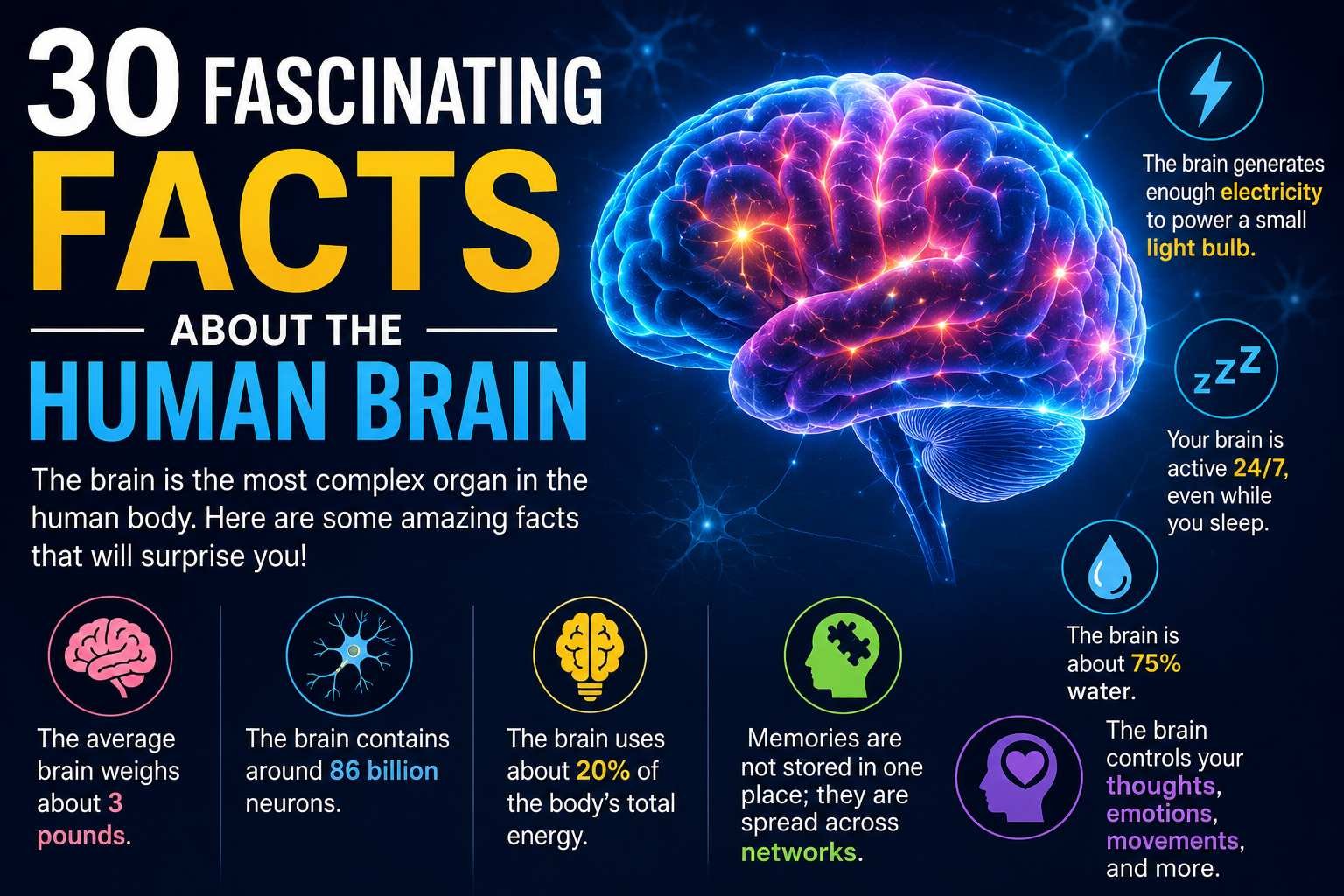
The human brain is one of the most complicated and fascinating parts of the body. It helps us think, learn, remember, move, speak, dream, and respond to the world around us. And despite decades of research, scientists are still discovering new things about how it works.
From the surprising amount of energy your brain uses to the reason you get a brain freeze, these fascinating brain facts show just how remarkable the organ inside your head really is.
1 Your Brain Is Mostly Fat
It may sound surprising, but the brain is one of the fattiest organs in the human body. About 60% of its dry weight is made up of fat, including fatty acids that are important for normal brain function.
That is one reason healthy fats are often considered an important part of a balanced diet.
2 Your Brain Weighs About 3 Pounds
The average adult human brain weighs around three pounds. Although that might sound heavy, the brain represents only about 2% of total body weight.
Interestingly, having a larger brain does not automatically mean having greater intelligence. Brain size alone isn’t a reliable measure of how smart someone is.
3 Your Brain Contains Billions of Neurons
Your brain is packed with an extraordinary number of nerve cells called neurons. Current estimates cited in the supplied sources put the number at roughly 86 billion.
These neurons communicate with one another through enormous networks of connections called synapses.
Also Read:-50 Amazing Facts About Space You Never Knew
4 Your Brain Uses Around 20% of Your Body’s Energy
Despite being relatively small compared with the rest of your body, the brain has a huge energy demand. One source notes that it uses about 20% of the body’s energy and oxygen intake.
That constant supply is essential because brain cells need oxygen and fuel to keep functioning properly.
5 The Brain Can Produce Enough Electricity to Power a Small Light Bulb
Your brain works through electrical and chemical signals. Estimates in the supplied sources suggest that the brain generates roughly 12–25 watts of electrical power while awake.
That’s enough energy to power a small, low-wattage light bulb. Pretty impressive for an organ sitting quietly inside your skull!
6 You Don’t Use Only 10% of Your Brain
The famous claim that humans use only 10% of their brains is a myth. Brain imaging and neurological research show that different areas of the brain remain active over time.
Even while you’re sleeping, your brain doesn’t simply switch off. It continues performing important activities.
7 Your Brain Can Rewire Itself
One of the brain’s most remarkable abilities is called neuroplasticity. This means the brain can reorganize its connections and adapt in response to experiences and changes.
Research discussed in the supplied material has shown that areas normally associated with vision can be recruited to process other types of information in people who were born blind.
8 The Brain Itself Can’t Feel Pain
Here’s a fact that sounds almost impossible: the brain itself doesn’t have pain receptors.
Headaches can still hurt, of course, because structures surrounding the brain—including its coverings, blood vessels, scalp, and nearby tissues—can contain pain-sensitive structures.
9 Brain Freeze Doesn’t Actually Freeze Your Brain
That painful sensation after eating ice cream too quickly has a scientific name: sphenopalatine ganglioneuralgia.
The sensation is related to changes involving blood vessels and nerves around the mouth and throat. The pain can be felt in the forehead, even though your brain itself isn’t freezing.
10 Your Brain Is Still Developing During Your 20s
The human brain doesn’t suddenly become fully mature when childhood ends. The supplied sources note that brain development continues into the mid-20s, with areas involved in planning and reasoning among the later parts to mature.
This helps explain why the teenage and young-adult years are an important period of brain development.
11 A Tiny Piece of Brain Tissue Contains an Incredible Number of Connections
A piece of brain tissue about the size of a grain of sand can contain approximately 100,000 neurons and around 1 billion synapses, according to the supplied sources.
Think about that for a moment: something smaller than a grain of sand can contain a microscopic communication network of enormous complexity.
12 Your Brain Needs a Constant Supply of Oxygen
The brain is extremely dependent on oxygen. The supplied material notes that even a short interruption of oxygen can cause brain cells to become damaged.
That’s why conditions that interrupt blood flow to the brain, such as a stroke, can have serious consequences.
13 Your Brain Is Always Busy—Even While You Sleep
Going to sleep doesn’t mean your brain takes the night off. Brain activity continues during sleep, and dreaming is one of the fascinating examples of this ongoing activity.
The sources describe dreams as involving a combination of neurological, physiological, and imaginative processes.
14 Most Brain Cells Aren’t Neurons
When people imagine the brain, they usually think about neurons. But neurons aren’t the only important cells in there.
Glial cells provide support, help supply neurons with nutrients and oxygen, assist with insulation, and contribute to maintaining healthy communication between nerve cells.
15 Exercise Is Good for Your Brain Too
Exercise doesn’t just train your muscles. Physical activity also increases blood flow and oxygen delivery, giving your brain important support.
The supplied material links exercise with processes involved in brain plasticity, memory, learning, and mood.
16 Multitasking Isn’t Really Multitasking
Think you’re great at doing several things at once? Your brain may actually be switching rapidly between tasks rather than processing everything simultaneously.
This constant context-switching can make tasks take longer and may increase mistakes.
17 The Part of Your Brain That Processes Vision Is at the Back
Your eyes are located at the front of your head, but the main visual processing area—the occipital lobe—is located toward the back of the brain.
It’s one of those anatomical facts that seems strange until you learn how information travels through the nervous system.
18 Brain Signals Can Travel Extremely Fast
Communication within the nervous system can happen remarkably quickly. Depending on the type of nerve fiber and the pathway involved, information can travel at speeds reaching hundreds of miles per hour.
The supplied sources give estimates ranging from about 150 to more than 250 miles per hour for certain neural signals.
19 Your Brain Has a Huge Network of Connections
Neurons don’t work alone. They communicate through synapses, creating a vast network that allows information to move throughout the brain.
Some estimates suggest that the number of connections could reach the trillions or even around one quadrillion, depending on how they are counted.
20 Your Brain Activity May Be as Unique as Your Fingerprints
Researchers have found that patterns of connectivity and brain activity can differ significantly from one person to another.
Studies using functional MRI have explored these individual connectivity patterns, suggesting that each person’s brain has a distinctive organization.
21 Your Brain Changes as You Get Older
The brain doesn’t stay exactly the same throughout life. As people age, structural changes can occur, including some degree of brain shrinkage.
Importantly, brain size alone isn’t a measure of intelligence. A smaller brain isn’t automatically a less capable brain.
22 Sleep Is Essential for Brain Function
A lack of sleep can affect memory, judgment, reaction time, and other cognitive abilities.
Sleep also plays an important role in memory and maintaining healthy brain pathways, which is why getting enough quality sleep is one of the simplest ways to support your brain.
23 Your Brain Is Protected by a Blood-Brain Barrier
The brain has a specialized protective system known as the blood-brain barrier. It helps control which substances circulating in the blood can reach brain tissue.
This protection is extremely important, although the barrier isn’t completely impenetrable.
24 Your Memories Aren’t Stored in Just One Spot
Memory is much more complicated than having a single “memory center” inside the brain.
Research described in the supplied sources suggests that memories involve networks of brain activity and can be distributed across different areas rather than sitting in one isolated location.
25 Your Brain Can Generate Thousands of Thoughts
The human brain is sometimes described as a constant thought generator. Estimates cited in the supplied sources suggest that people may experience thousands of thoughts over the course of a day.
Many of these thoughts can be repetitive, which is why the mind can sometimes feel like it is constantly running in the background.
26 Reading Aloud Uses Different Brain Circuits
Reading isn’t a single brain activity. Reading aloud involves speaking and auditory processing in addition to understanding written language.
The supplied material notes that reading aloud and reading silently engage different brain circuits, making the process more complex than it might seem.
27 The Brain Is Soft and Delicate
The human brain isn’t a hard, solid organ. Brain tissue is soft and has a consistency that has been compared with soft tofu or gelatin.
That is one reason the brain needs strong protection from the skull, membranes, and surrounding fluid.
28 Your Brain Floats in Protective Fluid
The brain is surrounded by cerebrospinal fluid, commonly called CSF. This fluid helps cushion the brain and provides an additional layer of protection.
The supplied source notes that the brain produces cerebrospinal fluid continuously as part of this protective system.
29 Music Can Influence Brain Function
Music can affect the way we feel and can engage different brain systems involved in attention, memory, and emotion.
However, the popular idea that simply listening to Mozart makes people permanently smarter—the so-called “Mozart effect”—has not held up as a unique scientific effect.
30 Your Brain Is Still One of Science’s Biggest Mysteries
Perhaps the most fascinating brain fact of all is that scientists still don’t completely understand it.
The supplied sources emphasize that brain research has advanced rapidly, yet many aspects of the human brain remain mysterious. With billions of neurons and an enormous network of connections, there is still a lot left to discover.
Conclusion
The human brain may weigh only a few pounds, but its abilities are extraordinary. It allows us to remember the past, imagine the future, solve problems, experience emotions, learn new skills, and adapt to changes throughout life.
From its remarkable network of neurons to its ability to reorganize itself, the brain is a reminder that the most fascinating discoveries can sometimes be found inside our own bodies. And the more scientists learn about it, the more intriguing it becomes.
1 thought on “30 Fascinating Facts About the Human Brain”