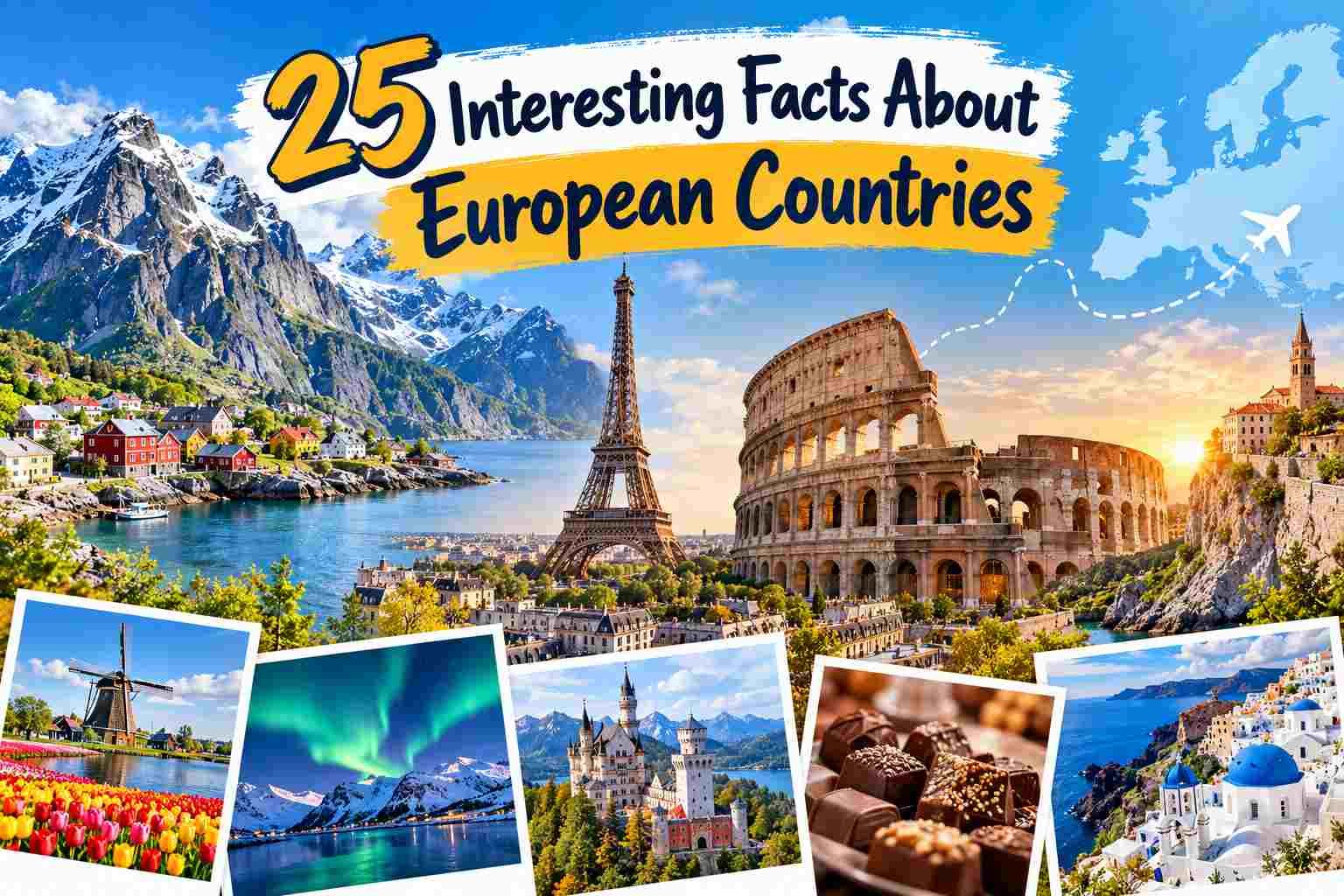
Europe is a continent where almost every country has its own story, traditions, landscapes, and surprising little details. From ancient history and unusual geography to fascinating cultural traditions, there is always something new to discover.
What makes Europe especially interesting is its variety. In just one region of the world, you can find tiny countries, huge mountain ranges, medieval castles, ancient cities, unique alphabets, and even places with almost no mosquitoes.
We’ve gathered 25 interesting facts about European countries from the supplied reference articles. Some of these facts are well-known, while others may genuinely surprise you. So, let’s take a journey across Europe and see how many you already knew!
Albania Has a Surprising Way of Saying “Yes” and “No”
In some areas of Albania, people use head movements differently from what many visitors might expect. Nodding can indicate “no,” while shaking the head can mean “yes.”
It is a small cultural detail, but it can certainly cause confusion for someone visiting for the first time!
Andorra Has No Airport or Train Station
The tiny country of Andorra, located in the Pyrenees between France and Spain, doesn’t have its own airport or railway station.
Visitors generally enter the country by road. This makes the journey to Andorra quite different from visiting many other European destinations.
Also Read-30 Fascinating Facts About Different Countries
Armenia Was the First Country to Adopt Christianity as Its State Religion
Armenia has an important place in religious history. The supplied source states that Armenia became the first country in the world to adopt Christianity as its state religion in 301 AD.
That gives the country a remarkable connection with the early history of Christianity.
The Alps Cover Much of Austria
Mountains are a major part of Austria’s landscape. According to the supplied source, the Alps cover approximately 62% of the country.
This helps explain why Austria is so strongly associated with dramatic mountain scenery, skiing, hiking, and alpine villages.
Azerbaijan Is Known as the “Land of Fire”
Azerbaijan is sometimes called the “Land of Fire” because of its naturally burning gas vents.
The country’s connection with natural flames has helped make fire an important part of its history and cultural identity.
Belarus Is Home to Large Numbers of European Bison
Belarus is home to a significant population of European bison, also known as wisent.
These powerful animals are among Europe’s most iconic wild mammals, and Belarus has one of the world’s largest populations of them.
Brussels Hosts Major International Institutions
Brussels, Belgium, is home to the headquarters of major international organizations, including the European Union and NATO.
Because of this, Brussels is not only famous for its architecture, food, and chocolate but also plays an important role in European and international affairs.
Bosnia and Herzegovina Has a Famous Historic Bridge
The Stari Most, or Old Bridge, in Mostar, Bosnia and Herzegovina, is one of the country’s best-known landmarks.
The bridge is a UNESCO World Heritage Site and has become an important symbol of unity and reconstruction following the Bosnian War.
The Cyrillic Alphabet Was Created in Bulgaria
The Cyrillic alphabet, used by many languages in Eastern Europe and beyond, has an important connection with Bulgaria.
The supplied source states that the alphabet was created in Bulgaria during the 9th century.
Croatia Has a Tiny Town Called Hum
Croatia is home to Hum, which the supplied source describes as the world’s smallest town, with a population of around 30 people.
Despite its tiny size, Hum has become an interesting destination for travelers curious about unusual European places.
Cyprus Is Geographically Closer to Asia and Africa
The Mediterranean island of Cyprus has an interesting geographical position.
Although it is geographically closer to Asia and Africa, the supplied source explains that Cyprus is politically and culturally considered part of Europe.
This is one reason why defining Europe’s boundaries can sometimes be more complicated than it first appears.
The Czech Republic Has Very High Beer Consumption
The Czech Republic is famous for its beer culture. According to the supplied source, it has the highest beer consumption per capita in the world.
Beer has a long history in the country and remains closely connected with Czech food and social traditions.
Denmark Is Frequently Ranked Among the Happiest Countries
Denmark is often recognized in international happiness comparisons.
The supplied source notes that Denmark is frequently ranked as one of the world’s happiest countries, adding another interesting fact to its reputation for quality of life and strong social systems.
Estonia Has Many Meteorite Craters
Estonia has an unusual geological feature: a high number of meteorite craters relative to its land area.
The source describes Estonia as having the highest number of meteorite craters per land area in the world.
It is a fascinating reminder that objects from space have left their marks on Earth.
Finland Has Around 188,000 Lakes
If you love lakes, Finland is certainly an interesting country.
The supplied source says Finland has approximately 188,000 lakes, earning it a reputation for its spectacular watery landscapes.
With forests, islands, and countless waterways, it is easy to see why Finland is often associated with pristine nature.
The Eiffel Tower Was Originally Intended to Be Temporary
The Eiffel Tower is now one of the world’s most recognizable landmarks, but it was not originally planned as a permanent feature of Paris.
According to the supplied source, the tower was initially intended to be a temporary structure for the 1889 World’s Fair.
Imagine Paris without the Eiffel Tower today!
Georgia Has an Ancient Winemaking Tradition
Georgia has a remarkably old connection with winemaking.
The supplied source says Georgia claims to be the birthplace of wine, with a winemaking history dating back more than 8,000 years.
Traditional Georgian winemaking is an important part of the country’s cultural heritage.
Germany Has More Than 400 Zoos and Animal Parks
Germany is a great destination for animal lovers.
According to the supplied source, Germany has more than 400 zoos and animal parks, making it notable for the sheer number of places where visitors can see wildlife.
Berlin Zoo is also highlighted in another supplied source as one of Europe’s most visited zoos.
The Olympic Games Began in Ancient Greece
When you think about the Olympic Games, Greece naturally comes to mind.
The supplied source states that the Olympic Games originated in ancient Greece in 776 BC.
The modern Olympic Games are very different from their ancient predecessor, but the connection to Greece remains an important part of Olympic history.
Hungary Has the World’s Largest Thermal Water Cave System
Hungary is famous for its thermal waters, but its underground landscape is equally fascinating.
The supplied source states that Hungary is home to the world’s largest thermal water cave system.
The country’s thermal springs and baths have made Hungary especially popular among visitors looking for relaxing spa experiences.
Iceland Has No Mosquitoes
Here’s a fact that may surprise many travelers: Iceland is one of the few countries in the world with no mosquitoes.
The supplied source specifically highlights this unusual feature.
Another supplied reference also points out that Iceland’s cold conditions and lack of suitable shallow ponds help explain why mosquitoes are absent there.
Halloween Has Ancient Celtic Roots Connected to Ireland
The modern celebration of Halloween has deep historical roots.
According to the supplied source, Halloween can be traced back to the ancient Celtic festival of Samhain, associated with Ireland.
Over centuries, traditions surrounding Samhain evolved and influenced the Halloween celebrations familiar today.
Italy Has More Than 50 UNESCO World Heritage Sites
Italy is packed with historic and cultural treasures.
The supplied source states that Italy has more than 50 UNESCO World Heritage Sites, reflecting the country’s enormous archaeological, artistic, architectural, and cultural heritage.
From ancient Roman ruins to Renaissance cities, Italy has an extraordinary amount to explore.
Kosovo Declared Independence in 2008
Kosovo is one of Europe’s newer states.
The supplied source describes Kosovo as the youngest country in Europe, having declared independence from Serbia in 2008.
Its modern history makes it an especially interesting part of Europe’s constantly evolving political and cultural landscape.
Around Half of Latvia Is Covered by Forests
Nature lovers have another reason to look toward Latvia.
The supplied source states that approximately 50% of Latvia is covered by forests, giving the country an impressive amount of green space.
These forests form an important part of Latvia’s landscape and natural character.
Conclusion
Europe is much more than famous landmarks, beautiful cities, and popular tourist destinations. Its countries are filled with unusual traditions, ancient history, fascinating geography, and little details that can easily be missed.
From Finland’s thousands of lakes and Iceland’s lack of mosquitoes to Bulgaria’s connection with the Cyrillic alphabet and Georgia’s ancient winemaking tradition, every country has something that makes it distinctive.
And that’s what makes exploring Europe so interesting: even after learning 25 facts, there are still hundreds more stories waiting to be discovered. Whether you’re planning a European trip or simply enjoy learning about different countries, these facts are a great starting point for exploring the continent’s remarkable diversity.